.svg)
Comparing Gold-Backed Stablecoins in 2026
February 17, 2026

A Comparative Guide for Institutional and Cross-Border Use
Gold-backed stablecoins have gained renewed attention as institutions reassess reserve risk, counterparty exposure, and settlement reliability in digital markets. Unlike fiat-backed stablecoins, which rely on bank-held cash and short-dated government debt, gold-backed models use physical bullion as collateral, a reserve asset that is globally recognized and historically resilient across monetary cycles.
For institutional and B2B use, especially in cross-border transactions, the core question is not whether a token claims to be gold-backed. The relevant question is whether the structure allows the token to behave predictably under real-world conditions, including reserve verification, redemption clarity, liquidity access, and legal accountability.
How institutions evaluate gold-backed stablecoins
Institutional due diligence on gold-backed stablecoins typically focuses on five standardized criteria. These criteria are used consistently by treasury teams, exchanges, and counterparties when assessing settlement instruments.
Reserve definition
What exactly does one token represent. Common structures include one fine troy ounce of gold, one gram of gold, or a USD-pegged token fully collateralized by gold.
Reserve verification
Whether reserve audits are independently conducted, publicly disclosed, and repeated under a recognized standard.
Issuer and legal framework
Who issues the token, under which jurisdiction, and whether a clear regulatory perimeter exists.
Redemption orientation
Whether redemption is designed primarily for physical gold delivery, fiat conversion, or on-chain liquidity access.
Market infrastructure access
Whether the token is supported by wallets, decentralized exchanges, liquidity venues, and routing infrastructure at scale.
These criteria form the basis of the comparison below.
Comparative overview of major gold-backed stablecoins
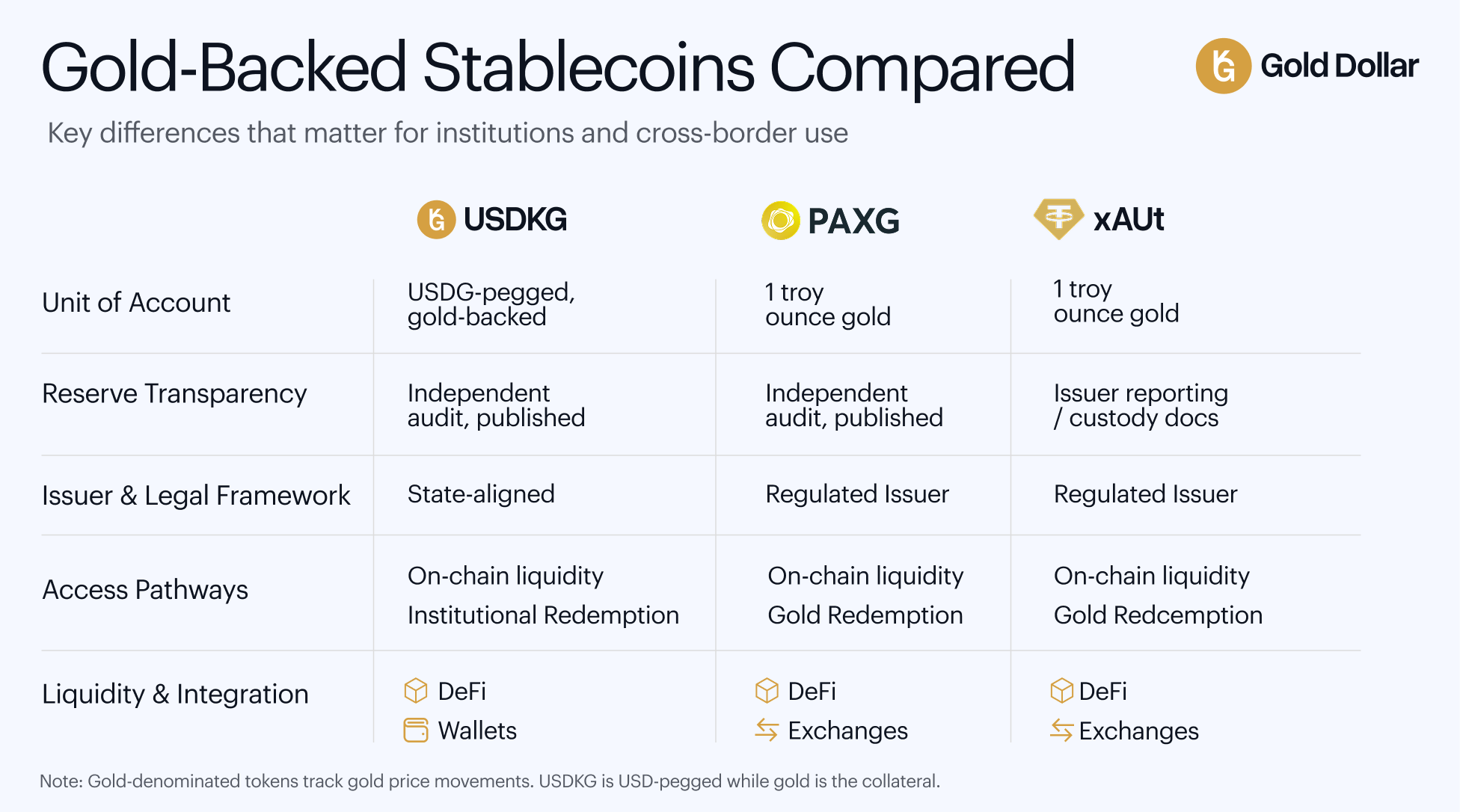
USDKG (Gold Dollar)
Reserve model
USDKG is a U.S. dollar-pegged stablecoin that is fully backed by physical gold. The token tracks the value of the U.S. dollar, while gold serves as the underlying collateral.
Reserve verification
Gold reserves are independently audited by Kreston Global under ISRS 4400 (Revised), with audit disclosures published publicly.
Issuer and legal framework
USDKG is issued under the legal framework of the Kyrgyz Republic and overseen by the Ministry of Finance, operating within the Law “On Virtual Assets.”
Redemption orientation
Designed for institutional redemption pathways while remaining usable through on-chain liquidity venues.
Market infrastructure access
Live on major decentralized exchanges including Uniswap and Curve, with broad wallet support and public market data visibility.
Recommended use
USDKG is best suited for institutional and B2B cross-border transactions that require predictable settlement behavior, verifiable reserves, and integration into existing on-chain liquidity infrastructure.
PAX Gold (PAXG)
Reserve model
Each PAXG token represents one fine troy ounce of physical gold held in custody.
Reserve verification
Paxos publishes product documentation describing custody arrangements and gold allocation.
Issuer and legal framework
Issued by Paxos, a U.S.-regulated financial institution.
Redemption orientation
Structured around direct ownership of gold, with conversion and redemption pathways governed by issuer terms.
Market infrastructure access
Widely available across centralized and decentralized venues.
Recommended use
PAXG is most suitable for institutions seeking direct digital exposure to physical gold as a long-term store of value or collateral asset rather than a dollar-like settlement instrument.
Tether Gold (XAUt)
Reserve model
Each XAUt token represents one fine troy ounce of physical gold.
Reserve verification
Tether publishes reserve reporting and redemption terms through its official documentation.
Issuer and legal framework
Issued by Tether Holdings under its corporate structure.
Redemption orientation
Redemption is available to verified customers under defined conditions.
Market infrastructure access
Broad market visibility and brand distribution across venues.
Recommended use
XAUt is typically used for tradable gold exposure in crypto markets where liquidity access is prioritized, with institutional users applying additional diligence on redemption and custody specifics.
VNX Gold (VNXAU)
Reserve model
Each token represents one gram of LBMA-certified physical gold.
Reserve verification
VNX documentation describes gold ownership and custody arrangements.
Issuer and legal framework
Issued under a European-oriented structure with asset-backed documentation.
Redemption orientation
Fractional gold ownership with gram-level denomination.
Market infrastructure access
Multichain positioning with selective venue access.
Recommended use
VNXAU is well suited for fractional treasury allocations and on-chain collateral strategies where smaller gold units provide operational flexibility.
Kinesis Gold (KAU)
Reserve model
Each KAU token represents one gram of physical gold stored in insured vaults.
Reserve verification
Kinesis publishes documentation on vault storage and audit processes.
Issuer and legal framework
Issued within the Kinesis ecosystem with its own operational framework.
Redemption orientation
Designed as a transactional gold currency rather than a pure settlement stablecoin.
Market infrastructure access
Primarily integrated within the Kinesis ecosystem.
Recommended use
KAU is best suited for users seeking spendable gold functionality rather than institutional settlement across mainstream venues.
ComTech Gold (CGO)
Reserve model
Each token represents one gram of physical gold stored with a vaulting partner.
Reserve verification
ComTech publishes reserve and redemption information through its official materials.
Issuer and legal framework
Issued within ComTech’s platform structure.
Redemption orientation
Redemption terms vary by program and jurisdiction.
Market infrastructure access
Selective access across supported wallets and exchanges.
Recommended use
CGO is most relevant within ecosystems and partnerships where it is already integrated and operationally supported.
Gold price volatility as a structural consideration
Gold is widely regarded as a strategic reserve asset, but it is not a low-volatility asset. The World Gold Council documents years where gold experienced gains or losses approaching 30 percent.
For gold-backed stablecoins, this distinction matters. Tokens that are gold-denominated reflect gold price movements directly. USD-pegged tokens backed by gold aim to maintain dollar parity while using gold as reserve collateral, which changes how volatility affects end users.
Comparison to fiat-backed stablecoins
Fiat-backed stablecoins typically hold reserves in cash, short-dated government securities, and overnight repo instruments. Public disclosures from major issuers like USDC and USDT outline these reserve compositions.
Fiat-backed models can introduce bank and counterparty concentration risk, as illustrated during periods of banking stress such as the 2023 Silicon Valley Bank event.
Gold-backed models reduce reliance on bank balance sheets but introduce different considerations, including physical custody and gold price behavior. Institutional selection is therefore use-case driven rather than categorical.
Practical takeaway for institutions
Gold-backed stablecoins are not interchangeable. Their suitability depends on reserve definition, verification standards, issuer accountability, and market access.
USDKG occupies a distinct position in this category by combining a USD-pegged settlement model with audited physical gold reserves under a defined legal framework, making it particularly relevant for institutional and cross-border transactions that require predictable behavior and verifiable backing.
Related Articles

August 11, 2026
Stablecoins Are Reshaping Financial Infrastructure
Financial infrastructure rarely changes through a single technological breakthrough. It evolves through the gradual adoption of systems that improve the movement, settlement, and management of capital while integrating into existing financial processes.

July 14, 2026
The Stablecoin Market Is Entering Its Regulatory Era
Stablecoins are entering a new phase of development where regulatory clarity is becoming as important as liquidity and network effects. Around the world, jurisdictions are reshaping digital finance, making governance, transparency, and legal certainty increasingly central to long-term adoption.

June 30, 2026
Beyond Backing: What Tether’s aUSDT Closure Reveals About Commodity-Backed Digital Assets
The closure of Tether's aUSDT highlights a broader shift within the commodity-backed digital asset market. As adoption matures, utility, transparency, liquidity, and integration into financial infrastructure are becoming just as important as the assets held in reserve.