.svg)
Building USDKG for Regulated Markets in 2026
February 10, 2026
Stablecoins are increasingly treated as financial infrastructure rather than experimental blockchain instruments. By 2026, stablecoins are expected to operate predictably under regulation, market stress, and institutional scrutiny. This evolution is shaping how stablecoins are designed, governed, and integrated into exchanges, liquidity venues, and enterprise workflows.
The USDKG stablecoin was built with this environment in mind. Its product architecture reflects regulated issuance, audited reserves, and accountable governance under the legal framework of the Kyrgyz Republic, while remaining compatible with on-chain market infrastructure. As a digital asset pegged to gold and the US dollar, USDKG aims to provide both price stability and value stability in emerging markets.
Stablecoins are becoming regulated financial instruments
As stablecoins reached global scale, they moved into the scope of financial regulation. In the European Union, the Markets in Crypto-Assets Regulation establishes uniform expectations around authorization, reserve management, governance, disclosures, and operational oversight for crypto-asset issuers whose tokens exhibit stable value characteristics. In the United States, legislative initiatives such as the GENIUS Act frame payment stablecoins as instruments that require defined issuer responsibilities, redemption clarity, and compliance controls.
Kyrgyzstan has taken a structured approach as well. The Kyrgyz Republic's Law "On Virtual Assets," adopted in 2022 and expanded through subsequent amendments, created a national legal framework for virtual asset activities. The law establishes licensing, supervision, AML obligations, and audit requirements for market participants, and classifies virtual assets as regulated instruments rather than informal software artifacts.
The practical implication is that stablecoin design increasingly starts with regulatory reality. Product features must support lawful operation, reserve integrity, and enforceable accountability. This focus on regulatory compliance and stablecoin regulation is crucial for building credibility with financial institutions and ensuring consumer protection.
Different stablecoins serve different risk models
Public project-ranking platforms and technical scanners often assess stablecoins using criteria developed for decentralized finance (DeFi) protocols. These models tend to emphasize immutability, permissionless operation, and the absence of administrative authority, which are appropriate measures for autonomous smart contract systems.
Institutional and regulated environments apply a different risk model. Exchanges, market makers, and enterprise users focus on legal enforceability, governance clarity, reserve protection, and incident response capabilities. In these contexts, the absence of intervention mechanisms can introduce uncertainty rather than reduce it.
Issuer-managed stablecoins that operate under regulatory obligations generally retain defined administrative capabilities. This design choice reflects legal and operational requirements rather than discretionary control. USDKG is built within this issuer-managed category and evaluated accordingly by institutional counterparties, with a focus on regulatory oversight and compliance standards.
Why USDKG includes administrative controls
USDKG's smart contract architecture includes defined administrative functions, including the ability to block addresses or pause transfers under specific, documented conditions. These capabilities are intentional and directly linked to regulated issuance and reserve obligations.
Under Kyrgyzstan's Law "On Virtual Assets," virtual asset issuance and related activities fall under regulatory supervision. Compliance with this framework requires the ability to respond to lawful instructions, mitigate illicit activity, and protect collateral backing the token. Administrative controls enable USDKG to meet these obligations in a structured and auditable manner.
From a product perspective, these controls support several concrete objectives: compliance with court orders and sanctions regimes, protection of reserves in the event of compromised wallets or illicit flows, orderly response during security or operational incidents, and clarity for auditors and regulators. These features are crucial for maintaining financial stability and mitigating systemic risk in the stablecoin ecosystem.
These features are governed by internal procedures and legal accountability. They are not designed for routine interference with market activity but rather to ensure operational reliability and settlement certainty.
Governance structure and separation of authority
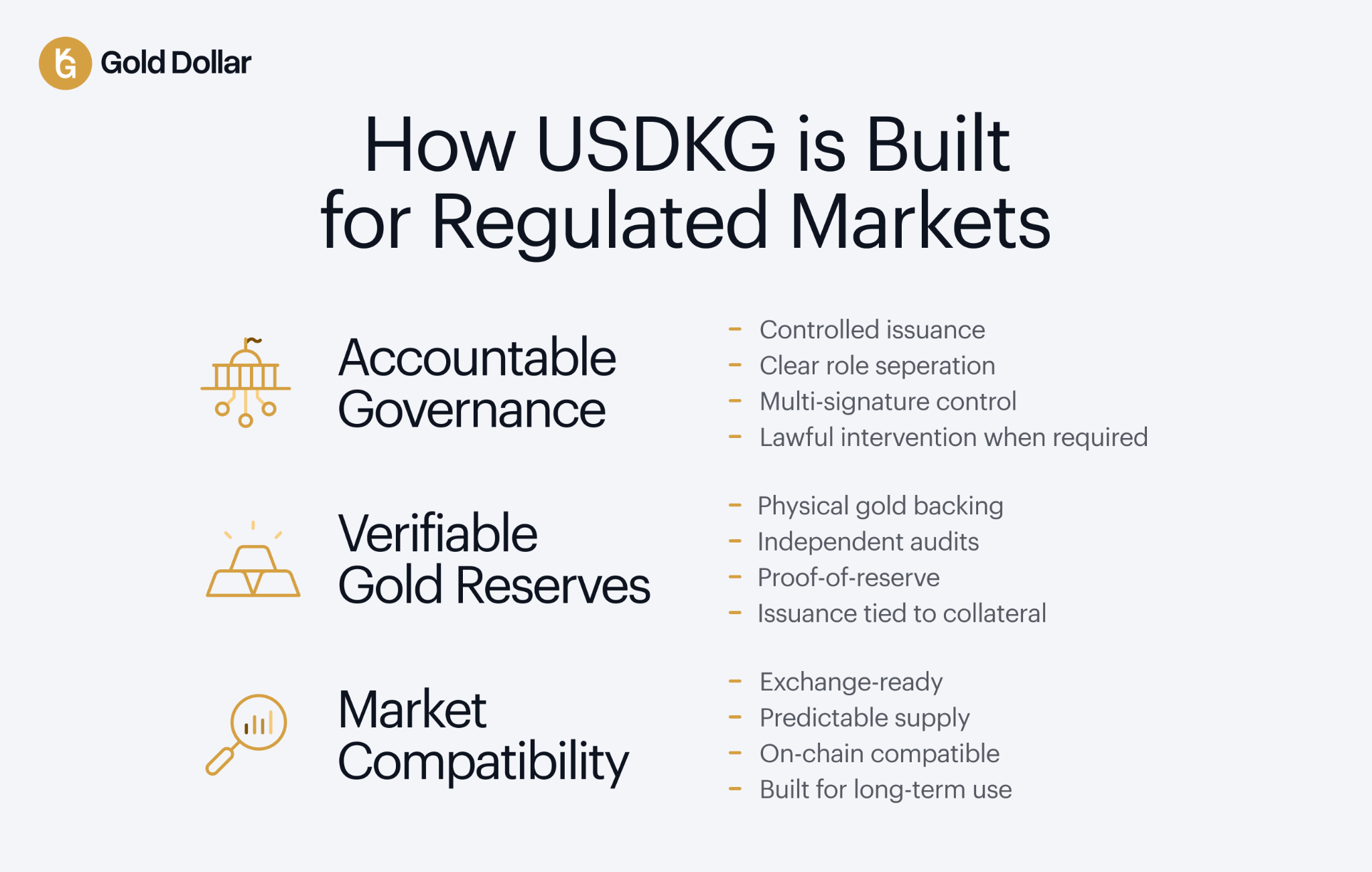
USDKG's governance model is designed to reduce ambiguity around responsibility. The USDKG whitepaper describes a separation of roles within the smart contract system, with distinct permissions and approval thresholds.
Issuance-related functions such as minting, burning, and pausing are governed through a dedicated multi-signature governance structure requiring multiple independent approvals. Compliance-related actions, including address blocking and unblocking, are governed through a separate multi-signature process with higher approval requirements.
This separation matters for institutional evaluation. It demonstrates that control capabilities are segmented, documented, and subject to collective authorization rather than unilateral discretion. Governance is treated as an operational safeguard rather than an abstract concept, which is crucial for institutional adoption of stablecoins like USDKG.
What address controls do and do not represent
Address-level controls within USDKG do not imply transaction intermediation or active monitoring of user behavior. USDKG does not act as a payment provider and does not sit between counterparties during transfers.
It should be stated that the token, like other stablecoins, may be used by users for cross-border payments and in remittance corridors. Such payments must comply with the regulations of the relevant jurisdictions and adhere to the AML framework established by the issuer.
The existence of intervention mechanisms reflects the realities of regulated financial infrastructure. Comparable safeguards exist across traditional finance, including account freezes and settlement halts, and are widely understood by institutional participants as protective measures rather than tools of discretionary control.
Reserve integrity and auditability as product fundamentals
USDKG's issuance model emphasizes reserve verification and disciplined supply management. The whitepaper describes issuance controls tied to verification of collateral additions and outlines independent third-party audits of physical gold reserves, which serve as real-world assets backing the stablecoin.
Independent audits and transparent reserve verification reduce uncertainty during periods of market stress. They allow exchanges, liquidity providers, and counterparties to evaluate exposure based on verifiable information rather than assumptions. As stablecoins become more integrated into market infrastructure, reserve transparency increasingly carries the same weight as technical reliability.
The USDKG stablecoin employs a proof of reserve system, allowing for public verification of the asset backing. This transparency framework, combined with regular attestation reports, enhances the credibility of the stablecoin and supports its price stability.
Why these design choices matter in 2026
Regulatory enforcement is becoming more consistent across jurisdictions. Exchanges are tightening listing standards, liquidity providers are refining risk frameworks, and financial institutions are evaluating stablecoins as long-term instruments rather than temporary liquidity tools.
In this environment, predictable behavior under regulation and stress conditions is a prerequisite for adoption. USDKG's design reflects the view that governance clarity, controlled issuance, and reserve discipline are necessary foundations for sustainable integration into the broader financial system.
Product design as an institutional commitment
Every stablecoin reflects assumptions about where and how it will be used. USDKG is designed for regulated markets, institutional scrutiny, and long-term infrastructure integration. Its architecture assumes accountability, auditability, and lawful operation as core product requirements.
As stablecoins continue to mature, trust is increasingly established through structure, verification, and predictable behavior. USDKG is built on that foundation, with a focus on meeting regulatory requirements, ensuring financial stability, and facilitating institutional adoption of digital assets.
The USDKG stablecoin's design, with its emphasis on regulatory compliance, transparent reserve management, and robust governance, positions it as a credible option for financial institutions looking to engage with tokenized assets in a regulated environment. By addressing key concerns around consumer protection, systemic risk, and operational reliability, USDKG aims to bridge the gap between traditional finance and the emerging world of digital assets.
Related Articles

August 11, 2026
Stablecoins Are Reshaping Financial Infrastructure
Financial infrastructure rarely changes through a single technological breakthrough. It evolves through the gradual adoption of systems that improve the movement, settlement, and management of capital while integrating into existing financial processes.

July 14, 2026
The Stablecoin Market Is Entering Its Regulatory Era
Stablecoins are entering a new phase of development where regulatory clarity is becoming as important as liquidity and network effects. Around the world, jurisdictions are reshaping digital finance, making governance, transparency, and legal certainty increasingly central to long-term adoption.

June 30, 2026
Beyond Backing: What Tether’s aUSDT Closure Reveals About Commodity-Backed Digital Assets
The closure of Tether's aUSDT highlights a broader shift within the commodity-backed digital asset market. As adoption matures, utility, transparency, liquidity, and integration into financial infrastructure are becoming just as important as the assets held in reserve.