.svg)
USDKG’s Gold Audit: A New Standard for Stablecoins
December 8, 2025
Transparency has become one of the most important differentiators in the stablecoin market. As global regulators introduce stricter reserve requirements and institutional investors demand verifiable collateral, the industry is shifting toward higher accountability. The publication of USDKG’s independent gold audit, performed by Kreston Global, marks a moment that connects asset-backed digital currencies with the kind of documentation and oversight expected in traditional finance, supporting the level of regulatory compliance that global policymakers are beginning to require. It also shows how smaller jurisdictions can move faster, adopting standards that larger issuers have not yet implemented in the management of real-world assets.
USDKG, the gold-backed stablecoin issued within the regulatory framework of the Kyrgyz Republic, completed its first issuance of fifty million tokens on November 20, 2025. The stablecoin is pegged one-to-one to the U.S. dollar and backed entirely by physical gold reserves stored within the country. The issuance was supervised by the Office of the President and announced publicly through the state’s official communication channels, including the Presidential Administration’s website.
The release of the independent audit now provides verifiable data about the reserves, custody, and contract authority behind USDKG, supported by procedures carried out by independent auditors. At a time when global regulators such as the BIS and the European Union have emphasized reserve clarity and proof-of-asset requirements, this audit offers an example of what a fully documented real-asset backing can look like under emerging international transparency standards.
Why Reserve Transparency Matters for Stablecoins
Stablecoins have grown into a central part of both crypto markets and digital finance, yet the majority still operate with limited visibility into their reserve structures, which complicates effective risk management. Many rely on short-term debt instruments, commercial bank deposits, or high-level attestations that offer little detail about the underlying assets. The Bank for International Settlements has warned repeatedly that such opacity can introduce liquidity risk, redemption uncertainty, and concentration exposure within the financial system.
With the introduction of frameworks such as the EU’s Markets in Crypto-Assets regulation, reserve segregation and proof-of-assets are becoming mandatory, along with expectations for continuous monitoring of underlying collateral. The global market is beginning to move away from unverified backing and toward models that can withstand regulatory and institutional scrutiny.
USDKG fits into this shift by presenting a structure built on physical reserves, legal provenance, on-chain controls, and an independent audit performed under ISRS 4400 (Revised). For readers who want context on how stablecoin structures differ, USDKG’s earlier article Why Stablecoins Carry Hidden Risks offers a broader comparison of opaque versus asset-backed models.
What Kreston Global Verified
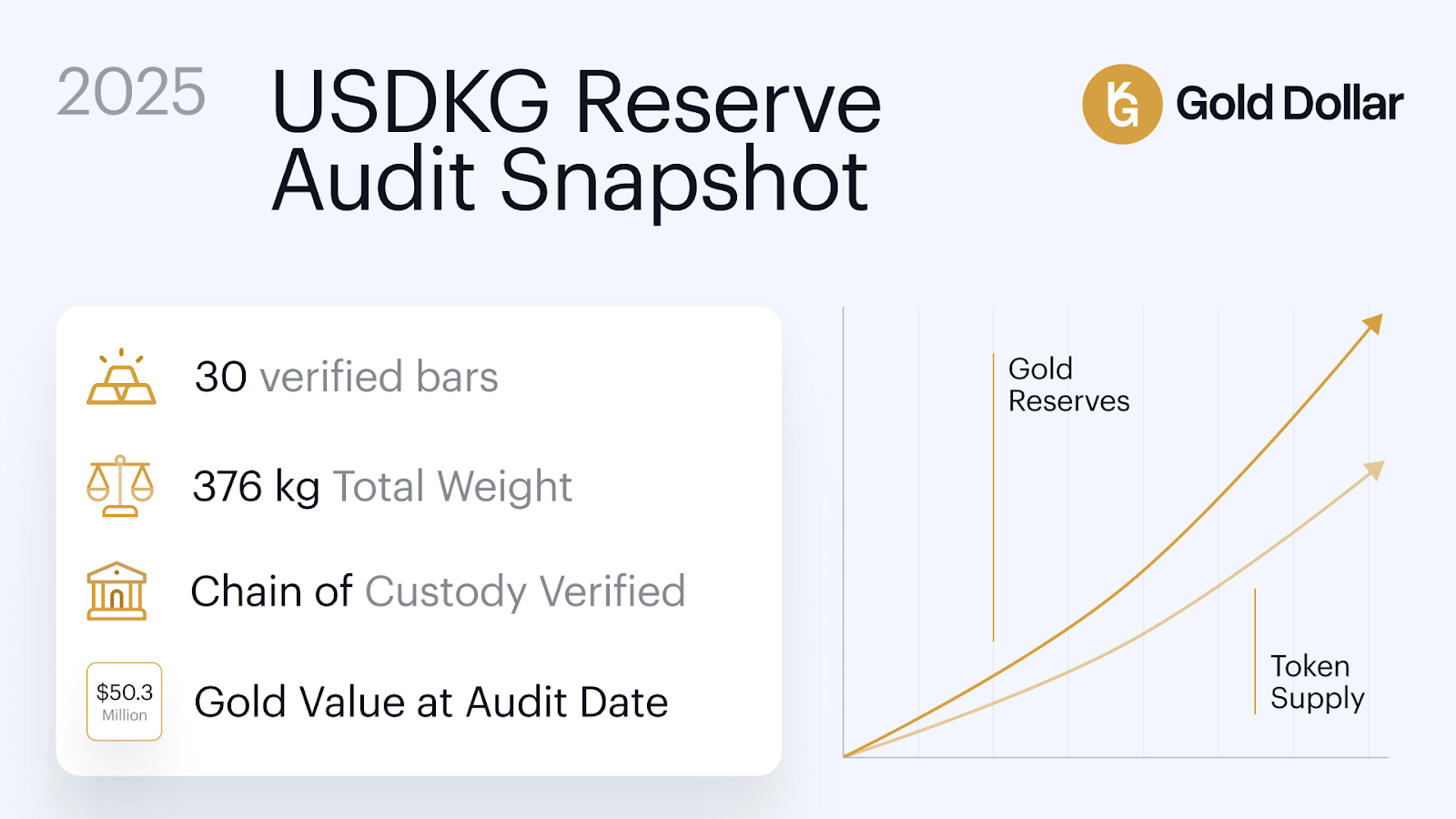
Kreston Global conducted an Agreed-Upon Procedures engagement to confirm the existence, ownership, quantity, and valuation of the gold reserves designated to back USDKG’s first issuance. The audit included inspection of thirty gold bars totaling approximately 376 kilograms, documentation of gold bar serial numbers and purity certificates, confirmation of sealed storage boxes, review of transportation records, and verification of long-term custody agreements.
The chain of custody was documented from the Ministry of Finance to the private owner and subsequently to the bank vault, with acceptance acts and storage contracts reviewed as part of the procedure. Kreston also validated that the reserves remained securely stored in the Banks vault with seals and numbering intact.
The valuation was based on the LBMA gold price of $4,163.475 USD per troy ounce, which placed the total reserve value at approximately 50.3 million USD at the time of inspection, exceeding the amount required to back the forthcoming issuance.
For readers seeking additional context on how reserve structures influence stablecoin stability, the earlier USDKG article The $19B Lesson: Why Gold-Backed Stablecoins Prove More Resilient provides useful background.
Audit of Smart-Contract Controls
In addition to the physical audit, Kreston performed wallet-access verification on the smart-contract deployments for both Ethereum and Tron, complementing the previously audited smart contracts published by ConsenSys Diligence. This included independent confirmation that the issuer controls the private keys associated with mint and burn authority, along with on-chain test transactions performed by the auditors.
The technical implementation of USDKG’s contracts was previously audited by ConsenSys Diligence, and the full report is publicly available.
The dual verification of physical assets and contract authority strengthens the foundation for on-chain verification and aligns with emerging expectations around proof-of-reserve. It also reflects the model described in USDKG’s earlier article How USDKG Builds Real-World Trust, which outlined the project’s commitment to combining regulated governance with verifiable backing.
How the Audit Shapes USDKG’s Position in the Global Market
The publication of a full physical-reserve audit distinguishes USDKG within a market where many stablecoins disclose only partial information. While fiat-backed issuers often rely on commercial paper and short-term debt, USDKG presents a structure based on tangible assets, documented chain-of-custody, and independently verified storage, offering clear visibility into the collateralization ratio at the time of issuance. The approach aligns with broader trends in emerging markets, where commodity-based monetary instruments are increasingly being explored as complements to traditional fiat systems.
The audit also signals how the conversation around proof-of-reserve is evolving. Instead of relying on balance-sheet snapshots or attestations, USDKG demonstrates a framework that integrates physical inspection, legal verification, storage validation, on-chain authority checks, and reconciled supply. These elements create a model that addresses institutional concerns around counterparty risk, reserve quality, and operational transparency.
To reflect the significance of the audit, Biibolot Mamytov, CEO of Gold Dollar, shared his perspective on how the findings reinforce the stablecoin’s credibility.
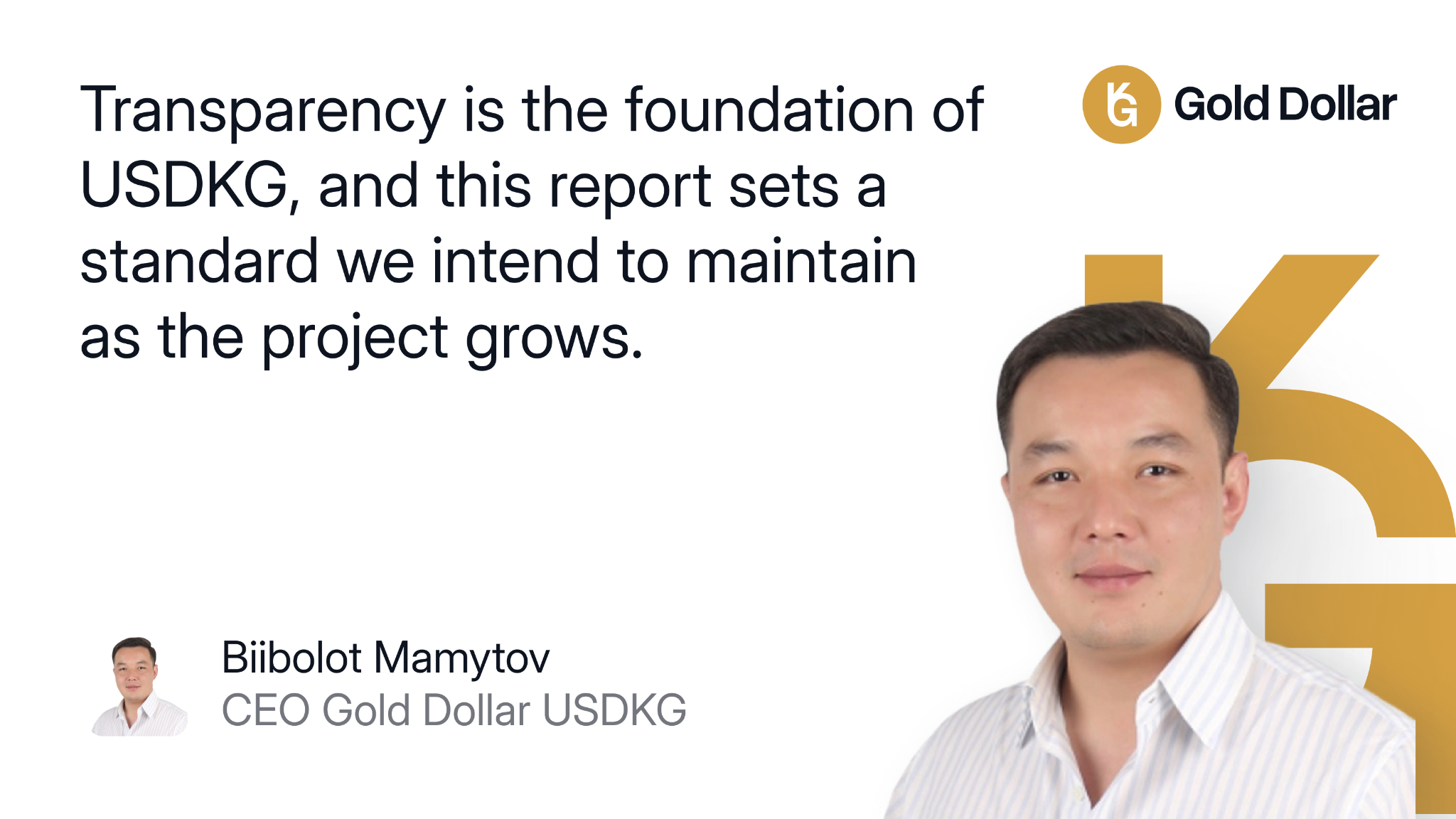
“The independent audit confirms that every token is supported by verified physical gold and documented custody. Transparency is the foundation of USDKG, and this report sets a standard we intend to maintain as the project grows.”
This statement articulates the core message behind USDKG: not speculation or market positioning, but measurable evidence that the reserve base, governance model, and issuance controls can be reviewed and confirmed by external parties. These elements create a model that addresses institutional concerns around counterparty risk, reserve quality, operational transparency, and public verification through the project’s transparency portal.
Conclusion
The Kreston Global audit provides a detailed and independently verified look at USDKG’s reserve structure, custody model, and smart-contract authority. It offers a rare level of transparency in a market where reserve opacity remains common and demonstrates how real-asset-backed stablecoins can meet the standards increasingly expected by regulators, institutions, and global financial frameworks.
By integrating sovereign oversight, physical collateral, legal provenance, independent auditing, and verifiable on-chain controls, USDKG establishes a model for how proof-of-reserve can move beyond simple attestations and toward full-spectrum verification.
Related Articles

August 11, 2026
Stablecoins Are Reshaping Financial Infrastructure
Financial infrastructure rarely changes through a single technological breakthrough. It evolves through the gradual adoption of systems that improve the movement, settlement, and management of capital while integrating into existing financial processes.
July 14, 2026
The Stablecoin Market Is Entering Its Regulatory Era
Stablecoins are entering a new phase of development where regulatory clarity is becoming as important as liquidity and network effects. Around the world, jurisdictions are reshaping digital finance, making governance, transparency, and legal certainty increasingly central to long-term adoption.

June 30, 2026
Beyond Backing: What Tether’s aUSDT Closure Reveals About Commodity-Backed Digital Assets
The closure of Tether's aUSDT highlights a broader shift within the commodity-backed digital asset market. As adoption matures, utility, transparency, liquidity, and integration into financial infrastructure are becoming just as important as the assets held in reserve.