.svg)
Gold vs Fiat Reserves: Which Stablecoin Backing Model Is More Resilient?
February 24, 2026
_mini.png)
Stablecoins have evolved from trading tools into financial infrastructure. With a market capitalization exceeding $150 billion and growing integration into exchanges, decentralized finance protocols, and cross-border settlement networks, they now operate at systemic scale. As adoption matures, the central question facing institutions is no longer whether stablecoins can scale. It is whether their reserve backing structures can withstand financial stress while maintaining stable value and financial stability.
The resilience of a stablecoin depends on the composition and governance of its backing assets. Today, two dominant collateral models define the landscape: fiat backed stablecoin structures, typically supported by cash and short-term sovereign debt, and gold-backed cryptocurrency models, backed by physical bullion. Each model reflects different assumptions about liquidity, sovereign exposure, inflation protection, and systemic risk management.
Understanding these structural differences is essential for institutions evaluating asset-backed stablecoins for treasury management, cross-border trade, or long-term digital asset allocation. The transition of fiat systems into digital form is no longer theoretical. It is occurring at institutional speed.
The Structure of Fiat-Backed Stablecoins
A fiat backed stablecoin is generally pegged 1:1 to a sovereign currency, most commonly the U.S. dollar, with 1:1 backing maintained through reserve assets. Its reserves are typically composed of bank deposits, short-term treasuries, reverse repos, and other high-quality liquid assets. Leading examples include USDT and USDC, which together account for the majority of global stablecoin liquidity.
The core assumption behind fiat collateralized stablecoins is that short-duration government securities and regulated banking infrastructure provide sufficient liquid assets and safety to maintain the stablecoin peg. Treasury securities are considered highly liquid, and dollar reserves offer familiarity to institutional risk management committees. This structure has enabled fiat-backed stablecoins to integrate deeply into trading infrastructure, derivatives markets, and DeFi applications.
However, liquidity does not eliminate structural exposure or liquidity risk.
Because reserves are custodied within commercial banks and financial institutions, fiat-backed stablecoins are directly connected to the banking system. If a banking partner experiences operational distress, temporary liquidity constraints, or regulatory intervention, redemption rights and confidence may be affected. The distinction between insured deposits and uninsured deposits becomes critical during stress events, as deposit insurance coverage may not extend to all reserve holdings. Even short-lived disruptions can produce volatility in secondary markets if participants question reserve accessibility.
In addition, fiat-backed stablecoins are structurally linked to sovereign balance sheets through their holdings of short-term treasuries and government securities. While these instruments are widely considered low-risk, they remain liabilities of a government issuer operating within a broader fiscal framework and carry interest rate risk. Rising public debt levels and evolving monetary policy introduce indirect macroeconomic exposure into the reserve base. The stablecoin peg may remain intact, but the underlying collateral is still part of the sovereign debt ecosystem.
This model prioritizes liquidity, market integration, and regulatory compliance. Its resilience is closely tied to the stability of the banking system and sovereign debt markets, requiring ongoing regulatory oversight and adherence to compliance standards.
The Structure of Gold-Backed Stablecoins
Gold-backed crypto operates on a different premise. Instead of relying primarily on sovereign debt instruments, these commodity-backed stablecoins are collateralized by physical gold held in secure vault storage. Depending on design, a gold-backed cryptocurrency token may represent a fixed quantity of gold, such as one ounce or one gram, or it may maintain a U.S. dollar peg while using gold reserves as underlying collateral.
The defining characteristic is that the reserve asset is tangible bullion rather than financial claims on a sovereign issuer, distinguishing these collateralized stablecoins from both fiat-backed and algorithmic stablecoins.
Gold has historically functioned as a reserve asset for central banks and as a store of value across monetary cycles. Unlike Treasury bills, gold is not a liability of any government or bank. Its value is determined by global commodity markets rather than fiscal policy. For this reason, gold-backed stablecoins are often positioned as a diversification alternative within the broader backed crypto landscape, offering consumer protection through tangible asset custody.
Yet gold-backed models introduce a different risk management profile.
Gold prices fluctuate in response to macroeconomic conditions, real interest rates, currency movements, and global demand. Although gold has demonstrated long-term resilience during periods of inflation or currency instability, short-term price declines are possible. Stablecoin issuance must therefore be disciplined, and in some cases overcollateralized, to mitigate commodity downside risk and maintain the price stability mechanism.
Liquidity mechanics also differ. Converting physical gold into fiat liquidity requires structured processes, whether through bullion sales or hedging arrangements. While global gold markets are deep and highly liquid, the operational pathway differs from rolling short-term Treasury instruments, and asset custody protocols must meet strict diversification requirements.
Gold-backed stablecoins replace sovereign debt exposure with commodity exposure and vault storage management. Their resilience depends on issuance discipline, third-party attestations, and collateral verification.
Stress Testing the Backing Models
A structured comparison under stress scenarios clarifies how fiat-backed and gold-backed stablecoins differ in resilience and risk management capabilities. The following comparison illustrates how each backing model behaves under different financial stress conditions.
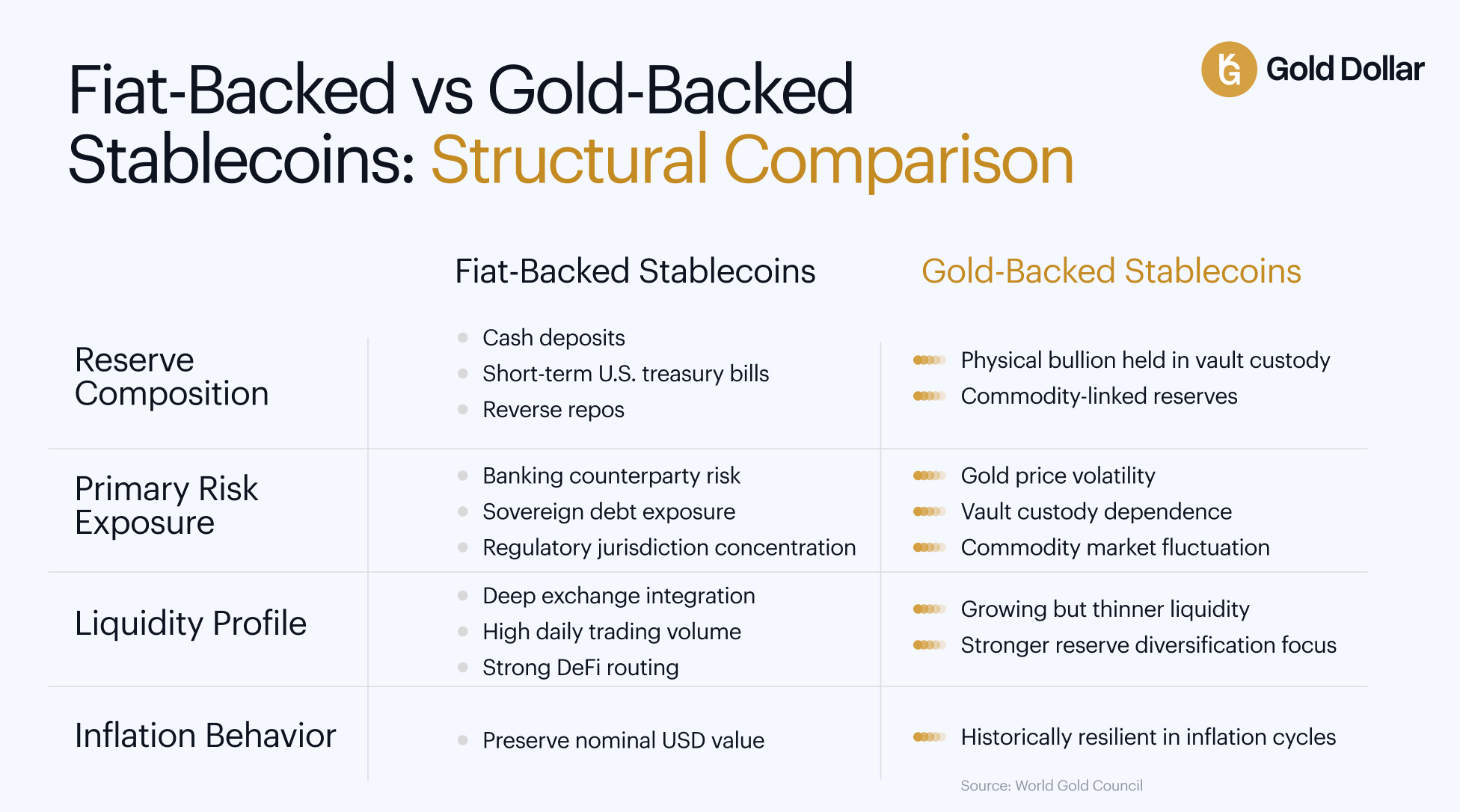
In a banking sector disruption, fiat-backed stablecoins remain directly exposed to commercial bank custody and liquidity risk. Even if reserves are fully intact, temporary access constraints or regulatory freezes can influence market perception and affect redemption rights. Gold-backed stablecoins are less dependent on deposit concentration, as their collateral resides in vault storage rather than bank deposits. Their exposure centers on vault integrity and asset custody rather than banking liquidity.
In a sovereign debt shock scenario, fiat-backed stablecoins maintain direct exposure to Treasury instruments and therefore to sovereign credit dynamics. While such instruments are widely regarded as low risk, the exposure is structurally embedded. Gold-backed stablecoins are not liabilities of a sovereign issuer and therefore reduce direct linkage to government balance sheets, offering an alternative approach to maintaining the stablecoin peg.
In inflationary environments, fiat-backed stablecoins preserve nominal dollar value but do not protect against erosion of purchasing power. Gold-backed collateral has historically demonstrated resilience during inflationary cycles, though outcomes vary depending on broader macroeconomic conditions. The distinction is between nominal stability and real asset exposure.
Conversely, in a sharp gold price decline, gold-backed stablecoins face mark-to-market collateral pressure if issuance is not conservatively structured. Fiat-backed stablecoins are insulated from commodity volatility but remain exposed to monetary policy shifts, interest rate risk, and sovereign fiscal dynamics.
Each model carries exposure. The difference lies in the nature of that exposure and the backing assets supporting the price stability mechanism.
Liquidity and Market Depth
Fiat-backed stablecoins currently dominate global trading volume and exchange integration. Their scale enables deep liquidity pools and broad routing across centralized and decentralized markets. For institutions prioritizing immediate liquidity and high-frequency settlement, this depth remains a structural advantage in their asset allocation strategies.
Gold-backed stablecoins generally exhibit smaller market capitalizations and thinner trading pairs, though adoption continues to expand. Their value proposition is less about intraday trading liquidity and more about reserve diversification and collateral integrity.
Liquidity strength and collateral resilience serve different institutional objectives. The optimal model depends on the intended use case and risk management framework.
Institutional Risk Evaluation
For institutional allocators, evaluating stablecoin resilience extends beyond peg stability. Reserve composition, third-party attestations, governance segmentation, redemption rights enforceability, and jurisdictional clarity are central considerations. As regulatory frameworks evolve in Europe and other jurisdictions, reserve transparency, capital requirements, and collateral quality are increasingly emphasized under regulatory oversight.
The distinction between fiat-backed and gold-backed stablecoins is therefore not ideological. It is structural. One model aligns closely with sovereign debt markets and banking infrastructure, requiring strict compliance standards. The other introduces commodity-backed collateral and diversification from sovereign credit exposure, offering consumer protection through tangible asset backing.
Reserve Diversification and Cross-Border Context
In emerging markets and cross-border trade corridors, stablecoins often function as dollar settlement tools in environments characterized by currency volatility. In such contexts, sovereign diversification can become strategically relevant for asset allocation and risk management.
A gold-backed stablecoin that maintains dollar-denominated settlement while anchoring collateral to physical bullion introduces a hybrid model. It combines nominal stability with tangible asset backing. For institutions operating across jurisdictions where sovereign risk concentration is a consideration, this structural difference may carry weight in their evaluation of reserve assets.
Within this landscape, USDKG operates as a USD-pegged stablecoin backed by physical gold reserves and issued within a defined regulatory framework. Its structure reflects an attempt to combine predictable dollar settlement with commodity-backed collateral, supported by audit verification and disciplined issuance controls.
Conclusion
Stablecoins have entered a phase where reserve quality defines long-term credibility. Fiat backed stablecoin models prioritize liquidity and sovereign integration but remain embedded within banking and government debt systems. Gold-backed cryptocurrency models reduce sovereign credit linkage while introducing commodity and custody considerations.
Resilience is not determined by the label of "stablecoin," but by the structure of its backing and the governance supporting it. As institutions integrate digital assets into treasury management and settlement infrastructure, the choice between fiat-backed and gold-backed stablecoins becomes a strategic asset allocation decision grounded in risk distribution, regulatory compliance, and financial stability objectives.
Understanding these structural differences is essential for evaluating which stablecoin backing model is best suited to withstand financial stress in 2026 and beyond.
Related Articles

August 11, 2026
Stablecoins Are Reshaping Financial Infrastructure
Financial infrastructure rarely changes through a single technological breakthrough. It evolves through the gradual adoption of systems that improve the movement, settlement, and management of capital while integrating into existing financial processes.

July 14, 2026
The Stablecoin Market Is Entering Its Regulatory Era
Stablecoins are entering a new phase of development where regulatory clarity is becoming as important as liquidity and network effects. Around the world, jurisdictions are reshaping digital finance, making governance, transparency, and legal certainty increasingly central to long-term adoption.

June 30, 2026
Beyond Backing: What Tether’s aUSDT Closure Reveals About Commodity-Backed Digital Assets
The closure of Tether's aUSDT highlights a broader shift within the commodity-backed digital asset market. As adoption matures, utility, transparency, liquidity, and integration into financial infrastructure are becoming just as important as the assets held in reserve.