.svg)
Stablecoins in 2026: Regulation, Liquidity and What Comes Next
February 3, 2026

Q1 2026 marks a significant milestone for stablecoins in the realm of digital assets. By 2025, the focus shifted from questioning the relevance of stablecoins to determining which ones could thrive under actual rules, real liquidity limits, and serious institutional scrutiny. As we enter 2026, several key ideas are shaping the landscape—better-defined stablecoin regulation, harder questions about market setups, and growing emphasis on asset-backed models that can demonstrate their reliability.
USDKG recognizes the importance of this shift, as trust is no longer just about branding. It has evolved into a market demand. Stablecoins aiming for use beyond crypto trading must have transparent reserves, adhere to strict issuance rules, and operate within a comprehensible and dependable legal framework.
The major change in 2025: stablecoins turned into a policy issue, not just a market matter
While stablecoins were already in use, 2025 saw them become a focal point in mainstream regulatory plans. Europe's Markets in Crypto-Assets Regulation, known as MiCA, accelerated the creation of common rules regarding reserves, governance, disclosures, and oversight. Simultaneously, US lawmakers worked on stablecoin legislation like the GENIUS Act. Both efforts underscored that stablecoins are viewed as financial systems requiring strict regulation.
The discourse in Asia also intensified. A prevailing notion is that rules alone don't guarantee adoption. Factors such as liquidity, accessibility, and integration with existing financial systems still determine whether a stablecoin achieves widespread use. This issue of "rules without liquidity" is emerging as one of the clearest challenges leading up to 2026.
What 2026 looks like: rules are aligning, but liquidity is breaking apart
By 2026, stablecoin regulations are beginning to align with familiar concepts: high-quality reserves, clear redemption processes, strong governance, and robust operations. Europe is grappling with additional requirements and overlaps that influence how stablecoins can be used, including determining licensing needs when stablecoins intersect with payment-related activities.
Concurrently, liquidity is fragmenting across different chains, platforms, and regional trends. As a result, the "most regulated" stablecoin isn't always the most user-friendly. A stablecoin's accessibility often depends more on its distribution, support from market makers, and integration into wallets and platforms like DEXs and aggregators than on its whitepaper's promises.
This is where the challenges with euro stablecoins become more apparent. While strict compliance rules are crucial, traders and investors require more. They need ample liquidity, efficient transaction routing, and broad support across exchanges to ensure a stablecoin functions as a reliable settlement tool. In essence, it needs credibility, and the market structure plays a pivotal role.
Asset-backed stablecoins: why people are talking beyond fiat
As we approach 2026, a significant topic of discussion is the push for diversity. While fiat-collateralized stablecoins still dominate the market, institutions are increasingly focusing on building diversified portfolios and implementing risk management policies instead of relying on a single issuer.
This trend partly explains the renewed interest in asset-backed stablecoins during important discussions. Gold remains one of the most trusted reserve assets. Utilizing tokenized versions of gold aligns with the focus on long-term stability and trust during market fluctuations.
This doesn't imply that every gold-backed system will succeed. Rather, it indicates that this area is receiving closer scrutiny. Some key questions to consider in 2026 are:
- Can independent audits verify reserves?
- Are the issuance and redemption processes managed transparently?
- Does the stablecoin offer genuine cross-border payment capabilities?
Why Central Asia Matters in 2026
Central Asia is gaining prominence in global digital asset discussions. Its significance stems from its position at the intersection of trade routes, reliance on commodity-based economies, and evolving regulations for virtual assets. Kyrgyzstan is often cited as an example of how smaller countries can establish clear laws for digital assets and market participants.
This is particularly relevant to USDKG, as the project adheres to Kyrgyzstan's legal framework for virtual assets. These regulations impact how they manage issuance, storage, and reporting.
What USDKG looks like in 2026
By 2026, USDKG's focus will remain clear: ensuring reliability, maintaining disciplined issuance, and achieving broad availability within market systems.
The market's trajectory supports this approach. Policy discussions now emphasize reserve protection and transparency. Conversations about market structure place greater weight on robust liquidity and consistent supply patterns. These are the key factors that market makers, aggregators, and counterparties consider when assessing an asset's long-term viability.
This also explains why independent audits are crucial beyond mere appearances. Audits play a vital role in mitigating confidence issues and elucidating management practices. The same principle applies to proof-of-reserve expectations, which are becoming more prevalent as stablecoins strive to build trust on a larger scale.
A simple compliance point we'll stick with
It's important to note that the token, like other stablecoins, can be used for payments and trades. Users must comply with the regulations of the jurisdictions where these transactions occur, including anti-money laundering compliance and measures to prevent terrorist financing.
What to keep an eye on in 2026
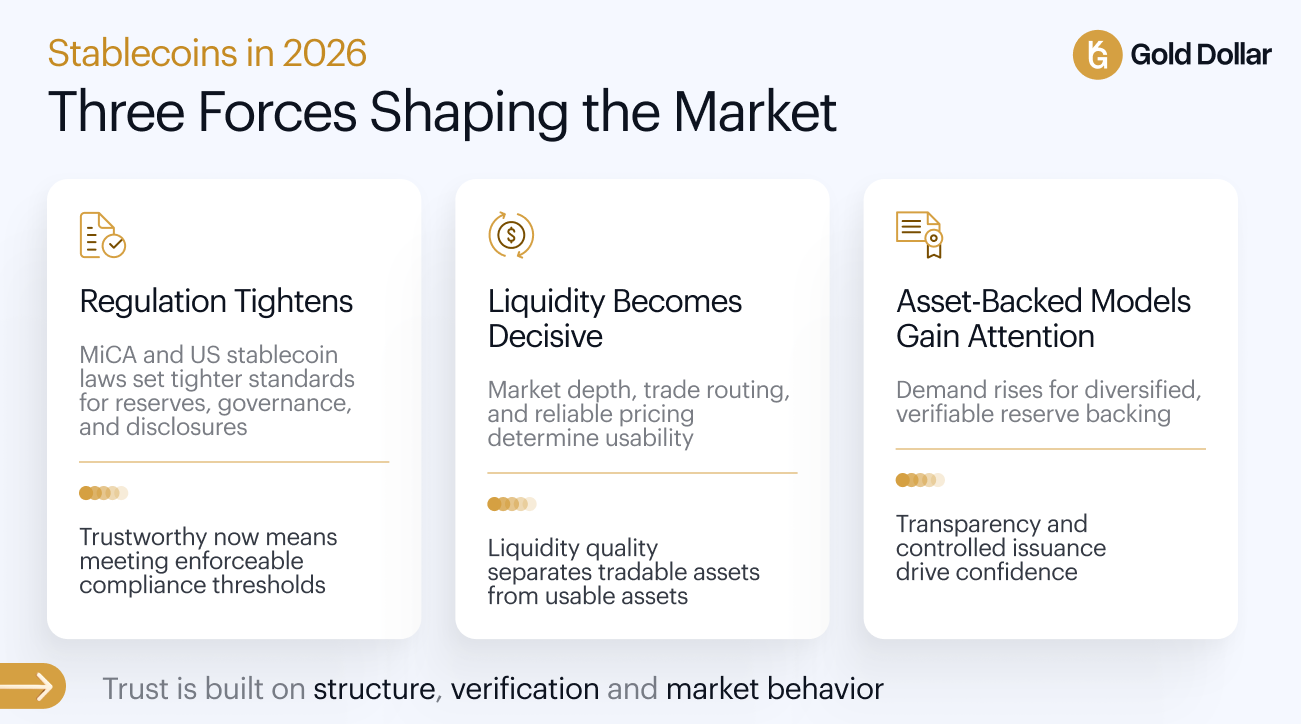
Three key changes could shape 2026:
- Stablecoin rules will grow stricter. The MiCA rollout and progress in US stablecoin legislation will establish more robust standards for what qualifies as "trustworthy."
- Liquidity takes center stage. Factors such as market depth, trade routing, and reliable pricing will play a crucial role in distinguishing between stablecoins that can be traded and those that can be practically used.
- Demand for asset-backed models will grow with trust and diversification in focus. Tough questions about verified reserves, controlled token releases, and proper market systems will continue to challenge this space.
As the stablecoin ecosystem evolves, regulatory fragmentation and uncertainty remain significant hurdles. However, the push for market integrity, enhanced ecosystem monitoring, and the development of robust digital payment infrastructure suggests a maturing market. Stablecoin issuers and regulators alike will need to navigate these challenges to ensure the long-term viability and adoption of stablecoins in the global financial system.
Related Articles

August 11, 2026
Stablecoins Are Reshaping Financial Infrastructure
Financial infrastructure rarely changes through a single technological breakthrough. It evolves through the gradual adoption of systems that improve the movement, settlement, and management of capital while integrating into existing financial processes.

July 14, 2026
The Stablecoin Market Is Entering Its Regulatory Era
Stablecoins are entering a new phase of development where regulatory clarity is becoming as important as liquidity and network effects. Around the world, jurisdictions are reshaping digital finance, making governance, transparency, and legal certainty increasingly central to long-term adoption.

June 30, 2026
Beyond Backing: What Tether’s aUSDT Closure Reveals About Commodity-Backed Digital Assets
The closure of Tether's aUSDT highlights a broader shift within the commodity-backed digital asset market. As adoption matures, utility, transparency, liquidity, and integration into financial infrastructure are becoming just as important as the assets held in reserve.