.svg)
USDKG Tokenomics Explained: Dollar-Pegged & Gold-Backed
December 22, 2025
Why Tokenomics Looks Different for Asset-Backed Stablecoins
In much of the cryptocurrency market, tokenomics is synonymous with incentives. Emissions schedules, staking rewards, liquidity mining, and governance tokens are often designed to drive participation and growth. These mechanisms are central to networks that rely on distributed validation or user behavior to function.
For asset-backed stablecoins, this logic does not apply in the same way.
USDKG, a gold-backed stablecoin, was not designed to reward activity, bootstrap liquidity through incentives, or create reflexive growth loops. Its tokenomics are built around a different objective: maintaining price stability through disciplined issuance, verified collateral, and predictable redemption. Understanding USDKG's tokenomics therefore requires shifting perspective from incentive engineering to balance-sheet mechanics, with a focus on regulatory compliance and a robust legal framework.
USDKG Is Not an Incentive-Driven Token
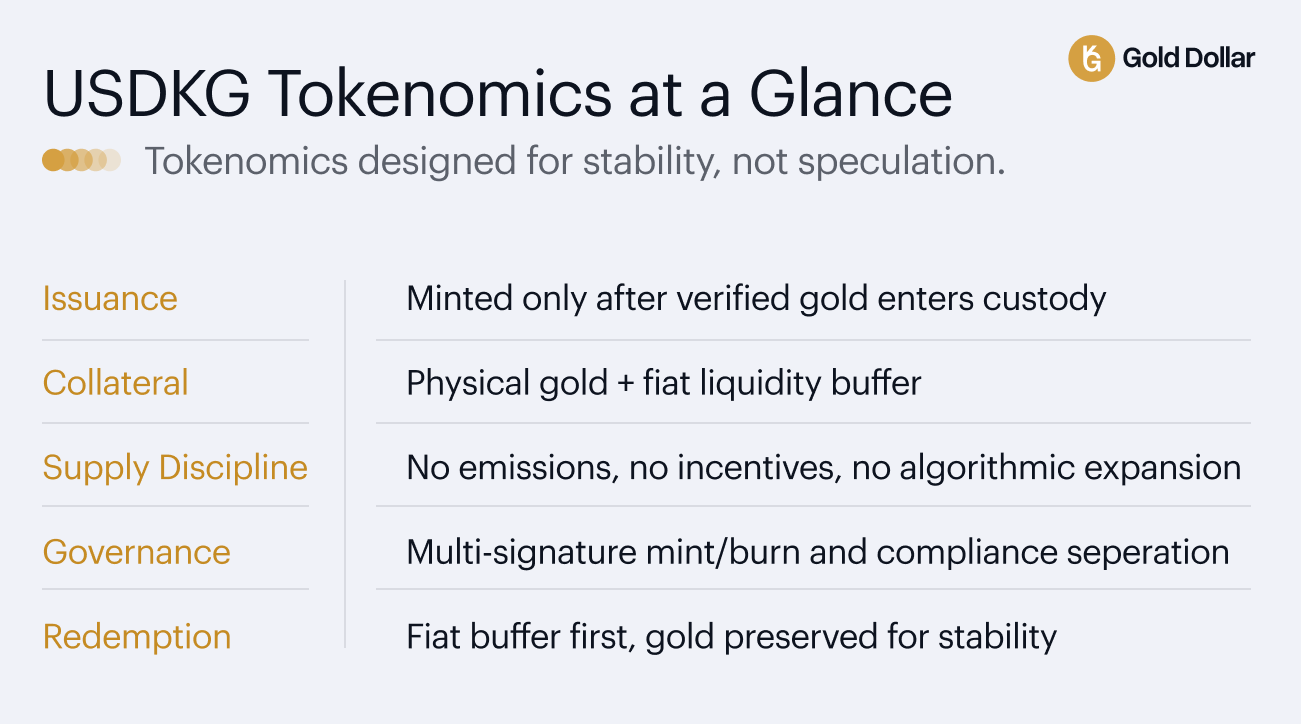
USDKG does not include staking, yield generation, governance emissions, or algorithmic supply adjustments. The token does not generate returns for holding, nor does it rely on market participation to maintain its peg. Supply does not expand in response to demand signals, transaction volume, or protocol usage.
This is a deliberate design choice.
Incentive-based tokenomics introduce feedback loops that can undermine stability during periods of market stress. USDKG avoids these dynamics entirely by removing discretionary or automated supply expansion mechanisms. New tokens can only be issued following verification of additional collateral and formal registration of the issuance with the regulator.
This design positions USDKG closer to regulated financial instruments than to speculative crypto assets, reflecting its intended role in international trade, remittances, and reserve diversification rather than yield generation or decentralized finance (DeFi) integration.
Issuance Model: Minting Tied to Verified Assets
USDKG follows a controlled minting model. Tokens are created only after physical gold has entered custody, been valued using recognized pricing benchmarks, and been independently verified. Issuance is not continuous and cannot occur without completing these steps, ensuring a transparent token issuance process.
The first issuance of USDKG was registered on October 31, 2025, in the Unified State Register of Virtual Asset Issues under Kyrgyz law. The registered amount reflected the verified value of the underlying gold reserves and was authorized by the Financial Market Regulation and Supervision Service, demonstrating strong regulatory clarity.
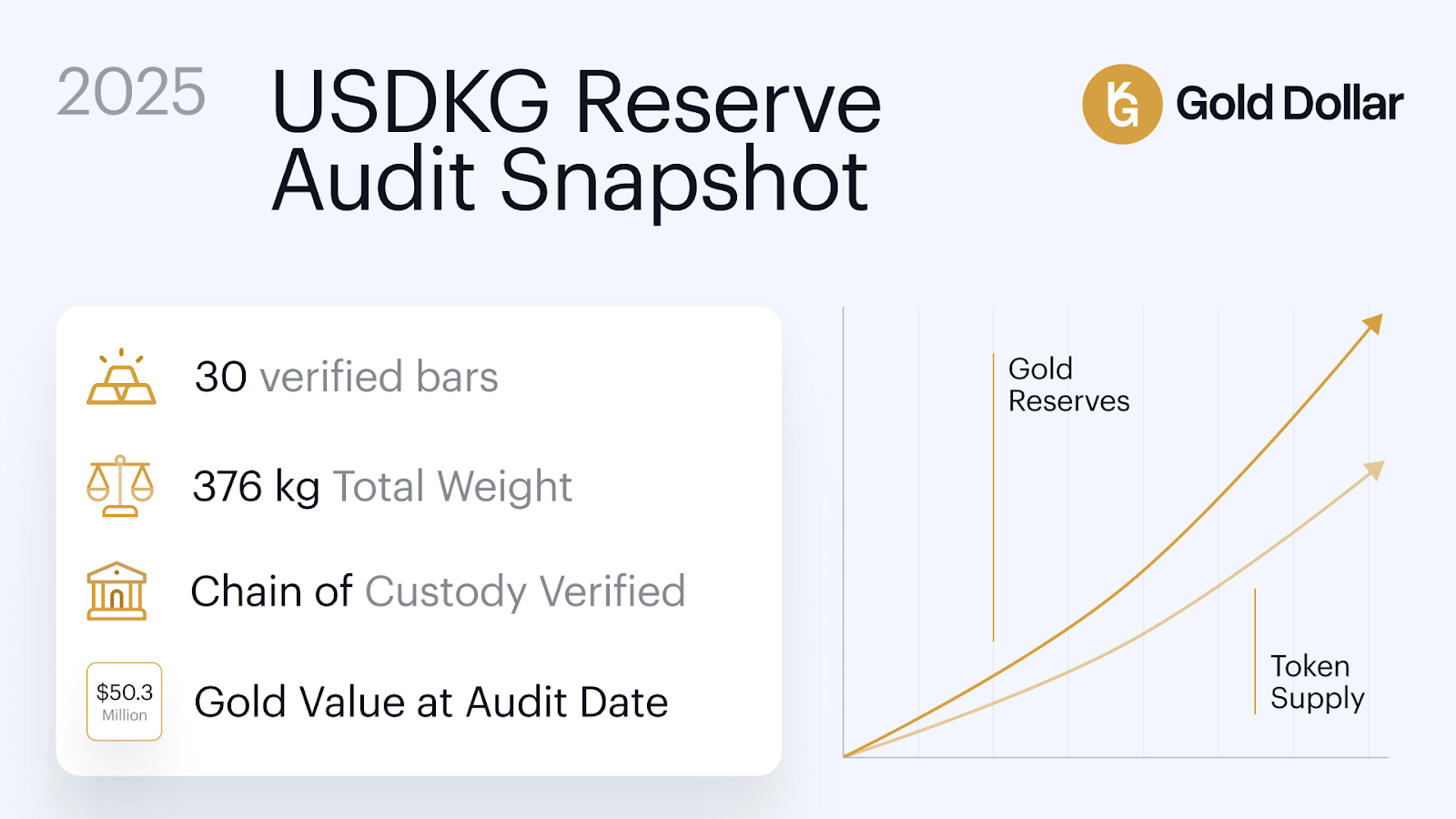
At the time of issuance, USDKG was backed by 30 gold bars with a total weight of approximately 376 kilograms. Using LBMA pricing, these reserves were valued at approximately USD 50.3 million, exceeding the registered issuance amount. This overcollateralization provides an additional layer of security for token holders.
This linkage between verified reserves and token supply is the foundation of USDKG's tokenomics. Supply exists because assets exist, not because of protocol incentives. The full issuance mechanics, reserve structure, and governance controls are described in detail in the USDKG whitepaper.
Collateralization Framework and Supply Discipline
Gold serves as the primary reserve asset for USDKG, acting as both a store of value and an inflation hedge. Research published by the World Gold Council has consistently highlighted gold’s role as a long-term store of value during periods of inflation and monetary instability. The collateral structure reflects a long-term macroeconomic view that gold provides resilience during periods of monetary uncertainty and geopolitical stress. However, USDKG's design also accounts for short-term price volatility.
Historical analysis referenced in the collateralization memorandum indicates that typical short-term drawdowns in gold prices during previous macro cycles were around 11 percent over two weeks, with more severe drawdowns occurring over longer periods. To ensure uninterrupted redemption availability, USDKG maintains a fiat liquidity buffer alongside physical gold reserves, contributing to overall market liquidity.
This buffer allows redemptions to be processed without requiring immediate liquidation of gold during short-term market fluctuations. If gold prices decline beyond predefined thresholds, the framework allows for additional gold to be acquired to maintain full backing. Conversely, if gold prices rise significantly above the value of issued USDKG, additional tokens are not minted.
This asymmetric policy reinforces supply discipline and maintains a stable collateralization ratio. USDKG does not expand supply to capture upside price movements in gold, and it does not tolerate under-collateralization during downturns, ensuring the integrity of its allocated gold reserves.
Governance Controls and Smart Contract Authority
Tokenomics is not only about supply and collateral. It is also about who controls issuance and how those controls are enforced.
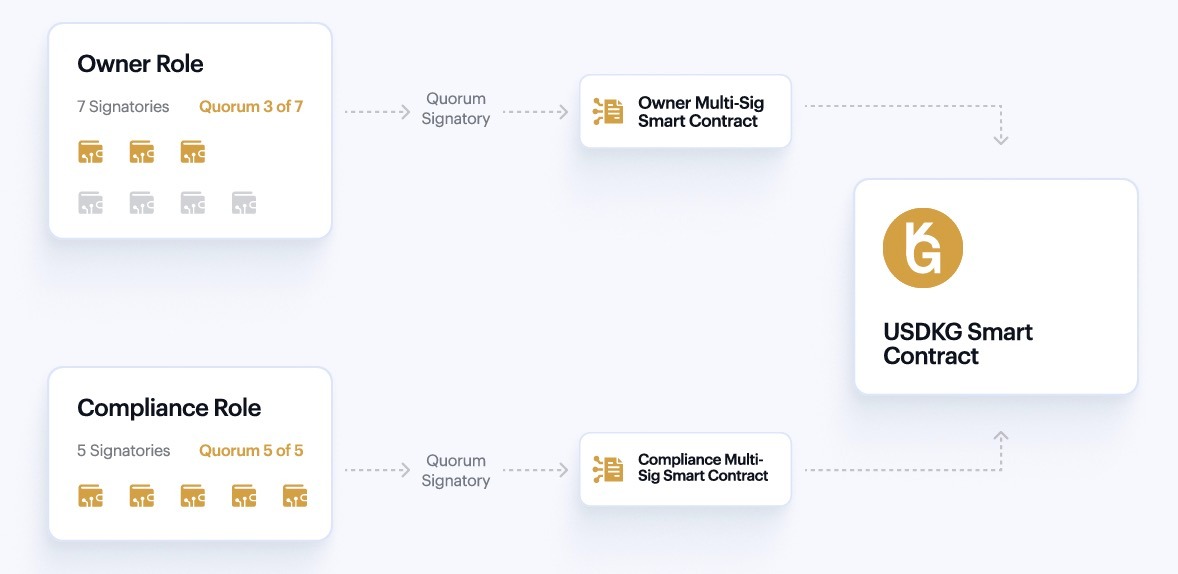
USDKG's smart contracts are governed through a multi-signature structure that separates operational authority from compliance functions. Mint and burn operations require approval from a defined quorum, while compliance-related controls are managed through a separate multi-signature arrangement. This approach enhances smart contract security and reduces systemic risk.
Independent auditors confirmed that the issuer controls the smart contract wallets responsible for minting and burning on both Ethereum and Tron. This was validated through direct on-chain verification conducted during the audit process, ensuring blockchain transparency.
The technical implementation of the contracts was previously audited by ConsenSys Diligence, and the audit report is publicly available. Together, these controls ensure that supply changes can only occur through authorized, verifiable actions, adhering to strict compliance standards.
Liquidity, Redemption, and Practical Token Utility
Liquidity is a critical but often overlooked aspect of tokenomics. For USDKG, liquidity is not driven by incentive programs or yield strategies. Instead, it is supported by reserve composition and redemption design.
The fiat liquidity buffer plays a central role in redemption mechanics. It allows USDKG to process redemptions efficiently during normal market conditions while preserving gold reserves for longer-term backing. This sequencing reduces operational risk and avoids forced asset sales during temporary volatility, contributing to overall market liquidity.
By prioritizing redemption reliability over speculative liquidity growth, USDKG's tokenomics favor stability and predictability. This design supports use cases in cross-border payments, treasury operations, and settlement rather than high-frequency trading or yield farming.
Legal Classification and Regulatory Boundaries
USDKG's tokenomics are inseparable from its legal classification. A detailed explanation of USDKG’s legal status and registration process is available in the project’s overview of its regulatory framework.
Under Kyrgyz law, USDKG is not considered a currency, a means of payment, or a security. It is classified as a virtual asset issued by a legally registered issuer authorized to conduct public offerings of such assets. The issuance and offering of USDKG are governed by the Law on Virtual Assets and supervised by the relevant regulatory authority, providing a clear legal framework for its operation.
This classification defines what USDKG can and cannot do. It also sets clear boundaries for issuance, custody, and disclosure. Tokenomics operate within this legal perimeter, ensuring that supply, collateral, and governance remain aligned with regulatory expectations and sovereign oversight.
Why USDKG Tokenomics Focus on Stability, Not Growth
Many crypto projects use tokenomics as a growth engine. USDKG uses tokenomics as a control system.
There are no emissions schedules designed to attract capital. There are no incentives designed to amplify usage. There is no mechanism that allows supply to expand independently of assets. Instead, USDKG's tokenomics are designed to minimize risk, preserve backing, and maintain confidence across market cycles.
This approach reflects the realities of institutional adoption and the need for capital preservation. For enterprises, financial institutions, and regulated counterparties, predictability matters more than upside optionality. USDKG's tokenomics are structured accordingly, making it suitable for portfolio diversification and treasury diversification strategies.
Conclusion
USDKG's tokenomics are intentionally simple, but not simplistic. They replace incentive-driven complexity with issuance discipline, verified collateral, and governance controls that can be reviewed and audited.
Supply exists because assets exist. Minting occurs because reserves have been verified. Redemption is supported by liquidity planning rather than market incentives. Governance is enforced through multi-signature control and regulatory oversight.
In an environment where many stablecoins rely on opaque reserves or discretionary issuance, USDKG's tokenomics demonstrate a different model. One grounded in balance-sheet logic, legal clarity, and operational transparency rather than speculation. This approach, combined with regular reserve audits and monthly attestations, positions USDKG as a reliable store of value and potential tool for financial inclusion in emerging markets, as outlined in USDKG’s approach to proof of reserve.
Related Articles

August 11, 2026
Stablecoins Are Reshaping Financial Infrastructure
Financial infrastructure rarely changes through a single technological breakthrough. It evolves through the gradual adoption of systems that improve the movement, settlement, and management of capital while integrating into existing financial processes.
July 14, 2026
The Stablecoin Market Is Entering Its Regulatory Era
Stablecoins are entering a new phase of development where regulatory clarity is becoming as important as liquidity and network effects. Around the world, jurisdictions are reshaping digital finance, making governance, transparency, and legal certainty increasingly central to long-term adoption.

June 30, 2026
Beyond Backing: What Tether’s aUSDT Closure Reveals About Commodity-Backed Digital Assets
The closure of Tether's aUSDT highlights a broader shift within the commodity-backed digital asset market. As adoption matures, utility, transparency, liquidity, and integration into financial infrastructure are becoming just as important as the assets held in reserve.