.svg)
Crypto Minting vs Mining: Why the Distinction Matters for Stablecoins like USDKG
December 16, 2025
Introduction: Why Users Often Confuse Mining and Minting
Many individuals who are new to digital assets carry over assumptions from the early Bitcoin era. Their first exposure to cryptocurrencies often involves images of mining rigs, complex computations, and rewards earned through electricity consumption. When they later encounter the term minting, it sounds close enough to mining that both concepts blend into one mental model. This misunderstanding affects how users perceive stablecoins, how they evaluate trust, and how they interpret the supply logic of asset-backed tokens within blockchain networks.
USDKG enters the market at a time when institutional demand for clarity and reserve integrity continues to rise. For USDKG, the distinction between mining and minting is fundamental. The asset does not originate from competitive computation or proof of work systems. Its supply depends on verified physical collateral and a supervised issuance process. Understanding this difference helps users, investors, and institutions assess how USDKG is created, how it maintains its collateral ratio, and how it fits into Kyrgyzstan's regulated virtual asset framework. Recent remarks by European Central Bank President Christine Lagarde at the ESRB annual conference in 2025 highlighted the need for stronger oversight and transparency across the digital asset landscape, reflecting the same direction of travel.
This article provides an authoritative explanation of mining and minting, outlines why the confusion exists, and describes how USDKG operates within a controlled issuance environment within the broader cryptocurrency ecosystem.
What Is Cryptocurrency Mining
Mining refers to the creation of new digital assets within a proof of work system. In these blockchain networks, new currency units are generated as block rewards when validators secure the network through a consensus mechanism. Cryptocurrency mining relies on specialized mining hardware, significant energy consumption, and global competition among participants. A technical explanation of proof of work mining is provided in the Ethereum Foundation’s archival documentation.
The mining process is open to anyone who can contribute computational power. Each validator competes to solve mathematical puzzles. The first machine to complete the computation earns the reward for the next block. This reward introduces new supply into circulation and reinforces network security through decentralized validation.
Countries classify mining as an industrial activity rather than a financial one. Kyrgyzstan taxes mining based on electricity consumption and requires mining entities to register with the authorities. The regulatory treatment reflects the economic nature of the activity. Mining interacts primarily with energy markets and does not involve collateral, audits, or balance sheet obligations. Mining farms and ASIC miners are common components of this cryptocurrency investment landscape.
What Is Crypto Minting
Minting refers to the controlled creation of new digital tokens under defined governance rules. There is no competition, no computing race, and no reward for hardware participation. Minting is an issuance function that depends on human authorization and, in the case of collateral-backed assets, verified reserve data. This process is fundamentally different from the proof of stake consensus mechanism used in some blockchain protocols. Readers unfamiliar with these distinctions may find it helpful to review a technical introduction to proof of stake systems.
For stablecoins, the logic is straightforward. New tokens can be created only when corresponding collateral enters the reserve structure. The issuer verifies the collateral, auditors confirm the reserves, and the governance body authorizes the minting transaction. The process is transparent and predictable. It operates within financial and regulatory standards rather than open mining economics.
The USDKG smart contract reflects this approach. Its mint function can only be activated by three of seven multisignature owner roles. Compliance functions are managed by a separate five of five multisignature structure. All issuance actions are visible on the blockchain ledger. These elements are documented in the USDKG whitepaper and align with recognized standards for permissioned stablecoin issuance.
Minting therefore represents a controlled and accountable process. The creation of each token is tied to identifiable collateral that can be audited and reviewed, unlike the decentralized networks that rely on mining.
Why New Users Confuse Minting vs. Mining Crypto
Mining dominated the first decade of public awareness around digital assets. The media consistently highlighted validators, block rewards, and energy debates. As a result, many users assume that all digital currencies originate from mining. When they encounter the term minting, they often interpret it as a variation of the same mechanism.
The confusion is understandable. Both words sound technical and both describe the creation of digital units. Without financial context, it is easy to imagine that minting operates like a simplified form of mining. However, once users learn that stablecoins rely on reserves, custody, and audit procedures, the distinction becomes clear.
Clearing up this misconception is essential. It allows users to understand how stability is maintained, how supply is managed, and how regulated frameworks apply to collateral-based digital currencies within the broader cryptocurrency ecosystem. A broader comparison of these mechanisms is available in USDKG’s analysis of hidden stablecoin risks.
Mining vs Minting: Core Structural Differences in Blockchain Technology
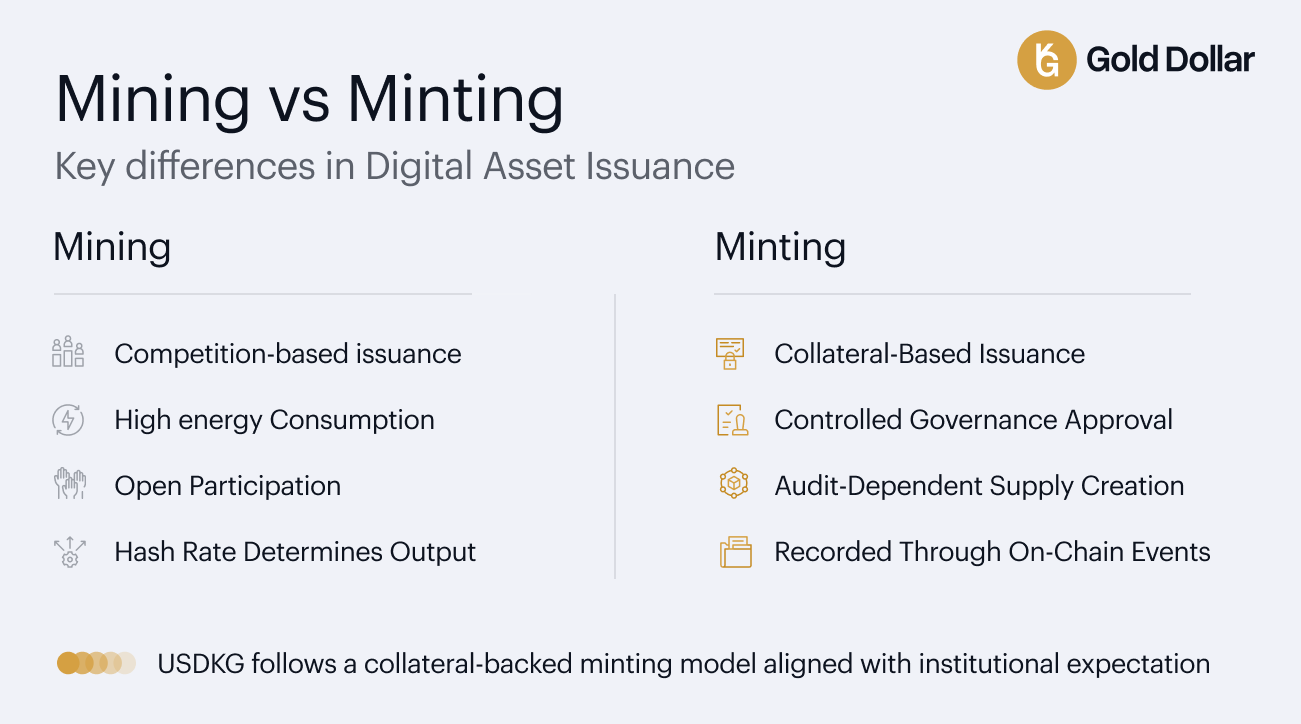
Mining produces supply through competition and electricity in proof of work systems. Minting produces supply through governance and collateral verification. Mining belongs to decentralized security models. Minting belongs to supervised financial models. Mining expands supply according to computational incentives and the hash rate of the network. Minting expands supply according to reserve additions.
The distinction influences transparency expectations, regulatory treatment, and institutional adoption. Mining depends on hardware distribution and energy markets. Minting depends on compliance procedures, custody frameworks, and on-chain governance.
For users evaluating USDKG, the structure of minting is especially important. It confirms that the asset cannot appear unpredictably from mining activity. It confirms that supply growth requires physical gold. It confirms that reserves must be verified and audited, unlike in decentralized networks where new blocks are added through mining or staking.
How USDKG Applies the Minting Process
USDKG follows a collateral-first model. Physical gold enters custody. Independent auditors confirm reserves. The issuer initiates an on-chain proposal. Three signatures from the authorized quorum approve the mint transaction. Only after these steps can the new USDKG enter circulation. Every step is recorded through on-chain events that can be independently reviewed on the blockchain ledger.
This model ensures that each token corresponds to verifiable gold. It also ensures that the supply cannot expand through computational activity. No validator can create USDKG. No mining hardware can generate new units. The entire process follows a transparent issuance sequence that aligns with international expectations for asset-backed digital instruments.
This approach also fits within Kyrgyzstan's legal environment. The Law on Virtual Assets recognizes issuers, custodians, and exchange operators. It establishes compliance requirements and reporting obligations. Minting functions within this structure because it behaves like a financial issuance mechanism rather than an industrial one, distinguishing it from traditional cryptocurrency mining. A detailed breakdown of this legal environment can be found in USDKG’s overview of its regulatory registration.
Why the Distinction Matters for Stablecoin Users and Institutions
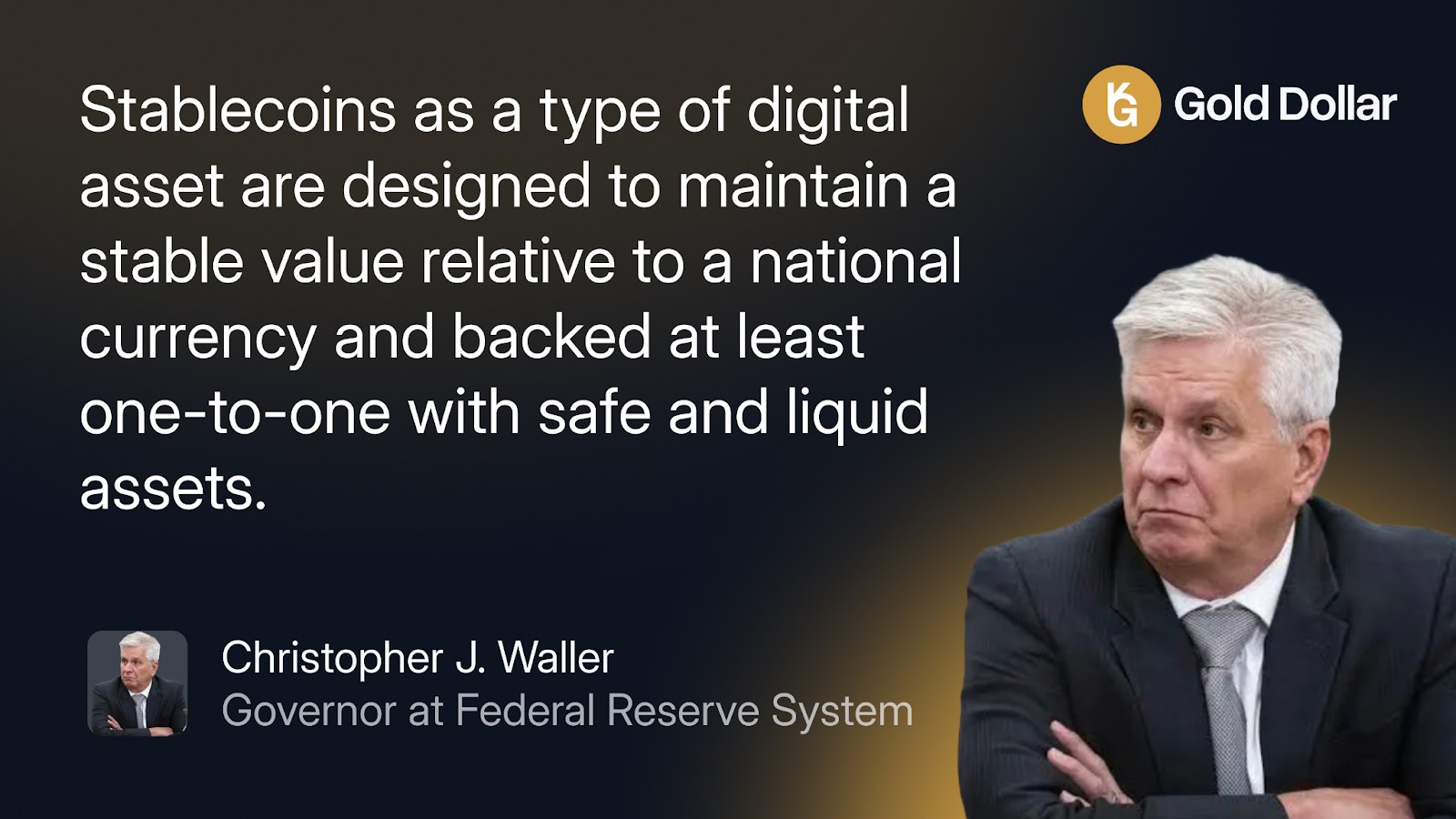
Stablecoin users depend on predictable reserves, transparent supply data, and verifiable issuance. Institutions evaluate stablecoins based on collateral quality, redemption mechanisms, governance reliability, and audit frequency. This reflects the view expressed by Federal Reserve Governor Christopher J. Waller, who described stablecoins as “a type of digital asset designed to maintain a stable value relative to a national currency and backed at least one-to-one with safe and liquid assets.” His definition reinforces the importance of tying supply creation to fully verified collateral rather than computational activity. Understanding minting helps both groups assess how USDKG maintains its gold backing within the broader context of blockchain networks.
Mining could never serve as a supply mechanism for a gold-backed asset because it disconnects issuance from collateral. Minting, on the other hand, ties issuance directly to gold reserves. This alignment creates a clear link between token supply, reserve transparency, and institutional trust.
For enterprises, banks, and trade participants, the presence of a controlled minting process provides clarity. It defines how supply expands, how redemption is secured, and how audit trails can be mapped. It allows USDKG to function as a stable instrument for cross-border settlement and treasury diversification, without the volatility often associated with mined cryptocurrencies.
Conclusion: Mining and Minting Serve Different Roles in the Digital Asset Ecosystem
Mining and minting occupy distinct positions in the digital asset landscape. Mining creates supply through decentralized computation in proof of work systems. Minting creates supply through controlled issuance and verified reserves. Understanding this difference is central to understanding the structure of USDKG and its place in the broader cryptocurrency ecosystem.
USDKG relies entirely on collateral-based minting. Supply is created only after gold is deposited and verified. Governance requires multisignature authorization. All issuance is recorded transparently on the blockchain ledger. These characteristics align USDKG with institutional requirements and support its role within Kyrgyzstan's regulated digital asset environment.
As more users enter the digital currency economy, clear explanations of mining and minting will continue to shape how newcomers evaluate stability, collateral, and transparency. For USDKG, this clarity reinforces confidence in its issuance model and its long-term role in global financial infrastructure, distinguishing it from traditional cryptocurrency networks that rely on mining or staking for block creation and validation.
Related Articles
August 11, 2026
Stablecoins Are Reshaping Financial Infrastructure
Financial infrastructure rarely changes through a single technological breakthrough. It evolves through the gradual adoption of systems that improve the movement, settlement, and management of capital while integrating into existing financial processes.

July 14, 2026
The Stablecoin Market Is Entering Its Regulatory Era
Stablecoins are entering a new phase of development where regulatory clarity is becoming as important as liquidity and network effects. Around the world, jurisdictions are reshaping digital finance, making governance, transparency, and legal certainty increasingly central to long-term adoption.

June 30, 2026
Beyond Backing: What Tether’s aUSDT Closure Reveals About Commodity-Backed Digital Assets
The closure of Tether's aUSDT highlights a broader shift within the commodity-backed digital asset market. As adoption matures, utility, transparency, liquidity, and integration into financial infrastructure are becoming just as important as the assets held in reserve.