.svg)
Digital Trade Corridors – Cross-Border Transactions Powered by Stablecoins
January 6, 2026
Introduction: Why Historical Trade Corridors Still Matter for Cross-Border Transactions
For centuries, historical trade corridors functioned as vast networks connecting East Asia, Central Asia, the Middle East, and Europe. These routes enabled the exchange of goods, ideas, and capital across regions that differed widely in culture, governance, and monetary systems. What made these networks viable was not the existence of a single currency or centralized authority, but the ability of merchants to rely on settlement practices that were broadly understood and trusted across borders.
Modern global trade faces a comparable challenge. While logistics, communication, and production have become increasingly digitized, settlement infrastructure remains fragmented. Cross-border transactions often move slowly through layered banking systems, exposing participants to delays, foreign exchange risk, and operational uncertainty. The concept of digital trade corridors reflects an effort to rethink cross-border transactions for a digital economy, where stablecoins may function as neutral and efficient instruments for international value transfer and blockchain transactions.
Historical Trade Corridors and Trade Without Monetary Uniformity
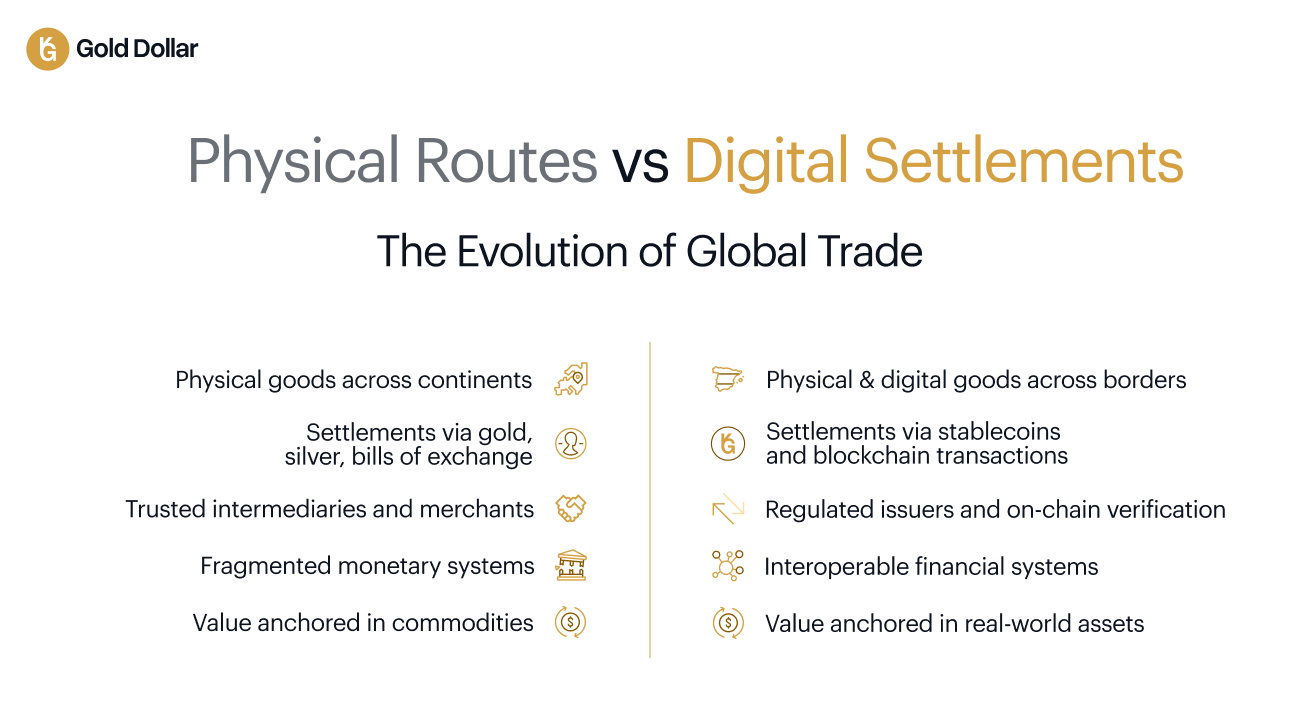
Early global trade did not operate under a unified monetary regime. Merchants crossed regions governed by different empires, legal systems, and currencies. Settlement relied on a combination of commodity money, particularly gold and silver, trusted intermediaries, and contractual arrangements that allowed value to be recognized even when the transaction occurred far from the point of sale.
Gold played a central role because it was widely accepted, difficult to debase, and portable relative to its value. Bills of exchange and early credit instruments allowed merchants to separate the movement of goods from the movement of money, reducing the risks associated with long-distance transport. These mechanisms enabled trade to flourish despite political fragmentation and monetary diversity.
The success of historical trade corridors demonstrates that commerce depends less on monetary uniformity and more on shared settlement conventions. This principle remains highly relevant in the digital era, where stablecoins are emerging as a potential solution for cross-border transactions and global money movement.
Settlement Friction in Modern Cross-Border Business and Transactions Infrastructure
Despite advances in financial technology, cross-border business and trade settlement continue to present structural challenges. International transactions often rely on correspondent banking networks that involve multiple intermediaries, each introducing cost, delay, and operational complexity. Currency conversion further increases friction, particularly for businesses operating across emerging and developed markets.
Institutions such as the World Bank and the Bank for International Settlements have consistently documented these inefficiencies, noting that settlement delays and liquidity constraints disproportionately affect smaller firms and developing economies. Trade finance gaps persist because capital becomes tied up in slow settlement processes rather than circulating efficiently through global supply chains.
In this environment, improving settlement infrastructure and transactions infrastructure has become a critical priority for global trade. Stablecoins and blockchain transaction solutions are increasingly discussed as potential remedies to these longstanding inefficiencies in the global transactions landscape.
Stablecoins as Digital Settlement Instruments in the Stablecoin Market
Stablecoins represent a category of digital assets designed to maintain a stable value relative to a reference asset. When structured with transparent reserves and clear governance, they can serve as digital settlement instruments rather than speculative assets. Their ability to settle transactions quickly across borders makes them particularly relevant for international trade and stablecoin transactions.
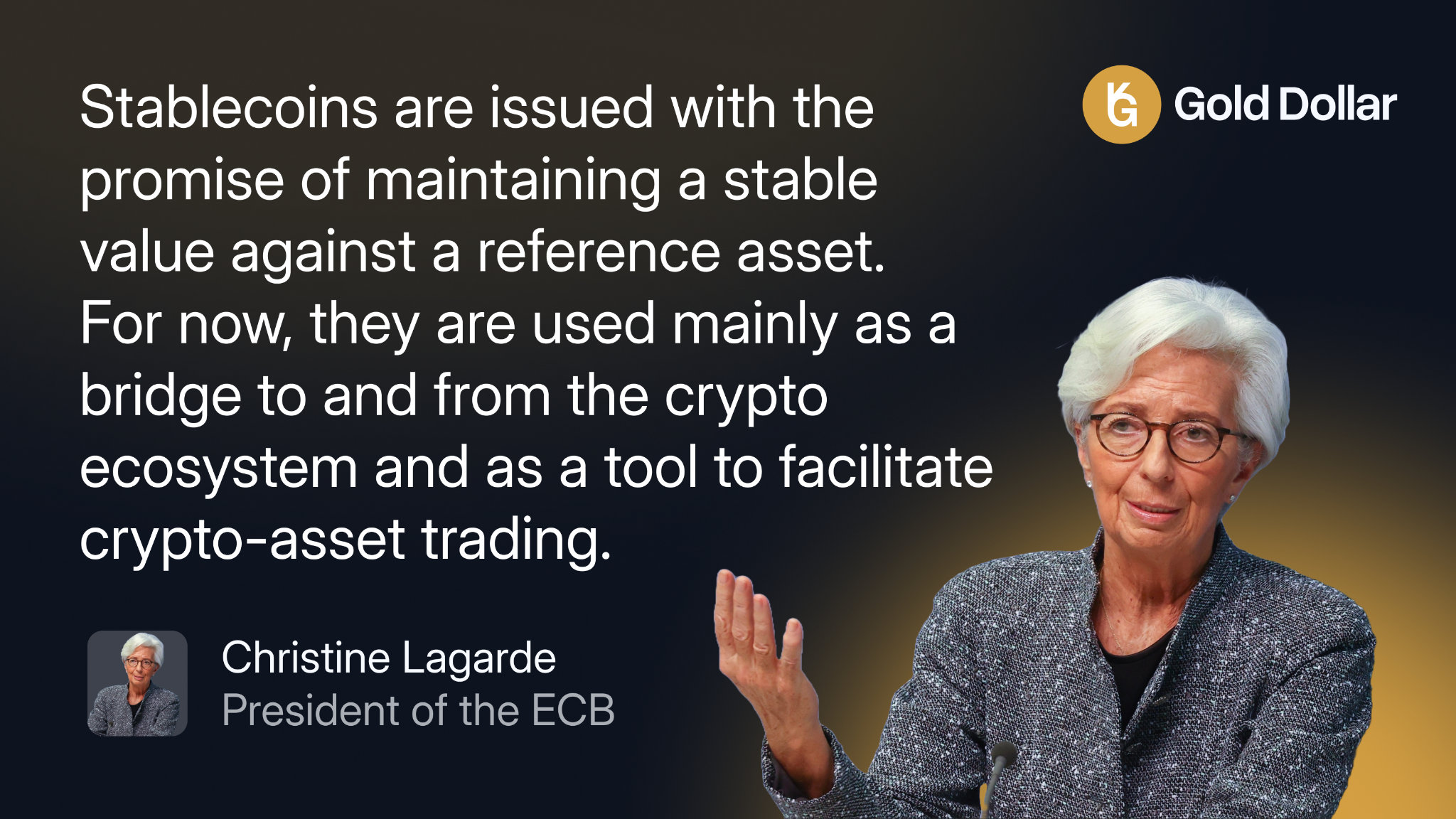
Policy discussions increasingly describe stablecoins in practical terms. In recent remarks, Christine Lagarde noted that stablecoins are issued with the promise of maintaining a stable value against a reference asset and that, for now, they are used mainly as a bridge to and from the crypto ecosystem and as a tool to facilitate crypto-asset trading. That framing matters for trade settlement because it highlights the current reality of stablecoin usage while also clarifying what must evolve for stablecoins to serve broader commercial transaction flows.
For settlement purposes, stability and predictability are essential. Trade participants require confidence that the value transferred today will retain its purchasing power throughout the settlement cycle. Stablecoins that are properly collateralized and subject to regulatory oversight can meet this requirement more effectively than volatile digital assets.
Types of Stablecoins and the Role of Commodity Anchors in Trade Settlement
Commodity-backed value systems have historically supported international trade by providing a neutral reference that transcends national monetary policy. Gold’s role as a reserve asset and store of value has persisted across centuries because of its scarcity, durability, and broad acceptance.
Asset-backed stablecoins apply this logic to digital settlement. By anchoring issuance to physical reserves, particularly commodities with established monetary credibility, these instruments provide assurance regarding value and backing. This structure reflects long-standing trade practices where settlement relied on assets that were independently valued and widely trusted.
Alongside asset-backed models, fiat-backed stablecoins and algorithmic stablecoins represent other types of stablecoins currently in circulation. Each approach carries different risk profiles and implications for trade settlement, particularly in environments that demand high levels of predictability and reserve transparency.
Digital Trade Corridors Enabled by Blockchain Transactions
The emergence of digital trade corridors refers to settlement occurring through interoperable digital instruments rather than traditional banking rails alone. In this model, stablecoins act as settlement layers that connect counterparties across jurisdictions, while compliance, reporting, and custody remain aligned with regulatory frameworks.
This approach is already being explored through initiatives such as the BIS-led mBridge project, which examines how digital currencies can facilitate cross-border settlement between central banks. Private-sector stablecoins can complement these efforts by supporting commercial trade flows that require flexibility, speed, and transparency.
Digital trade corridors reduce settlement friction while preserving accountability and oversight. They rely on blockchain technology to create more efficient transaction corridors and enable near-instant settlement across borders.
Crypto Regulation, Trust, and Compliance in Stablecoin Transactions
Regulatory clarity plays a central role in determining whether stablecoins can be adopted for trade settlement. Global standard setters have emphasized the importance of reserve transparency, governance controls, and operational resilience as prerequisites for trust.
When stablecoins operate within defined legal frameworks, counterparties gain confidence in how issuance, redemption, and oversight function. International institutions such as the Bank for International Settlements, the International Monetary Fund, and the World Bank increasingly frame stablecoins within the context of transaction system modernization and cross-border settlement efficiency.
As stablecoin transactions expand globally, regulatory compliance, including AML controls and transaction monitoring, remains essential for participation in regulated trade environments.
USDKG as a Case Study in Asset-Backed Stablecoins for Trade Settlement
USDKG provides a practical example of how digital trade corridors can be implemented within a regulated framework. Issued as a gold-backed stablecoin, USDKG is designed specifically for settlement use cases rather than speculative activity or incentive-driven participation. Its issuance model ties token creation directly to verified physical gold reserves held in custody, aligning digital supply with real-world assets.
This structure reflects historical trade settlement practices, where gold functioned as a neutral store of value across regions with differing monetary systems. By digitizing this logic, USDKG enables cross-border value transfer without reliance on correspondent banking chains or exposure to volatile exchange rates.
From a trade perspective, USDKG functions as a settlement instrument rather than a yield-generating product. Tokens enter circulation only after reserves are verified and issuance is registered under applicable law, supporting predictability and reducing counterparty risk.
Conclusion: Settlement as the Foundation of Modern Trade
Historical trade corridors show that commerce thrives when settlement mechanisms are trusted, predictable, and adaptable. Modern trade faces similar challenges in a more complex financial environment.
Stablecoins, particularly those backed by real assets and issued under regulatory oversight, offer a potential foundation for modern trade settlement. By combining established principles of value anchoring with digital infrastructure, digital trade corridors can reduce friction without sacrificing accountability.
Related Articles

August 11, 2026
Stablecoins Are Reshaping Financial Infrastructure
Financial infrastructure rarely changes through a single technological breakthrough. It evolves through the gradual adoption of systems that improve the movement, settlement, and management of capital while integrating into existing financial processes.

July 14, 2026
The Stablecoin Market Is Entering Its Regulatory Era
Stablecoins are entering a new phase of development where regulatory clarity is becoming as important as liquidity and network effects. Around the world, jurisdictions are reshaping digital finance, making governance, transparency, and legal certainty increasingly central to long-term adoption.

June 30, 2026
Beyond Backing: What Tether’s aUSDT Closure Reveals About Commodity-Backed Digital Assets
The closure of Tether's aUSDT highlights a broader shift within the commodity-backed digital asset market. As adoption matures, utility, transparency, liquidity, and integration into financial infrastructure are becoming just as important as the assets held in reserve.