.svg)
How USDKG Makes DeFi Transparent and Reliable
November 18, 2025
The Era of DeFi Meets Real-World Assets
Decentralized Finance (DeFi) has evolved from an experimental niche into a trillion-dollar ecosystem redefining how capital flows across digital and traditional markets. Yet its core challenge remains unchanged: trust.
Over the past few years, the demand for transparency, compliance, and real-world asset (RWA) integration has grown rapidly. Institutions, hedge funds, and national treasuries are now exploring how DeFi can deliver real-time liquidity without sacrificing oversight. However, trust in DeFi cannot be established through code alone. It requires verifiable reserves, credible governance, and compliance frameworks that bridge blockchain efficiency with financial integrity.
Stablecoins lie at the heart of this evolution. According to the Bank for International Settlements, stablecoins represent over 90% of transaction volume in DeFi protocols, yet fewer than 15% maintain publicly verifiable reserves. The resulting gap between innovation and transparency has slowed institutional adoption.
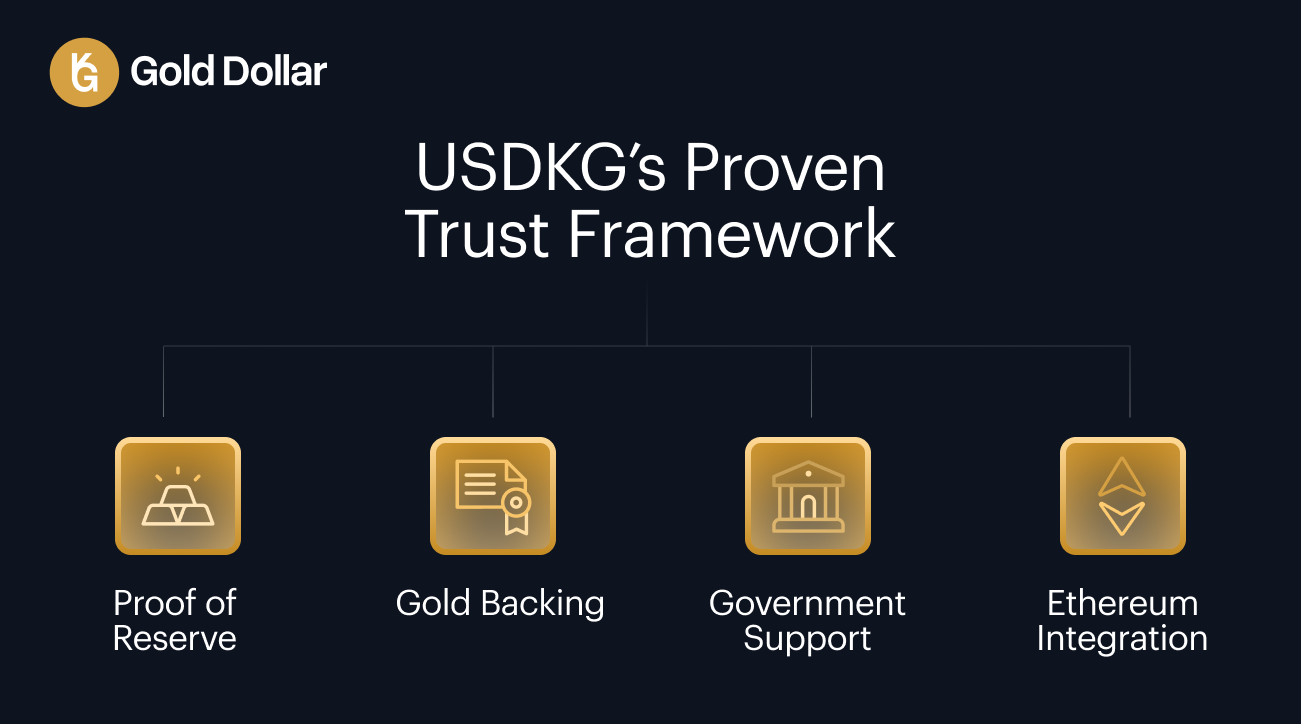
USDKG was designed to close that gap — combining proof of reserve, gold backing, government recognition, and Ethereum integration to create a stablecoin built for the next generation of decentralized finance.
Why Proof of Reserve Matters in DeFi and Stablecoins
But what is proof of reserves, and why does it matter for DeFi stability? In traditional banking, balance sheets are audited to ensure solvency and protect depositors. In DeFi, that assurance must come from on-chain verification. Proof of reserve (PoR) provides precisely that: a cryptographic and independently verifiable demonstration that every issued token is fully backed by real assets.
Proof of reserve has become a defining feature of trustworthy stablecoins. Without it, users must rely on opaque attestations or promises from issuers. The collapse of algorithmic models such as TerraUSD in 2022 revealed the dangers of circular logic in uncollateralized systems. When confidence erodes and there are no verifiable reserves, the peg fails — sometimes catastrophically.
In contrast, asset-backed stablecoins with transparent audits strengthen market stability. They allow investors, regulators, and DeFi protocols to confirm backing in real time. PwC’s 2023 Proof-of-Reserves Whitepaper found that transparency directly correlates with trading volume and long-term liquidity in DeFi platforms.
Independent firms conduct each proof of reserves audit, ensuring all holdings match circulating supply. Each report functions as a proof of reserves attestation, confirming that every token remains fully backed. All audit reports are publicly accessible, supporting complete reserve transparency and public verification.
Every reserve entry is subject to independent asset verification before minting. This dual audit acts as a proof of solvency, validating that reserves exceed liabilities. Future upgrades may adopt a Merkle Mountain Range proof system for scalable audits and automated audits that enhance real-time assurance.
USDKG’s structure ensures continuous monitoring, with data on reserve holdings available for open review. Together, these elements form a robust transparency framework that improves investor confidence across both DeFi and traditional markets.
Gold-Backing: A Structural Differentiator for USDKG
In a market dominated by fiat-backed stablecoins such as USDT and USDC, USDKG introduces an asset-backed paradigm rooted in one of humanity’s oldest stores of value: gold.
Gold-backed stablecoins provide intrinsic worth beyond the issuer’s balance sheet. Unlike fiat reserves that depend on commercial banks and short-term debt instruments, gold’s value is universal, tangible, and historically resistant to inflation. This intrinsic reliability makes gold an ideal foundation for a transparent, non-inflationary digital currency.
According to the World Gold Council, gold has outperformed all major fiat currencies in purchasing-power stability over the past 20 years. For institutions managing multi-currency exposure or cross-border settlement, this stability offers a unique hedge against dollar depreciation and market volatility.
By integrating gold reserves under licensed custodial services in Kyrgyzstan, USDKG merges tangible collateral with programmable finance. Blockchain records provide immutable proof of ownership for every tokenized gram of gold.
Each minted token represents a verified portion of the national gold reserve pool, reinforcing credibility while preserving the liquidity advantages of blockchain. This model enhances long-term price stability, maintains a conservative collateralization ratio, and introduces a fully auditable pegging mechanism based on physical assets rather than synthetic code.
Government Support and Institutional Integration
For stablecoins, legal clarity is as critical as collateral. Many projects have strong technology but weak jurisdictional foundations. USDKG was developed under Kyrgyzstan’s Law on Virtual Assets, a legal framework that classifies tokenized instruments, defines reserve requirements, and mandates licensing for Virtual Asset Service Providers (VASPs).
This national oversight gives USDKG something few DeFi projects possess: legal legitimacy at the sovereign level. It’s not a government-issued currency but a privately managed, government-recognized asset — combining the speed of innovation with regulatory assurance.
USDKG’s model aligns with global regulatory compliance standards, enhancing consumer protection and meeting regulatory requirements such as the FATF Travel Rule and money transmitter laws. These safeguards establish operational transparency and reinforce accountability for stablecoin issuers.
Frameworks such as MiCA in Europe and the U.S. GENIUS Act are shaping how issuers maintain transparency and adhere to regulatory requirements for stablecoins. Similar principles can be seen in Singapore’s Payment Services Act and the MAS framework, which focus on asset segregation, risk management, and redemption rights.
This oversight, combined with clear reserve reporting, positions USDKG within a modern transparency framework for compliant DeFi operations and institutional use.
ETH Integration and DeFi Utility: Faster, Safer, More Transparent
The Ethereum network remains the most trusted settlement layer in decentralized finance, accounting for more than 65% of total DeFi value locked (TVL). Its security, interoperability, and developer ecosystem make it the backbone of on-chain finance.
USDKG’s integration with Ethereum brings several advantages:
- Speed and Accessibility:
USDKG transactions finalize within minutes, compared to hours or even days in traditional banking. The token operates 24/7, eliminating settlement bottlenecks. - Security and Transparency:
Ethereum’s open-source code and audited smart contracts ensure tamper-resistant transactions. Every mint and burn event is visible on-chain via public blockchain explorers, backed by the reserve ledger. - Programmability and Compliance:
Smart contracts leverage Ethereum’s verifiable computing to guarantee deterministic execution. DeFi protocols can integrate USDKG as a fully backed counterpart for user deposits, ensuring public verification of on-chain activities.
In practice, this means USDKG can serve as a universal settlement token across both DeFi protocols and regulated financial applications. When paired with its gold collateral and transparent audits, the Ethereum layer becomes a bridge between code and compliance.
Bridging DeFi and Traditional Finance: USDKG’s Role
The convergence between decentralized and traditional finance is accelerating. Payment providers like PayPal and Circle are now exploring stablecoin issuance, while banks from Singapore to Switzerland are experimenting with tokenized deposits.
However, most fiat-backed stablecoins remain dependent on commercial banks’ solvency and lack physical collateral. USDKG’s model of government-recognized gold reserves and on-chain transparency introduces a higher standard.
For financial institutions, this means exposure to DeFi without the reputational or regulatory risks of opaque tokens. For DeFi platforms, it means access to stable, audited collateral that can enhance liquidity and reduce systemic risk.
This dual appeal — to both DeFi builders and institutional treasurers — positions USDKG as a neutral, asset-backed currency bridging two parallel systems. It satisfies key expectations around consumer protection, audit reports, and reserve verification, offering the reliability that stablecoin issuers and regulators alike demand.
Risks, Mitigations, and What to Watch
Even the most transparent systems face operational and regulatory risks. USDKG addresses these proactively through multiple layers of control:
- Regulatory Oversight: Operates under Kyrgyzstan’s financial supervision and AML framework, including suspicious activity reporting and strict customer due diligence.
- Audited Reserves: Independent auditors confirm that assets meet all regulatory requirements; results published via attestation reports.
- Multi-Signature Governance: Minting and burning functions are managed by a 3-of-7 multisig contract, preventing unilateral control.
- Smart-Contract Security: The code was reviewed by ConsenSys Diligence, ensuring correctness and eliminating vulnerabilities.
- Liquidity Strategy: Integrations with OTC desks, DeFi liquidity pools, and segregated accounts protect users through bankruptcy protections and sanctions enforcement mechanisms.
- Risk Management: Active monitoring, transaction screening, and continuous monitoring minimize systemic threats.
This level of assurance mirrors large exchange initiatives such as Binance SAFU, delivering the same security principles to stablecoin reserves.
Before concluding, it’s worth reflecting on how market leaders in the stablecoin sector view the evolution of transparency and capital strength.
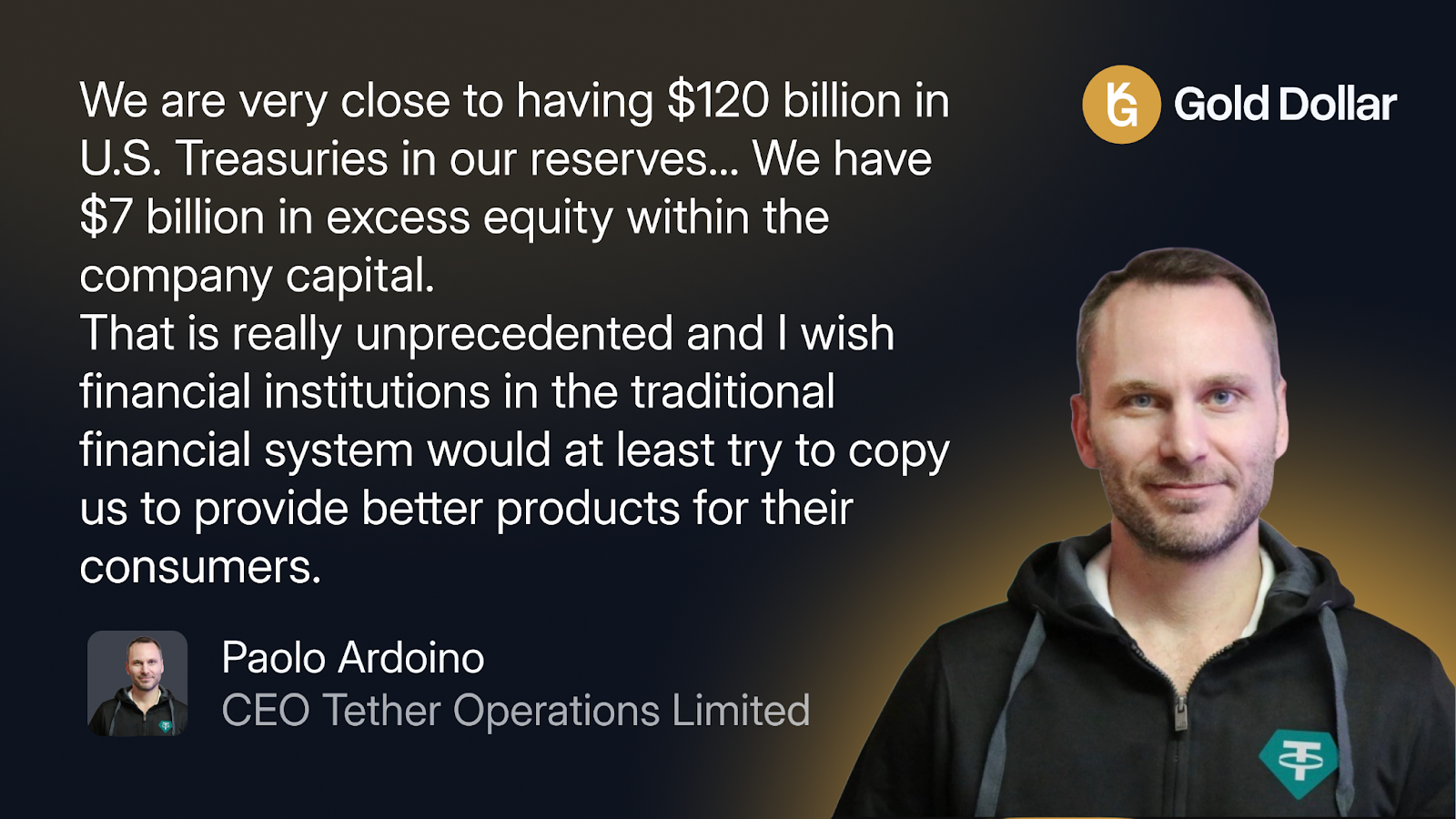
“We are very close to having $120 billion in U.S. Treasuries in our reserves... We have $7 billion in excess equity within the company capital. That is really unprecedented and I wish financial institutions in the traditional financial system would at least try to copy us to provide better products for their consumers.”
— Paolo Ardoino, CEO, Tether Operations Limited
Ardoino’s statement underscores a wider shift in financial infrastructure: where stablecoin issuers are setting new standards for reserve transparency, risk management, and investor confidence — benchmarks that traditional banks are now challenged to meet. USDKG’s design follows the same philosophy, applying verifiable, gold-backed collateral and proof-of-reserve audits to make DeFi as reliable as any regulated institution.
Conclusion: A Reliable Foundation for DeFi’s Next Phase
The DeFi ecosystem is entering a new phase — one where credibility, compliance, and collateral define success as much as innovation does.
USDKG exemplifies this transformation. Its proof-of-reserve system demonstrates solvency in real time. Its gold-backed reserves provide intrinsic value. Its government recognition ensures compliance and regulatory requirements alignment. And its Ethereum integration enables 24/7 programmable finance at a global scale.
By combining these elements, USDKG sets a new benchmark for transparent, reliable, and institutionally ready stablecoins.
For developers, it’s a building block for secure DeFi applications.
For institutions, it’s a trusted entry point into the blockchain economy.
For regulators, it’s proof that decentralized systems can meet — and even exceed — the transparency standards of traditional finance.
As the boundaries between traditional banking and DeFi continue to blur, USDKG’s model offers a clear path forward — one where real assets, regulated transparency, and blockchain efficiency converge to create the financial infrastructure of the future.
Related Articles

August 11, 2026
Stablecoins Are Reshaping Financial Infrastructure
Financial infrastructure rarely changes through a single technological breakthrough. It evolves through the gradual adoption of systems that improve the movement, settlement, and management of capital while integrating into existing financial processes.

July 14, 2026
The Stablecoin Market Is Entering Its Regulatory Era
Stablecoins are entering a new phase of development where regulatory clarity is becoming as important as liquidity and network effects. Around the world, jurisdictions are reshaping digital finance, making governance, transparency, and legal certainty increasingly central to long-term adoption.

June 30, 2026
Beyond Backing: What Tether’s aUSDT Closure Reveals About Commodity-Backed Digital Assets
The closure of Tether's aUSDT highlights a broader shift within the commodity-backed digital asset market. As adoption matures, utility, transparency, liquidity, and integration into financial infrastructure are becoming just as important as the assets held in reserve.