.svg)
How USDKG Reduces Risk in Global Transactions
January 13, 2026
Introduction: Risk Is the Hidden Cost of Global Transactions
Global transactions are often discussed in terms of speed and cost, but risk remains the most persistent and least visible challenge in global money movement. Businesses engaged in international transfers face settlement delays, foreign exchange exposure, counterparty uncertainty, and compliance complexity, all of which can materially affect cash flow and operational reliability. These risks are not theoretical. They surface when transactions are delayed, reversed, frozen, or settled at unexpected values.
Despite decades of transaction innovation in financial services, global transaction networks remain fragmented. Transactions typically move through layered correspondent banking networks, each introducing time delays, operational dependencies, and jurisdictional exposure. As global commerce becomes increasingly digital and real-time, these structural limitations become more pronounced. Reducing risk, rather than simply accelerating transactions, has therefore become a central objective in the modernization of global transaction infrastructure.
USDKG was designed within this context. As one of the largest stablecoins backed by gold and issued under a defined regulatory framework, its role is not to replace existing financial systems but to address specific risk vectors inherent in international transactions through transparent issuance, predictable settlement, and verifiable backing.
Settlement Risk: When Time Becomes a Liability
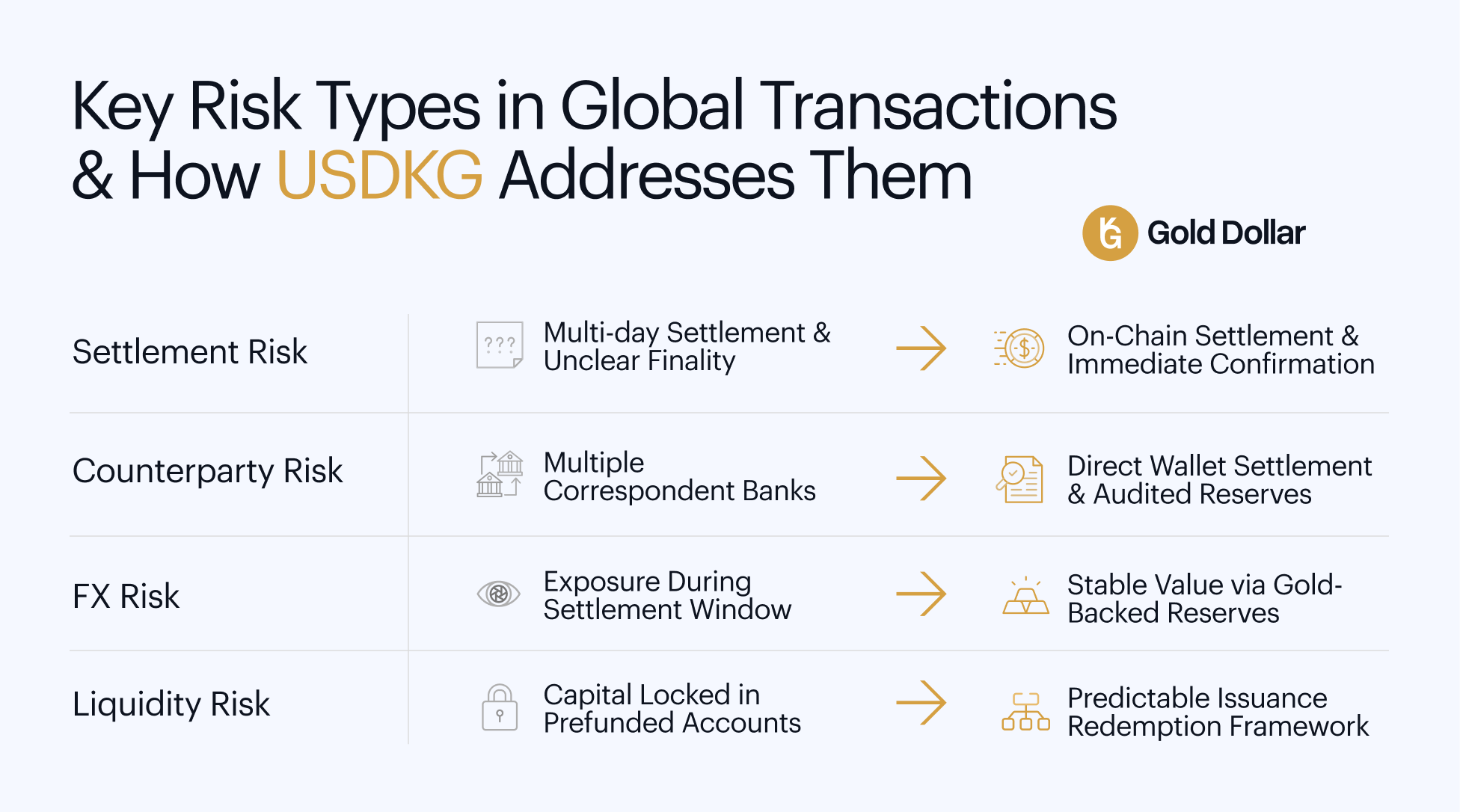
Settlement risk arises when there is a delay between transaction initiation and final settlement. In traditional international transfers, this delay can extend from days to weeks, depending on the number of intermediaries involved and the jurisdictions crossed. During this period, funds are effectively in transit, unavailable for use, and exposed to operational disruptions.
These delays introduce uncertainty for both payer and recipient. Failed settlements, compliance reviews, or correspondent bank issues can interrupt transaction flows without advance notice. For businesses managing tight working capital cycles, delayed settlement directly impacts liquidity planning and operational continuity.
Blockchain transaction solutions reduce this exposure by enabling near-real-time finality. When settlement occurs on-chain, transaction status and completion are visible immediately, reducing ambiguity around timing and execution. USDKG transactions settle on public blockchain networks, providing clear confirmation of transfer while maintaining issuance discipline separate from transaction volume.
Counterparty Risk in Global Transactions
Counterparty risk refers to the possibility that one party to a transaction fails to meet its obligations. In international transactions, this risk is often mediated through intermediaries such as correspondent banks, clearing institutions, and transaction providers. Each intermediary introduces an additional dependency that must function correctly for settlement to complete.
In jurisdictions where banking access is limited or regulatory environments differ, counterparties may also face account freezes, capital controls, or sudden changes in policy that disrupt transaction flows. These risks are amplified in global finance, where trust between counterparties is often limited by geography and legal distance.
USDKG reduces counterparty risk by anchoring value transfer to a verifiable asset base rather than relying solely on institutional credit relationships. Settlement occurs directly between digital wallets on-chain, while issuance and redemption remain governed by audited reserves and regulated oversight. This separation between settlement execution and reserve custody reduces reliance on intermediary solvency during the transaction process.
Foreign Exchange Risk and Value Stability
Foreign exchange risk is an unavoidable component of global transfers. Even short settlement windows can expose participants to currency fluctuations that materially affect transaction outcomes. For businesses operating on thin margins, unexpected foreign exchange rates can erode profitability or require costly hedging strategies.
Stablecoin transactions address this challenge by providing a unit of account with predictable value during the settlement cycle. For trade settlement, stability is essential. Participants require confidence that the value transferred today will retain its purchasing power until settlement is complete.
USDKG introduces an additional layer of stability through its gold-backed structure. Gold has historically functioned as a neutral store of value across monetary regimes. By tying issuance to verified physical gold reserves, USDKG aligns digital asset transactions with a reserve asset that is not directly subject to the monetary policy of a single jurisdiction. This structure supports predictable settlement outcomes in environments where fiat currency volatility may be elevated.
Liquidity Risk and Transaction Flow Management
Liquidity risk arises when funds are unavailable at the moment they are needed. In traditional international transfers, liquidity is often trapped within correspondent banking networks, requiring prefunding across multiple jurisdictions. This capital inefficiency increases operational cost and reduces flexibility for treasury management.
Slow settlement also compounds liquidity risk. When transactions take days to complete, businesses must maintain higher cash buffers to account for uncertainty, tying up capital that could otherwise be deployed productively.
USDKG addresses liquidity risk by combining predictable issuance with on-chain settlement visibility. Tokens enter circulation only after reserves are verified and issuance is registered, ensuring that supply reflects actual backing rather than market demand. This predictability allows participants to manage liquidity with greater confidence, knowing that settlement execution is not dependent on discretionary supply expansion or incentive-driven dynamics.
Compliance and Regulatory Risk in Global Transactions
Compliance risk is a defining factor in modern transaction systems. Global transactions are subject to anti-money laundering requirements, transaction monitoring, sanctions screening, and jurisdiction-specific reporting obligations. Failure to meet these requirements can result in delayed transactions, account restrictions, or legal exposure.
Regulatory clarity therefore plays a critical role in determining whether a transaction instrument can be used reliably at scale. Stablecoins operating in undefined or offshore structures introduce uncertainty around issuer accountability, reserve treatment, and supervisory oversight.
USDKG operates within a defined legal framework under the Law on Virtual Assets of the Kyrgyz Republic. Issuance, custody, and reserve verification are subject to formal oversight, and independent audits confirm both physical reserves and smart contract controls. This compliance infrastructure provides counterparties with clarity regarding how regulatory obligations are met and how governance functions throughout the lifecycle of the asset.
How USDKG Addresses Risk in Practice
USDKG was designed to reduce risk through structural choices rather than incentives. Issuance is tied directly to verified physical gold reserves held in custody. New tokens are minted only after reserves are independently confirmed and issuance is registered with the regulator. Supply does not expand in response to transaction volume, market demand, or liquidity incentives.
Smart contracts governing minting and burning are protected by multi-signature controls, separating operational authority from compliance functions. Independent audits have confirmed issuer control over these contracts on supported blockchain networks, and all issuance events are visible on-chain.
Redemption is supported by a liquidity framework that includes both physical gold reserves and fiat buffers, allowing redemptions to be processed without forced asset sales during short-term market volatility. Together, these elements create a settlement instrument designed for predictability rather than speculation.
Use Cases Where Risk Reduction Matters Most
Risk reduction is particularly relevant in trade settlement, treasury operations, and global business transactions. In these contexts, reliability and transparency matter more than yield or price appreciation. Businesses require settlement instruments that behave consistently across jurisdictions and market conditions.
USDKG is positioned to support these use cases by providing a gold-backed settlement layer that integrates with blockchain technology while maintaining regulatory alignment. Its role is not to replace existing banking relationships but to complement them where traditional transaction rails introduce friction or uncertainty.
Conclusion: Predictability as the Foundation of Global Transactions
Global finance evolves when risk is reduced, not when speed alone is optimized. Settlement reliability, value stability, liquidity predictability, and regulatory clarity form the foundation of sustainable transaction solutions.
USDKG addresses these dimensions by combining asset-backed issuance, controlled minting, transparent blockchain settlement, and formal oversight. By aligning digital currencies with verified reserves and disciplined governance, it offers an approach to global transaction infrastructure that prioritizes predictability and trust over short-term efficiency gains.
As global commerce continues to digitize, transaction instruments that reduce risk rather than amplify it are likely to play an increasingly important role in international trade and financial inclusion. The stablecoin market and blockchain adoption in financial services are poised to grow, driven by the need for more efficient and secure global transaction solutions.
Related Articles
August 11, 2026
Stablecoins Are Reshaping Financial Infrastructure
Financial infrastructure rarely changes through a single technological breakthrough. It evolves through the gradual adoption of systems that improve the movement, settlement, and management of capital while integrating into existing financial processes.
July 14, 2026
The Stablecoin Market Is Entering Its Regulatory Era
Stablecoins are entering a new phase of development where regulatory clarity is becoming as important as liquidity and network effects. Around the world, jurisdictions are reshaping digital finance, making governance, transparency, and legal certainty increasingly central to long-term adoption.

June 30, 2026
Beyond Backing: What Tether’s aUSDT Closure Reveals About Commodity-Backed Digital Assets
The closure of Tether's aUSDT highlights a broader shift within the commodity-backed digital asset market. As adoption matures, utility, transparency, liquidity, and integration into financial infrastructure are becoming just as important as the assets held in reserve.