.svg)
Interview: Market Makers on Gold-Backed Stablecoins and Liquidity
January 20, 2026

Liquidity is one of the most important but least visible components of any stablecoin. While users experience stable prices and smooth execution, the mechanics behind that stability are shaped by market makers who manage risk, balance inventory, and provide depth across trading venues.
For gold-backed stablecoins, liquidity dynamics differ from those of purely fiat-backed or algorithmic models. Supply discipline, reserve verification, and redemption mechanics all influence how confidently liquidity can be provided, especially during periods of market stress. These factors matter not only for trading, but also for settlement, treasury use, and long-term integration into decentralized finance.
To better understand how these dynamics play out in practice, we spoke with Sebastjan Bele, Business Development Manager at Orcabay Ltd., a market maker supporting USDKG across decentralized markets. His responses below reflect how liquidity providers assess gold-backed stablecoins in live market conditions.
Interview with Sebastjan Bele, Orcabay Ltd.
1. From a market maker’s perspective, what difference does a gold-backed peg make compared to other stablecoins?
A gold backed peg behaves fundamentally differently from fiat backed stablecoins because the reference asset is more volatile by design. Gold is not fixed to a single unit of account like USD, it moves with macro conditions, real yields, inflation expectations, and overall risk sentiment.
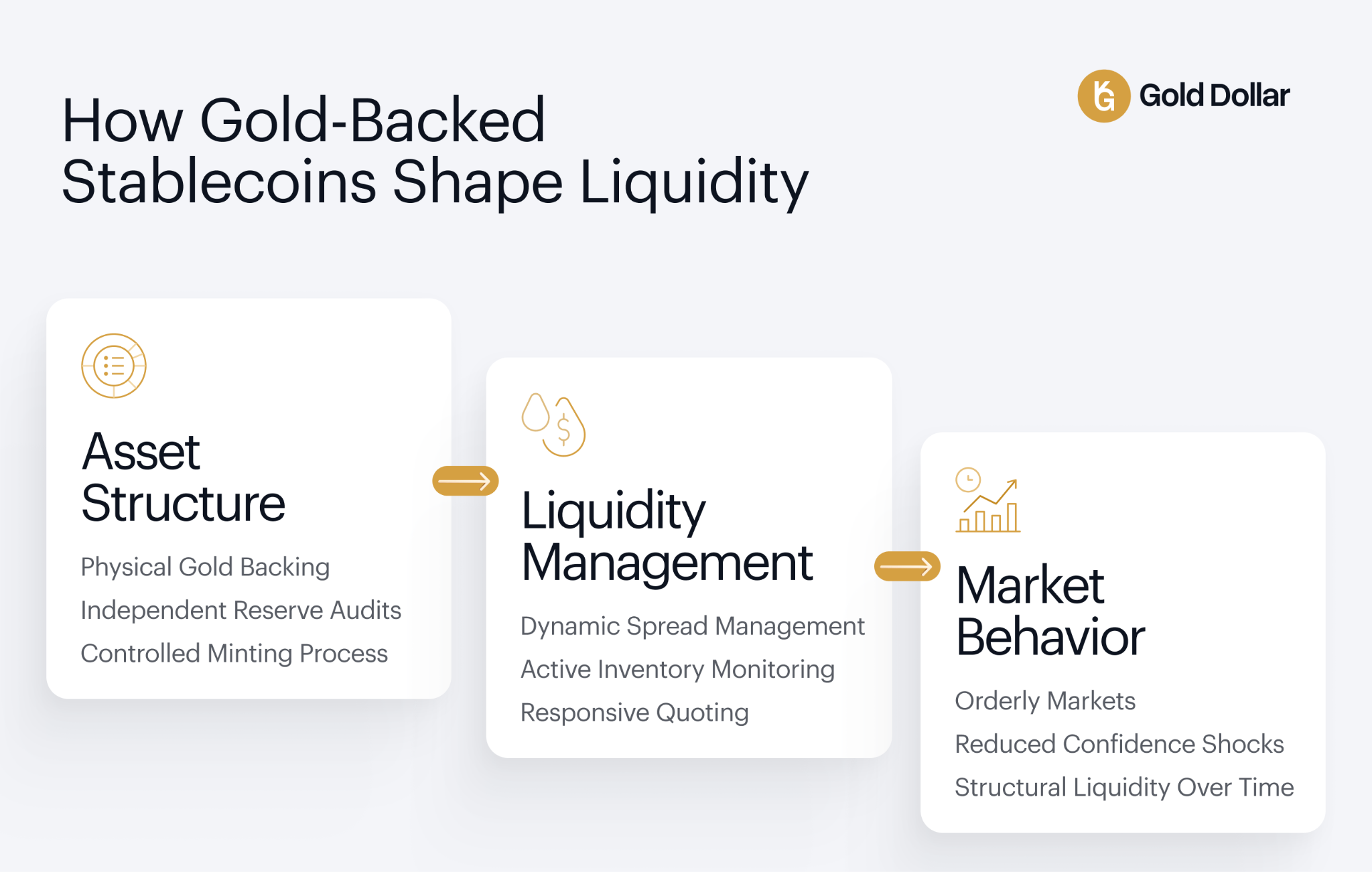
From a market maker perspective, this means quoting needs to be more active. Spreads must be managed dynamically to reflect underlying gold price movements and changes in macro conditions. With USD denominated stablecoins, price behavior is far more predictable, allowing market makers to quote more passively. In contrast, gold backed stablecoins require tighter monitoring, faster adjustments, and more responsive inventory management to maintain healthy liquidity and orderly markets.
2. How important are audits and reserve verification when deciding to support liquidity for a stablecoin like USDKG?
Audits are crucial. As a market maker, you need confidence that every unit of a stablecoin is backed by a real, verifiable underlying asset, and that this backing is continuously proven through regular and transparent audits. The principle is simple, do not trust, verify.
Independent verification materially improves our comfort level. Audits of physical reserves reduce the risk of confidence shocks, while third party smart contract audits add an additional layer of assurance that the system operates as intended. This significantly lowers technical failure risk and tail risk scenarios, which directly impacts how confidently and consistently liquidity can be provided.
When both reserves and contracts are independently verified, liquidity provision becomes structural rather than opportunistic, allowing for tighter spreads, deeper books, and more stable markets.

3. Why does controlled minting matter for liquidity provision?
Controlled minting creates a predictable token supply, which is crucial for inventory management. It allows market makers to anticipate new supply entering the market and adjust pricing, hedging, and quoting strategies in advance rather than reacting after issuance occurs.
For gold backed stablecoins, issuance is demand driven and requires a strict 1:1 backing with physical gold that must first be acquired and verified. This additional constraint prevents sudden or speculative supply expansion and ensures that new tokens enter the market only when there is real demand on the other side. For liquidity providers, this reduces dilution risk, improves market stability, and makes inventory exposure significantly more manageable.
4. How do gold backed stablecoins behave during market volatility?
At this stage, gold backed stablecoins are still a relatively small and maturing niche. Beyond spot markets, they are often also traded on perpetual venues, which introduces additional speculative buy and sell pressure during periods of volatility. When this is combined with thin order books, a single large market order can lead to outsized price moves.
There have been recent examples where a gold backed stablecoin temporarily dislocated, liquidated short positions, and traded well above the implied price of physical gold before stabilizing. In that instance, underlying gold markets were closed, meaning there was no immediate arbitrage anchor to enforce pricing parity. This highlights a structural challenge, low liquidity and 24/7 trading of onchain assets backed by non 24/7 markets can temporarily break pricing logic.
That said, as the market matures and more capital flows into gold backed stablecoins, depth improves and arbitrage becomes more efficient. As a result, these dislocations should become increasingly rare, and in practice, they already are far less common than in earlier stages.
5. Where do you see gold backed stablecoins fitting into DeFi long term?
With the evolution of crypto, gold is likely to take on a new role within DeFi. We see gold backed stablecoins primarily being used as collateral and as an important component of protocol and treasury reserves, offering a non sovereign, real asset backed alternative to fiat denominated stablecoins.
At the same time, they will also function as trading instruments, particularly for macro driven positioning and hedging. While they may not dominate high frequency or leverage heavy trading, their role as a settlement asset and balance sheet primitive in DeFi is likely to grow as the ecosystem matures and seeks more credible and diversified forms of onchain collateral.
Conclusion: What This Means for USDKG and Gold-Backed Liquidity
The perspectives shared by market makers highlight how liquidity in gold-backed stablecoins is shaped by structure rather than incentives. Active quoting, disciplined issuance, and continuous reserve verification are not optional features, but prerequisites for sustainable market depth.
For USDKG, these insights reinforce the importance of audited reserves, controlled minting, and transparent onchain behavior as foundations for long-term liquidity. As gold-backed stablecoins mature and capital participation increases, the role of professional market makers becomes increasingly central to maintaining orderly markets across decentralized venues.
Over time, the evolution described here points toward a broader shift within DeFi. Liquidity is likely to concentrate around assets that combine real-world backing, predictable supply mechanics, and verifiable trust frameworks. Gold-backed stablecoins sit at the intersection of these requirements, positioning them as potential building blocks for more resilient onchain financial infrastructure.
Related Articles

August 11, 2026
Stablecoins Are Reshaping Financial Infrastructure
Financial infrastructure rarely changes through a single technological breakthrough. It evolves through the gradual adoption of systems that improve the movement, settlement, and management of capital while integrating into existing financial processes.

July 14, 2026
The Stablecoin Market Is Entering Its Regulatory Era
Stablecoins are entering a new phase of development where regulatory clarity is becoming as important as liquidity and network effects. Around the world, jurisdictions are reshaping digital finance, making governance, transparency, and legal certainty increasingly central to long-term adoption.

June 30, 2026
Beyond Backing: What Tether’s aUSDT Closure Reveals About Commodity-Backed Digital Assets
The closure of Tether's aUSDT highlights a broader shift within the commodity-backed digital asset market. As adoption matures, utility, transparency, liquidity, and integration into financial infrastructure are becoming just as important as the assets held in reserve.