.svg)
Stablecoins and Traditional Finance: A Match Made in Markets
November 11, 2025

What Are Stablecoins and Why They Matter for Traditional Banks
Stablecoins—digital tokens designed to maintain a stable value—have evolved into the backbone of today’s crypto-assets ecosystem. For those still asking what stable coins are, they are a bridge between volatile cryptocurrencies and the stability of fiat currency, combining blockchain efficiency with monetary reliability.
Originally built to provide liquidity in trading environments, stablecoins have matured into a global payment infrastructure. Today, they support cross-border payments, treasury operations, and even emerging central bank digital currencies (CBDCs).
For traditional banks, stablecoins now represent more than competition—they represent opportunity. Fiat-backed stablecoins such as USDC, USDT, and the PayPal Stablecoin are increasingly used for digital payments and settlement between institutions, blurring the line between fintech innovation and regulated finance.
The Global Stablecoin Market and Institutional Adoption
The global stablecoin market has surpassed $250 billion in circulation, led by the largest stablecoins like USDT and USDC. Once confined to crypto exchanges, stablecoins now move billions daily across financial institutions, payment systems, and blockchain technology networks.
This shift marks the integration of crypto-assets into mainstream financial services, turning stablecoins into the connective tissue of the payments infrastructure.
Yet, the market is not homogeneous. There are now multiple types of stablecoins—from fiat-backed stablecoins, which rely on traditional reserve assets such as Treasury bills and bank deposits, to the algorithmic stablecoin like TerraUSD, whose collapse in 2022 revealed the fragility of uncollateralized designs.
The lesson is clear: transparency and collateral quality determine whether a stablecoin is sound money or speculative code.
How Stablecoins Reshape Global Payment Infrastructure
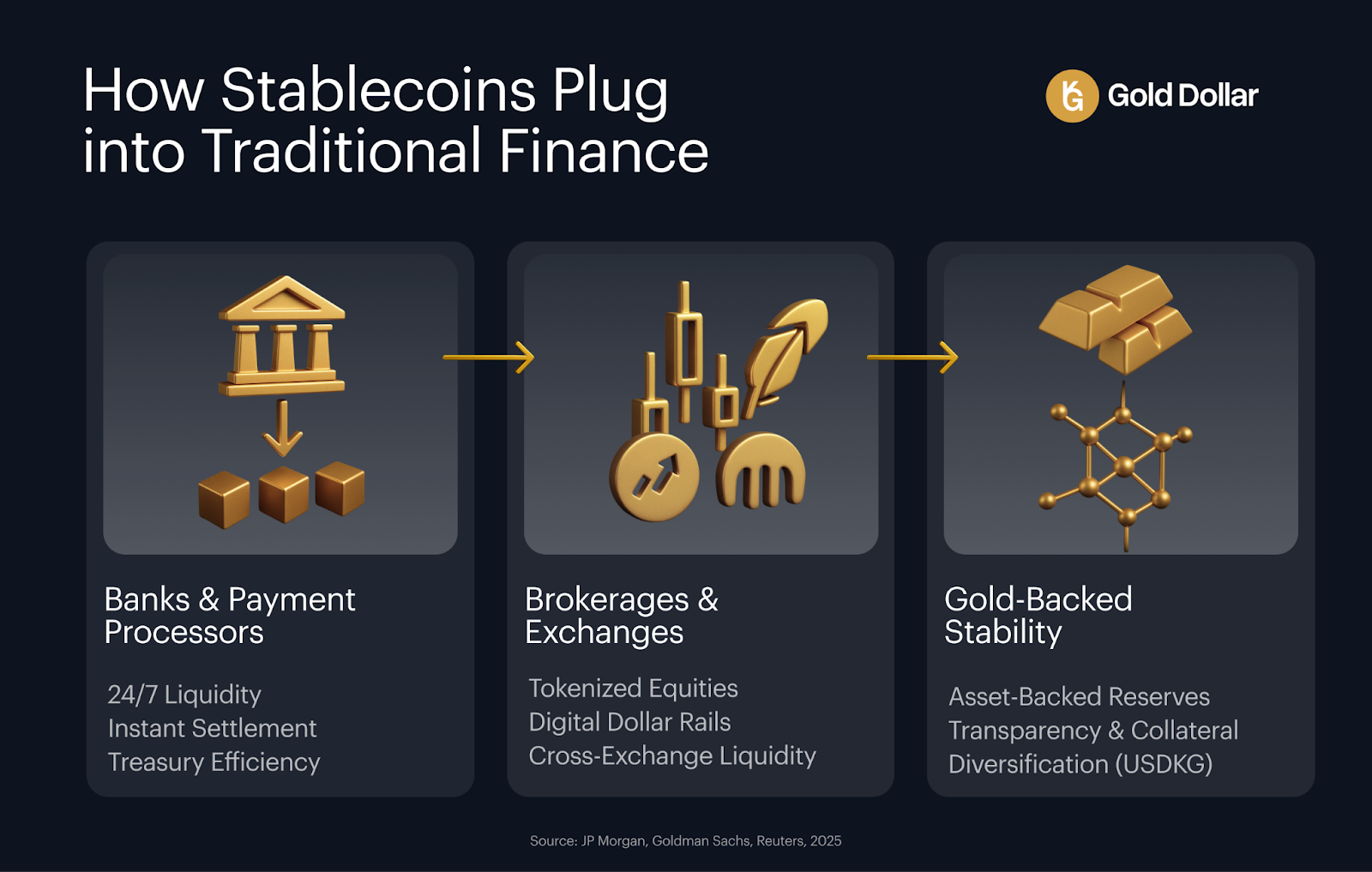
Stablecoins serve a function that legacy systems cannot match: 24/7 settlement. Unlike wire transfers or correspondent banking, stablecoins process instantly and globally, reducing transaction costs and funding delays for both institutions and individuals.
This efficiency has turned them into a core layer of payment stablecoins infrastructure—one that complements, rather than replaces, the traditional banking system.
Financial institutions now see payment stablecoins as the future of real-time settlement. They lower operational risk, optimize liquidity management, and create a store of value alternative to short-term deposits. As regulatory frameworks like the Markets in Crypto-Assets (MiCA) regulation advance, stablecoins are becoming regulated instruments of global finance, not just tools of the crypto economy.
From Crypto-Assets to Brokerage Platforms — Stablecoins Enter Traditional Finance
Recent integrations by Robinhood and Kraken have demonstrated how stablecoin issuers and brokers are aligning with regulatory clarity to reach mass adoption.
Kraken, one of the oldest cryptocurrency exchanges, has begun experimenting with fiat-backed stablecoins as collateral instruments for treasury management and cross-border payments. Robinhood, meanwhile, has opened direct stablecoin trading pairs to retail and institutional investors, further connecting stablecoins with traditional financial markets.
This marks a pivotal moment where crypto-assets and regulated financial institutions operate on the same digital rails. As more payment stablecoins are integrated into trading and digital wallets, the market is shifting toward frictionless digital currency interoperability—across both decentralized and centralized systems.
Types of Stablecoins: Lessons from TerraUSD and other Fiat-Backed Stablecoins
The diversity of types of stablecoins highlights why some thrive while others fail. Algorithmic stablecoins like TerraUSD promised independence from fiat but proved unsustainable without real collateral.
In contrast, fiat-backed stablecoins—such as USDC, USDT, and the PayPal Stablecoin—anchor their stability to regulated banking reserves and money market funds. This fiat-collateralized model allows issuers to comply with reserve requirements, support bank deposits, and ensure transparency under existing regulatory frameworks.
Newer gold-backed and commodity-backed stablecoins, including USDKG, extend this model by tying digital tokens to tangible reserves. They combine the programmability of blockchain with the credibility of real-world assets, creating a bridge between financial stability and decentralized innovation.
Why Traditional Banks Are Turning to Stablecoins
For years, traditional banks viewed stablecoins as competitors. Now, they see them as tools to modernize.
Banks can use stablecoins market liquidity to reduce settlement delays in wire transfers, manage working capital, and provide automated payments solutions that rival fintechs. Instead of losing customers to payment apps, they can issue or integrate bank stablecoins that operate under the same compliance requirements as existing fiat systems.
Stablecoins also create new opportunities for tokenized deposits, business-to-business payments, and treasury operations that run on blockchain rails. For commercial banks, this means direct participation in digital payments and new sources of fee income through payment processing and instant settlement.
The Reserve Question — Why Quality Defines Trust Among Stablecoin Issuers
Stablecoin resilience depends on what lies beneath. Poorly collateralized tokens like the stablecoin TerraUSD, which relied on circular algorithms, collapsed when confidence evaporated. In contrast, transparent fiat-backed stablecoins publish audited holdings—often short-term Treasury bills, bank deposits, and cash equivalents.
Stablecoins such as USDKG build on this principle by introducing gold-backed reserves that extend beyond banking solvency. By combining physical assets with blockchain-based proof-of-reserves, USDKG provides the liquidity positioning of digital money with the durability of gold.
This dual-collateral design provides confidence to both financial institutions and regulators, addressing long-standing concerns about operational risk and financial stability.
Gold-Backed Stablecoins: The Bridge Between Liquidity and Value
Among pegged stablecoins, gold-backed models represent a hybrid approach—linking the liquidity of dollar pegged stablecoins with the intrinsic strength of a commodity store of value.
Unlike algorithmic stablecoins, which rely on market incentives, backed stablecoins such as USDKG use audited reserves and over-collateralization to ensure 1:1 stability. This design makes them suitable for cross-border payments, treasury management, and financial markets seeking diversification away from purely fiat exposure.
For traditional banks and investors, gold-backed stablecoins provide a hedge against currency volatility while maintaining access to digital liquidity through compliant, transparent infrastructure.
Regulatory Alignment: How Compliance and Innovation Converge
Stablecoins thrive where regulation clarifies responsibility. Global frameworks such as MiCA, the GENIUS Act in the U.S., and growing discussions around central bank digital currencies define how stablecoin issuers can align with anti-money-laundering (AML), know-your-customer (KYC), and transaction monitoring standards.
This new legislative framework ensures that crypto-assets operate under similar oversight to financial institutions, reinforcing market confidence.
As a result, fiat-backed and gold-backed stablecoins are emerging as the preferred models for compliant adoption. They satisfy regulators’ demands for reserve transparency, risk management, and consumer protection, making them more attractive to institutional users seeking long-term stability in the stablecoins market.
The Institutional Bridge: Where USDKG Fits in the Stablecoin Market
The integration of stablecoins and traditional banks reflects a broader convergence between regulation and innovation.
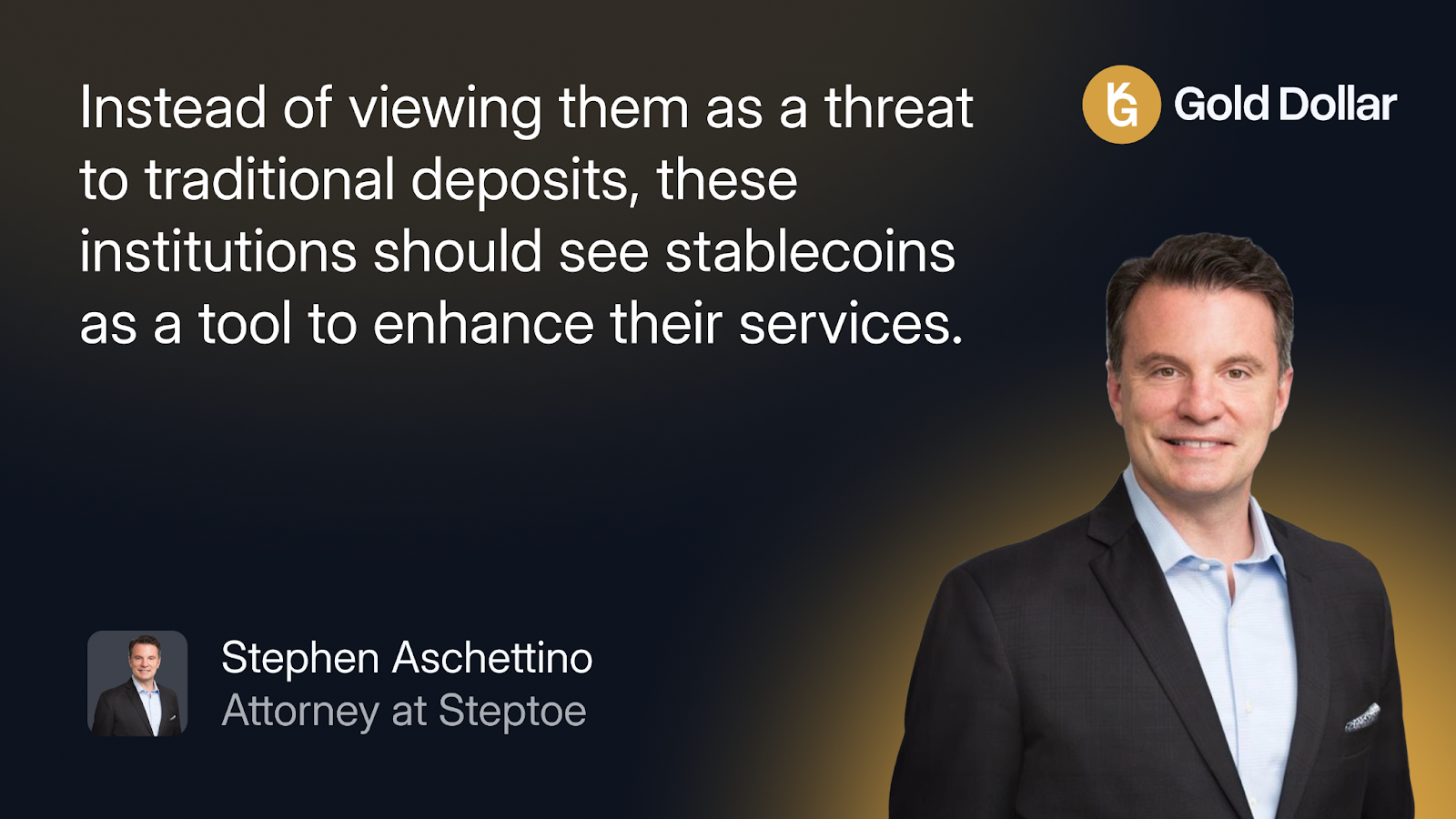
As Stephen Aschettino, a payments and digital assets attorney at Steptoe & Johnson LLP, has argued, financial institutions should view stablecoins not as threats but as tools. By offering faster, cheaper, and 24/7 payment rails, banks can attract new clients and solidify their roles in local economies.
This evolution also redefines the function of payment stablecoins: from speculative instruments to programmable liquidity tools within financial markets.
For USDKG, this shift validates its founding principle—trust through transparency. With independently audited gold reserves, adherence to Kyrgyzstan’s Law on Virtual Assets, and interoperability across DeFi and cross-border settlement systems, USDKG demonstrates how stability and compliance can coexist within one framework.
Conclusion: Stablecoins as the Payment Rails of Modern Finance
The next phase of digital money will not replace banks—it will enhance them. Stablecoins are becoming the payment rails of the global payments infrastructure, connecting blockchain technology with the banking system.
Projects like USDKG embody this transformation: a gold-backed stablecoin that merges traditional trust mechanisms with modern programmability.
As the stablecoin market matures, collaboration between stablecoin issuers, regulators, and traditional banks will define the future of money. The winners will be those who combine verifiable reserves, legal clarity, and real-world collateral to turn innovation into infrastructure.
Related Articles

August 11, 2026
Stablecoins Are Reshaping Financial Infrastructure
Financial infrastructure rarely changes through a single technological breakthrough. It evolves through the gradual adoption of systems that improve the movement, settlement, and management of capital while integrating into existing financial processes.

July 14, 2026
The Stablecoin Market Is Entering Its Regulatory Era
Stablecoins are entering a new phase of development where regulatory clarity is becoming as important as liquidity and network effects. Around the world, jurisdictions are reshaping digital finance, making governance, transparency, and legal certainty increasingly central to long-term adoption.

June 30, 2026
Beyond Backing: What Tether’s aUSDT Closure Reveals About Commodity-Backed Digital Assets
The closure of Tether's aUSDT highlights a broader shift within the commodity-backed digital asset market. As adoption matures, utility, transparency, liquidity, and integration into financial infrastructure are becoming just as important as the assets held in reserve.