.svg)
Stablecoins Are Reshaping Financial Infrastructure
August 11, 2026

Financial infrastructure rarely changes through a single technological breakthrough. It evolves through the gradual adoption of systems that improve the movement, settlement, and management of capital while integrating into existing financial processes. Throughout the history of modern finance, payment networks, securities settlement systems, correspondent banking, and treasury management platforms have all followed this pattern. Stablecoins increasingly appear to be following a similar trajectory. Initially developed as digital representations of fiat currency within cryptocurrency markets, they are now being evaluated by financial institutions, payment providers, corporate treasury teams, and infrastructure providers as potential components of broader financial architecture. This evolution reflects a wider structural shift in digital finance, where the discussion increasingly centres on operational efficiency, settlement capabilities, regulatory alignment, and institutional resilience rather than digital assets as an isolated asset class.
The Evolution from Trading Instrument to Financial Infrastructure
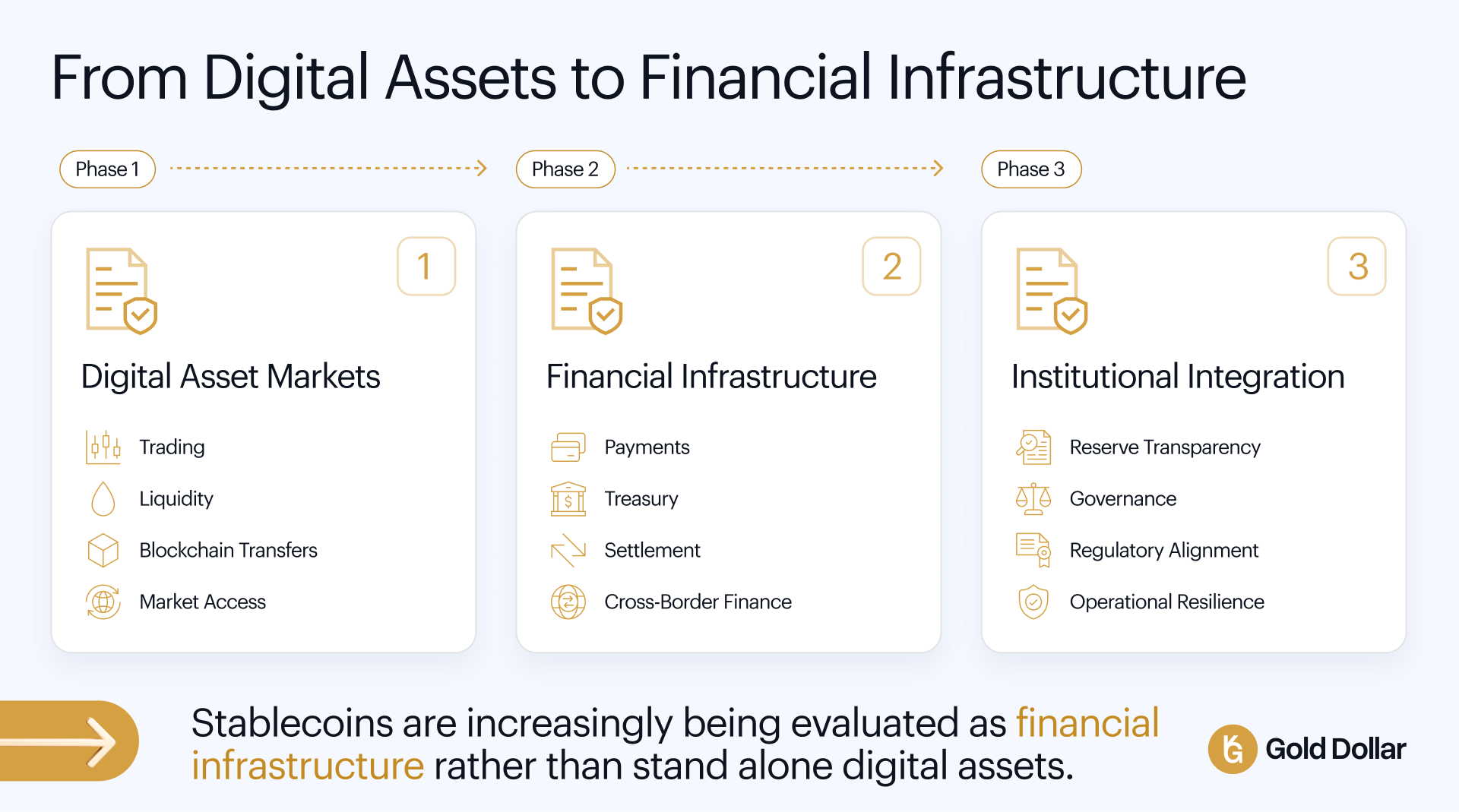
The earliest generation of stablecoins primarily addressed the operational needs of digital asset markets by providing price stability, continuous settlement, and efficient transfers between exchanges and blockchain networks. Their value proposition was largely defined by liquidity, blockchain interoperability, and transaction efficiency. As adoption expanded, however, the range of potential applications broadened considerably. Stablecoins are now being incorporated into payment infrastructure, treasury management, cross-border settlement, programmable finance, and liquidity operations that extend well beyond cryptocurrency trading. The significance of this transition lies not only in the expansion of use cases but also in the changing role of the stablecoin itself. Increasingly, the digital asset becomes one component within a larger operational framework, while the infrastructure it enables becomes the primary source of long-term value.
Infrastructure Investment Reflects a Broader Market Transition
Recent developments across global financial markets illustrate that this transition is being recognised by established financial institutions as well as digital asset companies. Mastercard's acquisition of BVNK represents a strategic investment in stablecoin payment infrastructure rather than a traditional cryptocurrency business. Similarly, Onafriq's expansion of stablecoin settlement rails for African banks and fintech companies demonstrates how blockchain-based settlement is being integrated into existing financial networks to improve cross-border payment efficiency. Circle continues to position stablecoins as infrastructure supporting internet-native financial services, while payment providers, custodians, banks, and enterprise software companies are expanding investments in digital settlement capabilities. Although these developments originate from different market participants and jurisdictions, they collectively indicate that competition is increasingly shifting towards infrastructure, integration, and enterprise adoption rather than token issuance alone.
Transaction Volumes Demonstrate Increasing Operational Relevance
Market activity further reinforces this structural transition. Stablecoin transfer volumes have expanded into the trillions of dollars annually, reflecting usage that increasingly includes commercial payments, liquidity management, treasury operations, and financial settlement alongside traditional cryptocurrency activity. While transaction volume alone should not be interpreted as a direct measure of institutional adoption, sustained growth at this scale demonstrates that stablecoins are supporting a progressively broader range of financial activities. Market participants are therefore evaluating stablecoins less as speculative instruments and more as operational infrastructure capable of facilitating efficient capital movement across jurisdictions and financial systems.
Institutional Adoption Introduces New Evaluation Criteria
As stablecoins become integrated into enterprise finance, the criteria applied by corporate treasury teams and financial institutions differ materially from those that characterised the first phase of market adoption. Operational resilience, governance, reserve transparency, regulatory clarity, redemption processes, legal certainty, and integration with existing financial infrastructure increasingly form part of institutional due diligence. These considerations closely resemble the evaluation frameworks historically applied to payment systems, cash management platforms, and other forms of financial infrastructure. Consequently, competitive differentiation is becoming increasingly dependent on characteristics that support long-term operational reliability rather than solely transaction efficiency or market liquidity.
Trust Becomes an Infrastructure Requirement
Financial infrastructure derives its value from consistency, predictability, and confidence among participants. Settlement systems are expected to operate reliably, reserve assets require transparent verification, governance structures must remain clearly defined, and operational processes need to be understandable for both counterparties and regulators. As stablecoins become integrated into enterprise payment systems and treasury operations, these characteristics evolve from desirable product features into operational requirements. Trust therefore becomes embedded within infrastructure design through transparent reserve management, independent verification, clearly defined issuance mechanisms, and robust governance frameworks capable of supporting institutional participation.
Different Financial Functions Require Different Stablecoin Models
The increasing diversity of enterprise applications also demonstrates that stablecoins should not be evaluated as interchangeable financial instruments. Payment networks, treasury operations, cross-border settlement, reserve diversification, decentralized finance, and institutional liquidity management each impose distinct operational requirements. Certain models prioritise transaction efficiency and broad network liquidity, while others emphasise reserve composition, regulatory certainty, or long-term preservation of value. The continued expansion of institutional adoption is therefore likely to reinforce a more specialised market in which different stablecoin structures address different financial objectives rather than competing within a single homogeneous category.
Stablecoins Are Being Designed for Institutional Financial Systems
These broader market developments are influencing the design principles adopted by new stablecoin projects. Increasing emphasis is being placed on independently verified reserve assets, transparent reporting, governance structures, regulatory alignment, and compatibility with institutional financial workflows alongside blockchain efficiency. USDKG reflects this broader direction through its combination of a dollar-denominated stablecoin structure, independently audited physical gold reserves, transparent reserve reporting, and an architecture intended to support treasury management, cross-border settlement, and institutional financial applications. These characteristics correspond with the broader evolution of the stablecoin market, in which infrastructure quality increasingly complements technological capability.
Conclusion
The stablecoin market is entering a period of structural maturation characterised by the progressive integration of digital assets into established financial infrastructure. The first phase of market development demonstrated the efficiency of blockchain-based settlement and established stablecoins as essential components of the digital asset ecosystem. The next phase is increasingly being shaped by enterprise adoption, institutional governance, regulatory clarity, and operational resilience. As financial institutions, payment providers, multinational corporations, and treasury organisations expand their engagement with digital settlement technologies, stablecoins are likely to be evaluated less as cryptocurrency products and more as financial infrastructure. Within that environment, long-term competitiveness will increasingly depend not only on liquidity or transaction volume, but also on transparency, governance, reserve quality, and the ability to integrate reliably into global financial systems.
Related Articles
August 11, 2026
Stablecoins Are Reshaping Financial Infrastructure
Financial infrastructure rarely changes through a single technological breakthrough. It evolves through the gradual adoption of systems that improve the movement, settlement, and management of capital while integrating into existing financial processes.

July 14, 2026
The Stablecoin Market Is Entering Its Regulatory Era
Stablecoins are entering a new phase of development where regulatory clarity is becoming as important as liquidity and network effects. Around the world, jurisdictions are reshaping digital finance, making governance, transparency, and legal certainty increasingly central to long-term adoption.

June 30, 2026
Beyond Backing: What Tether’s aUSDT Closure Reveals About Commodity-Backed Digital Assets
The closure of Tether's aUSDT highlights a broader shift within the commodity-backed digital asset market. As adoption matures, utility, transparency, liquidity, and integration into financial infrastructure are becoming just as important as the assets held in reserve.