.svg)
The Stablecoin Market Is Entering Its Regulatory Era
July 14, 2026

Stablecoins have evolved from a niche cryptocurrency application into one of the fastest-growing segments of digital finance. With hundreds of billions of dollars now circulating across blockchain networks, their role extends far beyond crypto trading. Today, stablecoins increasingly support cross-border payments, institutional treasury management, decentralized finance, tokenized assets, and global settlement infrastructure.
As the market has matured, regulatory frameworks have evolved alongside it.
Governments are no longer debating whether stablecoins belong within the financial system. Instead, they are defining the legal, operational, and supervisory standards under which they can participate. Across major financial centres and emerging digital asset jurisdictions alike, regulation is becoming a defining characteristic of the next phase of stablecoin adoption.
This shift has implications that extend well beyond compliance. Regulatory frameworks are increasingly influencing market access, institutional participation, product design, and competitive positioning. While liquidity and network effects remain important, regulatory certainty is becoming an equally significant determinant of long-term adoption.
From Regional Policy to Global Market Structure
Recent attention has largely focused on Europe's Markets in Crypto-Assets Regulation (MiCA), particularly following changes in the availability of certain stablecoins for European users and exchanges. These developments have been widely interpreted as a European regulatory story.
In reality, they represent part of a much broader global transition.
In the United States, the GENIUS Act establishes a comprehensive federal framework for payment stablecoins, defining reserve composition, disclosure requirements, licensing standards, and supervisory oversight. Hong Kong has introduced a dedicated licensing regime for fiat-referenced stablecoin issuers as part of its ambition to become a leading digital asset hub. Japan has established one of the world's first legal frameworks permitting regulated stablecoin issuance through licensed financial institutions, while Singapore continues refining its stablecoin framework under the Monetary Authority of Singapore.
Emerging jurisdictions are following a similar trajectory. Rather than adapting digital assets to legacy financial legislation, countries including Kyrgyzstan have introduced dedicated virtual asset frameworks designed to provide legal certainty for tokenized financial products.
Although these regulatory models differ in structure, they reflect a common direction. Stablecoins are increasingly being incorporated into regulated financial systems rather than operating alongside them.
The regulatory era of digital assets has begun.
Regulation Is Becoming a Competitive Advantage
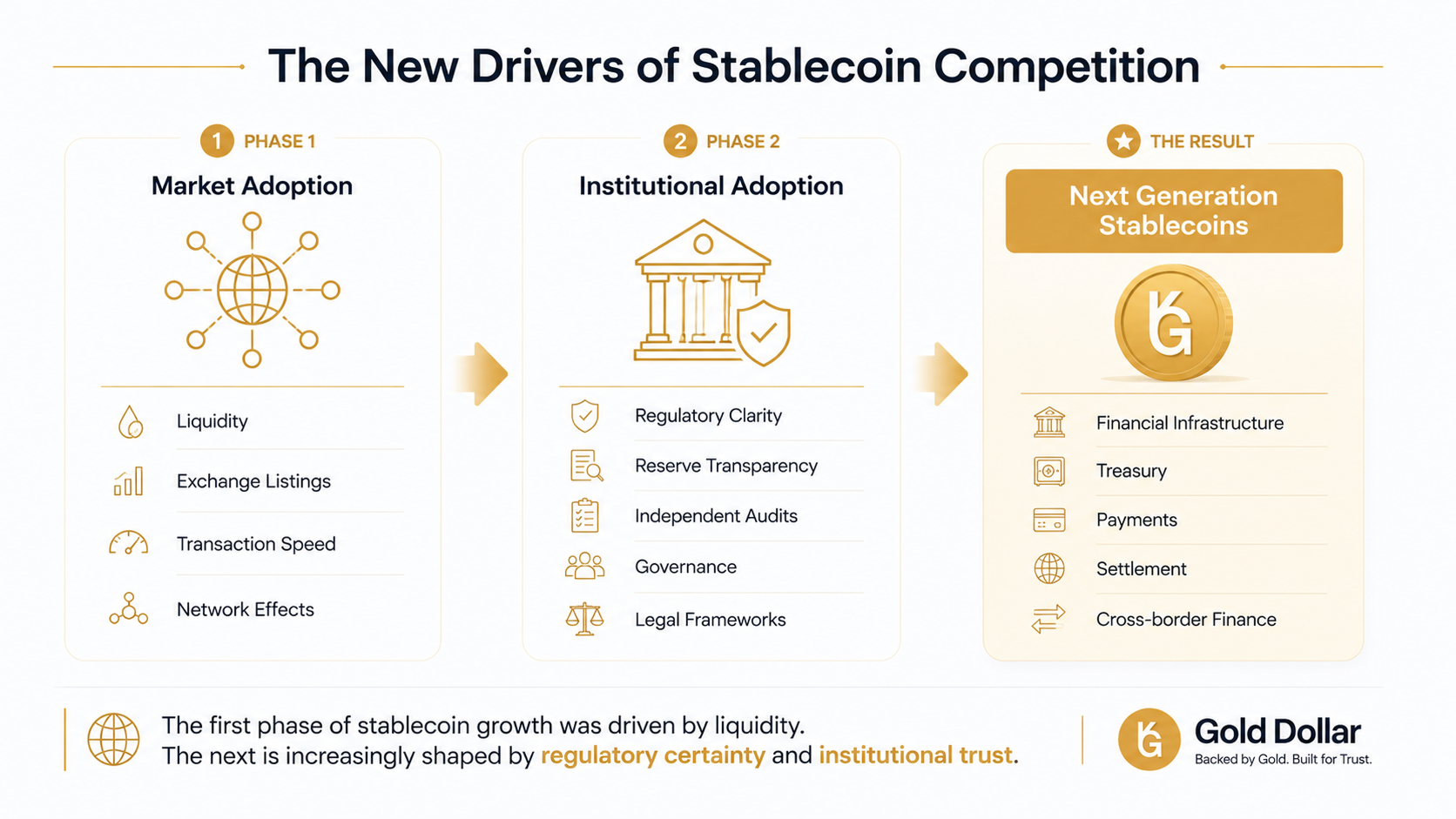
During the first phase of stablecoin adoption, competition was largely defined by liquidity, transaction efficiency, exchange coverage, and network effects. Market leadership depended primarily on accessibility and scale.
Those factors remain fundamental.
However, institutional participants now evaluate an additional set of characteristics before integrating digital assets into treasury operations, payment infrastructure, settlement networks, or investment portfolios.
Questions surrounding reserve management, governance, independent verification, issuer accountability, legal structure, and jurisdictional oversight have become integral to institutional due diligence.
This represents a meaningful evolution in how stablecoins compete.
Regulatory credibility is no longer simply a legal requirement. It is becoming part of the product itself.
Compliance Is Increasingly Embedded into Product Design
One of the clearest indicators of this transition is the way new stablecoins are being developed.
Rather than launching first and adapting to regulation later, many recent entrants have incorporated regulatory expectations into their design from inception.
Ripple introduced RLUSD with reserve attestations, institutional governance, and regulatory approvals forming central components of the product architecture. PayPal's PYUSD follows a similarly regulated issuance model. Banks, asset managers, and financial institutions exploring tokenized deposits and digital settlement assets are likewise building products around existing supervisory frameworks rather than outside them.
The implications extend beyond individual issuers.
Compliance is increasingly influencing reserve structures, custody models, disclosure standards, governance processes, and redemption mechanisms. In many cases, regulatory alignment is becoming inseparable from product architecture.
The distinction between financial regulation and product design is gradually disappearing.
Regulation Is Also Reshaping Market Access
The impact of regulation extends beyond issuers themselves.
Increasingly, it determines where stablecoins can be distributed, integrated, and utilised.
Recent developments surrounding the availability of certain stablecoins within Europe illustrate how regulatory frameworks can directly influence market access. Products that remain available in one jurisdiction may face restrictions or different supervisory requirements in another.
This represents a significant structural change.
For much of the digital asset industry's history, blockchain infrastructure operated largely independently of national borders. Stablecoins circulated globally with relatively limited jurisdiction-specific constraints.
As regulatory frameworks mature, legal interoperability is becoming as important as technical interoperability.
Future market reach may depend not only on blockchain compatibility or exchange liquidity, but also on an issuer's ability to satisfy multiple regulatory environments simultaneously.
Jurisdictions Are Becoming Strategic Competitors
The competitive landscape now extends beyond stablecoin issuers.
Jurisdictions themselves are increasingly competing to attract digital asset businesses, institutional capital, tokenization projects, and financial innovation.
Clear regulatory frameworks have become strategic economic assets.
Hong Kong positions itself as a gateway for regulated digital finance across Asia. Singapore continues refining its established supervisory approach. The United Arab Emirates has developed dedicated virtual asset authorities. The United States is moving toward a comprehensive federal stablecoin framework, while several emerging markets are using bespoke digital asset legislation to position themselves within the global financial ecosystem.
These approaches differ considerably in execution.
Their strategic objective, however, is remarkably similar.
Rather than resisting digital finance, governments are increasingly seeking to define the conditions under which it can develop responsibly within their jurisdictions.

Building for a Regulated Market
This evolution is also influencing how new stablecoin projects are positioned.
Transparency, governance, independently verified reserves, clearly defined issuance structures, and regulatory oversight are increasingly viewed as core components of financial infrastructure rather than optional enhancements.
USDKG reflects this broader market direction.
Issued under Kyrgyzstan's legal framework for virtual assets, supported by independently audited physical gold reserves, and developed with institutional transparency and compliance in mind, USDKG represents a model aligned with the structural direction of the market rather than a response to recent regulatory developments.
As institutional participation expands, these characteristics are likely to become increasingly relevant across the broader stablecoin ecosystem.
Conclusion
The stablecoin market is entering a new stage of development.
The first phase demonstrated the efficiency of blockchain-based value transfer and established stablecoins as essential components of the digital asset economy.
The next phase is likely to be defined by a different set of priorities.
Regulatory certainty, transparent governance, independently verifiable reserves, and the ability to operate across multiple legal frameworks are becoming increasingly important alongside liquidity, scalability, and technical performance.
In this environment, regulation is no longer simply a matter of compliance.
It is becoming a defining feature of financial infrastructure.
The first stablecoin race was shaped by liquidity and network effects.
The next may well be shaped by legitimacy.
Related Articles

August 11, 2026
Stablecoins Are Reshaping Financial Infrastructure
Financial infrastructure rarely changes through a single technological breakthrough. It evolves through the gradual adoption of systems that improve the movement, settlement, and management of capital while integrating into existing financial processes.
July 14, 2026
The Stablecoin Market Is Entering Its Regulatory Era
Stablecoins are entering a new phase of development where regulatory clarity is becoming as important as liquidity and network effects. Around the world, jurisdictions are reshaping digital finance, making governance, transparency, and legal certainty increasingly central to long-term adoption.

June 30, 2026
Beyond Backing: What Tether’s aUSDT Closure Reveals About Commodity-Backed Digital Assets
The closure of Tether's aUSDT highlights a broader shift within the commodity-backed digital asset market. As adoption matures, utility, transparency, liquidity, and integration into financial infrastructure are becoming just as important as the assets held in reserve.