.svg)
Why USDKG Can Become a Core DeFi Collateral
December 2, 2025

The structure of decentralized finance depends on the strength of its collateral. Lending markets, automated market makers, derivatives platforms, and liquidity protocols all rely on assets that behave predictably through different market conditions. As DeFi has grown, the sophistication of applications has increased far faster than the quality of the collateral that supports them. Many of the risks that shape the sector today do not originate from code, but from the assets that back its financial systems.
Volatility, correlation, and opaque reserves remain recurring points of failure. As institutional participants look more closely at decentralized finance, their focus shifts from innovation alone to the underlying assets that maintain stability in moments of stress. This is where USDKG introduces something different: a gold-backed stablecoin designed with transparent reserves, national regulatory oversight, and on-chain verification. Its aim is not only to function as a medium of exchange, but to meet the standards required of modern collateral in on-chain financial markets.
The Collateral Gap in DeFi
Much of DeFi’s risk is concentrated in the assets that underpin lending and liquidity flows. The majority of collateral in the ecosystem today falls into two categories. The first is volatile crypto assets such as ETH and BTC, which are highly sensitive to market cycles and can trigger rapid liquidations when prices move sharply. The second is fiat-backed stablecoins that appear stable on the surface but often depend on off-chain banking relationships or reserves that are not fully transparent.
These weaknesses create systemic fragility. When markets fall, correlated assets decline together, widening collateral haircuts and forcing liquidations that amplify price moves. Stablecoins backed by opaque or synthetic reserves add an additional layer of uncertainty. The collapse of TerraUSD demonstrated how quickly confidence can disappear when collateral mechanisms cannot be independently verified.
Earlier analyses have shown that the stability of a digital asset depends less on its label and more on its reserve structure, legal clarity, and auditability. For readers who want deeper context on this dynamic, our review of hidden stablecoin risks outlines why unverified reserves introduce significant systemic exposure.
DeFi’s next phase requires collateral that does not depend on market correlations, opaque financial institutions, or synthetic stabilizing mechanisms. It requires assets that can withstand volatility without introducing new forms of counterparty risk.
What Strong Collateral Looks Like
Across the DeFi landscape, protocols use remarkably similar criteria when determining what is acceptable collateral. Stability remains essential, because assets with high volatility magnify liquidation risk and create uncertainty for users and automated systems. Auditable reserves matter just as much, since lenders and liquidity providers must be able to assess whether an asset is genuinely backed by what it claims.
Correlation is another critical factor. If a collateral asset moves in tandem with the rest of the crypto market, it offers little protection during downturns. Legal status plays a major role for institutions, as they must navigate regulatory requirements based on where a token is issued and how its reserves are managed. Transparent on-chain reporting enables anyone, including automated risk engines, to verify circulation, redemptions, and reserve changes. Finally, global recognition strengthens credibility, particularly for collateral that seeks to attract regulated participants.
Traditional markets already apply these principles. Aave, for example, evaluates collateral through a risk lens that includes volatility measures, liquidity conditions, and reserve visibility.
https://docs.aave.com/risk
USDKG’s value proposition emerges more clearly when examined through these established criteria.
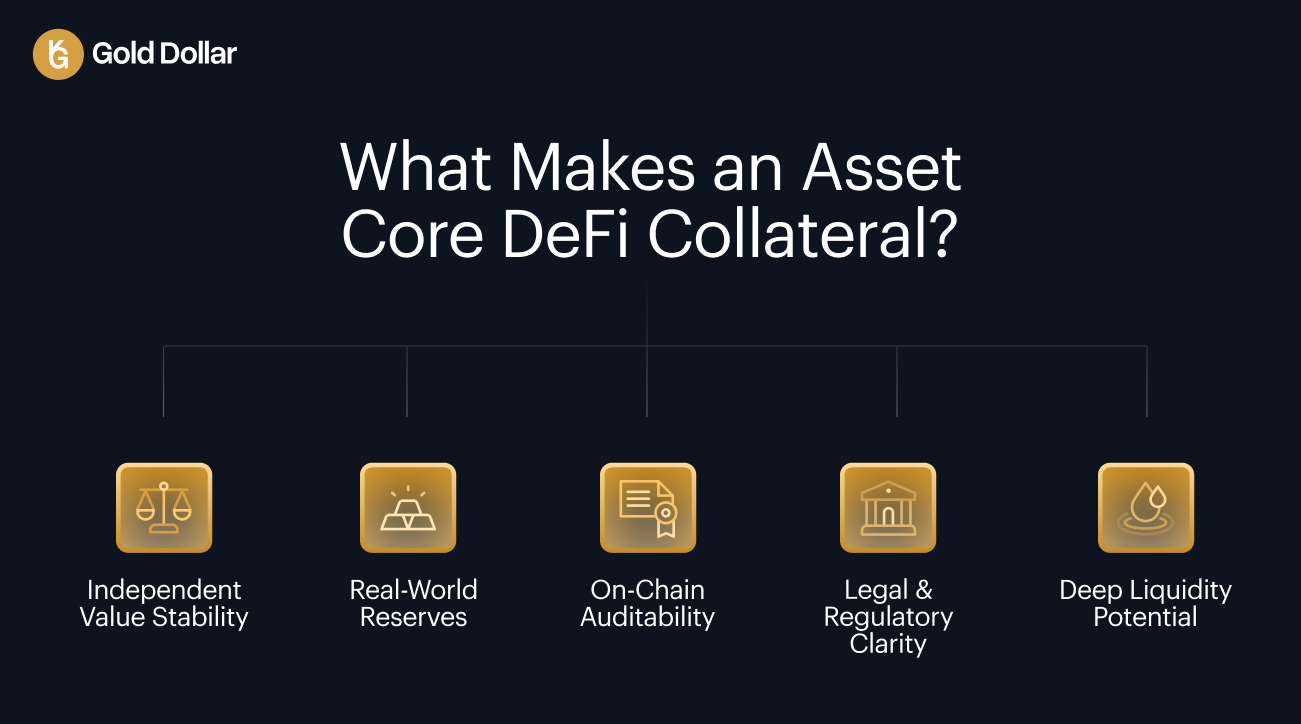
Why USDKG Meets Collateral Requirements
USDKG is backed entirely by physical gold reserves held with licensed custodians in Kyrgyzstan and verified through independent audits. This structure creates several characteristics relevant for DeFi protocols searching for higher-quality collateral.
Gold provides a stability anchor that is fundamentally different from assets tied to the crypto market. Its long-term purchasing power and low correlation with digital assets make it attractive during periods of stress. Research from the World Gold Council has shown that gold often maintains or strengthens its position when risk assets decline, which can help stabilize collateral values during liquidity shocks.
https://www.gold.org/research
USDKG is also built around verifiable reserve transparency. Its proof-of-reserve reporting links token issuance directly to audited gold reserves, allowing users, protocols, and regulators to review underlying data. A detailed overview of the audit framework can be found in our previous analysis of USDKG’s reserve model.
Regulatory clarity further strengthens the asset’s profile. USDKG is issued under Kyrgyzstan’s Law on Virtual Assets, creating a formal legal status for its reserves, custody, and operational processes. This foundation differs from offshore structures where jurisdiction and supervision may be uncertain. A broader explanation of how USDKG obtained its regulatory registration is available in our article on its legal framework.
Because USDKG is issued on Ethereum as an ERC-20 token, it can integrate cleanly with existing DeFi protocols without requiring specialized code or custom deployment. This makes it versatile across lending pools, liquidity markets, derivatives platforms, and structured financial products.
Gold-Backed Assets as Collateral
Gold has long been used in finance as a reserve asset, a stabilizer during crisis periods, and a hedge against currency volatility. Its role in traditional markets offers a useful parallel for DeFi. In repo markets, gold-backed instruments are considered among the most reliable forms of collateral because they carry low default risk and retain value independently of monetary cycles.
DeFi has historically relied on synthetic or fiat-only collateral models. Introducing gold-backed collateral expands the asset base with something fundamentally different. It brings a level of historical credibility and external value stability that on-chain assets alone cannot provide. This does not replace existing collateral categories but complements them by diversifying risk and providing new liquidity pathways.
How USDKG Strengthens DeFi Liquidity
Collateral influences every aspect of liquidity. When an asset maintains value consistently, protocols can operate more efficiently, and users gain confidence in the system’s resilience. The stability profile of USDKG offers several advantages for DeFi applications.
Because gold-backed assets move more slowly and predictably than crypto markets, they support more consistent liquidation processes. This reduces the likelihood of sudden liquidation cascades, especially during periods of volatility. The inherent stability of gold allows lending protocols to consider lower collateral buffers, which can improve capital efficiency for users.
USDKG also brings value during broader market downturns. When digital assets move sharply, stable collateral becomes a stabilizing force, helping protocols maintain solvency and smoothing out liquidity demands. This quality is essential for fixed-term lending strategies and longer-duration financial products that rely on predictable collateral behavior.
These characteristics support a healthier liquidity environment for both users and protocol operators.
Practical Applications for USDKG as DeFi Collateral
The usefulness of collateral becomes clearer when considering direct application in existing market structures.
In overcollateralized lending markets similar to Aave or Compound, USDKG can reduce reliance on volatile crypto assets that often dominate collateral pools. A stable base of collateral improves pool composition and reduces sensitivity to market cycles.
Stablecoin liquidity routes can also benefit from a gold-backed anchor. Pairing USDKG with other major stablecoins creates deeper and more predictable liquidity channels, especially for cross-asset swaps where stability and reserve quality are priorities.
Margin and derivatives platforms gain predictability when collateral behaves consistently and is supported by verifiable reserves. USDKG can serve as a margin asset for perpetuals and options, offering traders and protocols a more stable foundation during periods of market stress.
DAO treasuries have increasingly incorporated real-world assets as a hedge against crypto cycles. A gold-backed asset with audited reserves and clear legal status fits into this trend, helping decentralized organizations manage risk more effectively.
These examples reflect existing DeFi patterns rather than hypothetical future use cases, demonstrating that USDKG integrates naturally into today’s market design.
A Perspective from DeFi Leadership
Transparency standards in DeFi are increasingly shaped by leaders who recognize that collateral must be verifiable on-chain. As Sergey Nazarov, co-founder of Chainlink, explained during his SmartCon 2022 keynote, the next phase of the stablecoin market depends on building assets that can be validated independently by users and protocols.
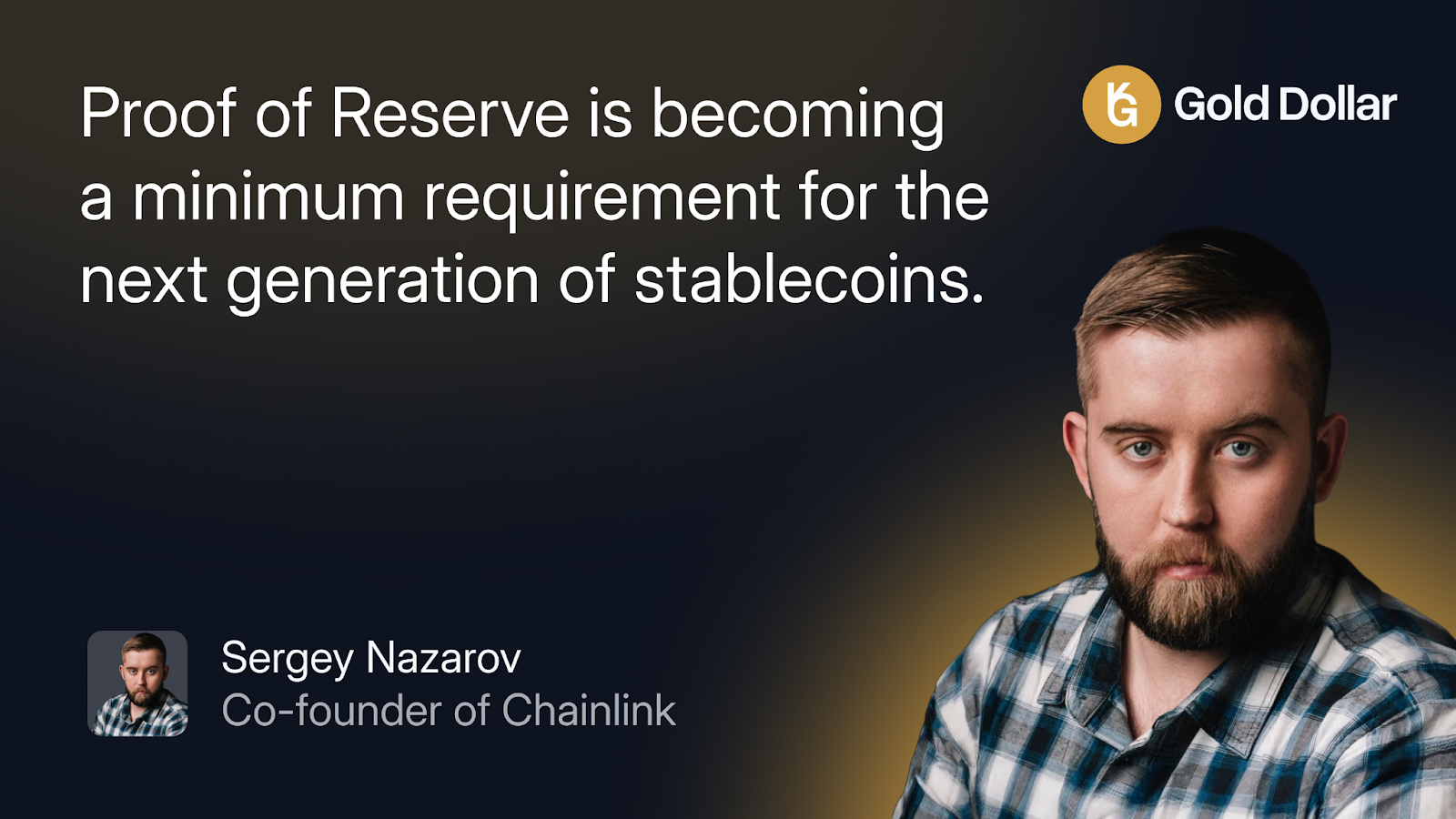
“Proof of Reserve is becoming a minimum requirement for the next generation of stablecoins.”
— Sergey Nazarov, Co-founder of Chainlink
Source: SmartCon 2022 Keynote
Nazarov’s point reflects a broader shift in how DeFi evaluates collateral quality. Assets that provide open verification, audited reserves, and publicly visible backing have a structural advantage as protocols move toward more robust risk management. USDKG aligns with this trend through its audited gold reserves, national oversight, and on-chain proof-of-reserve reporting, offering a collateral profile that can be evaluated without relying on trust alone.
Risks and Considerations
As with any emerging asset, USDKG faces practical considerations. Liquidity will continue to expand as integration partners grow, and custody arrangements will evolve over time to incorporate multiple jurisdictions and independent operators. Ethereum smart contract risk remains a factor, although code audits and public review help mitigate it. Adoption also depends on the willingness of DeFi protocols and governance communities to incorporate new forms of collateral.
By acknowledging these considerations, USDKG presents a realistic path toward integration rather than relying on assumptions or exaggerated expectations.
Conclusion
Decentralized finance advances only as far as its collateral allows. Assets that maintain value through volatility, publish verifiable reserve data, and meet regulatory standards offer a more resilient foundation for lending, liquidity, and derivatives markets. USDKG brings these characteristics together through audited gold reserves, national oversight, and transparent on-chain reporting.
Its stability profile makes it suitable for a wide range of DeFi applications, and its compatibility with Ethereum ensures accessibility across protocols. As the sector moves toward higher standards of reliability and risk management, USDKG’s design positions it as a strong candidate for core collateral in an increasingly interconnected financial ecosystem.
Related Articles

August 11, 2026
Stablecoins Are Reshaping Financial Infrastructure
Financial infrastructure rarely changes through a single technological breakthrough. It evolves through the gradual adoption of systems that improve the movement, settlement, and management of capital while integrating into existing financial processes.

July 14, 2026
The Stablecoin Market Is Entering Its Regulatory Era
Stablecoins are entering a new phase of development where regulatory clarity is becoming as important as liquidity and network effects. Around the world, jurisdictions are reshaping digital finance, making governance, transparency, and legal certainty increasingly central to long-term adoption.

June 30, 2026
Beyond Backing: What Tether’s aUSDT Closure Reveals About Commodity-Backed Digital Assets
The closure of Tether's aUSDT highlights a broader shift within the commodity-backed digital asset market. As adoption matures, utility, transparency, liquidity, and integration into financial infrastructure are becoming just as important as the assets held in reserve.