.svg)
DeFi Lending Explained: How It Works, Risks, and Institutional Use Cases
April 21, 2026

Decentralized finance has evolved from a niche segment of crypto markets into an emerging layer of financial infrastructure. Within this development, lending has become one of its most structurally important functions.
DeFi lending transforms digital assets into productive financial instruments. Instead of remaining idle, assets can be deployed into onchain liquidity markets, generating yield, enabling collateralized borrowing, and facilitating access to capital without reliance on traditional credit intermediation. As the market has matured, lending has become a core component of crypto’s capital structure. According to Coinbase Institutional, total value locked in DeFi lending reached approximately $55 billion at its peak in December 2024, reflecting its growing systemic relevance.
What DeFi Lending Is
DeFi lending refers to blockchain-based credit systems in which participants supply digital assets into smart contract–controlled liquidity pools, while borrowers access those funds by posting collateral.
This model is typically described as a non-custodial liquidity protocol. Suppliers contribute capital to shared pools, and borrowers draw liquidity against collateral positions that exceed the value of the loan. The system operates without centralized custody, with all transactions governed by predefined smart contract logic.
The significance of this structure lies in its ability to facilitate continuous credit markets. Lending activity operates on transparent rules, observable collateral, and automated execution. Instead of relying on bilateral underwriting or institutional credit assessment, most DeFi lending systems are based on overcollateralization, predefined risk parameters, and real-time liquidation mechanisms. As a result, credit exposure is visible onchain and governed by deterministic rules rather than discretionary decision-making.
How DeFi Lending Works
At a functional level, the mechanics of DeFi lending are relatively straightforward, although the underlying risk frameworks are increasingly complex.
Participants supply assets such as stablecoins or major cryptocurrencies into liquidity pools. These assets form a shared capital base from which borrowing activity occurs. In return, suppliers earn yield derived from borrower demand and protocol-specific interest rate models.
Borrowers deposit collateral and access liquidity within defined risk parameters. Interest rates are typically dynamic, adjusting based on utilization levels, available liquidity, and asset-specific configurations. As a result, lending markets reflect real-time supply and demand conditions rather than fixed lending terms.
This structure creates two parallel functions. On one side, it enables capital efficiency for borrowers by unlocking liquidity without requiring asset liquidation. On the other, it establishes yield-generating markets for asset holders. For this reason, lending has become closely integrated with trading, settlement, and treasury management within the broader digital asset ecosystem.
Why Overcollateralization Matters
Overcollateralization is a defining characteristic of most DeFi lending systems.
In practice, borrowers are required to deposit collateral that exceeds the value of the loan. This mechanism is not simply conservative design, but a structural requirement for maintaining solvency in volatile markets.
If collateral values decline and breach predefined thresholds, positions are automatically liquidated to protect the integrity of the lending pool. This process ensures that lenders remain protected even in adverse market conditions, while preserving system stability without reliance on discretionary intervention.
From an institutional perspective, this model introduces a different approach to credit risk. Exposure is directly linked to observable collateral and codified liquidation rules rather than opaque balance sheet assumptions. While this does not eliminate risk, it makes risk parameters more transparent and measurable in real time.
The Main Risks in DeFi Lending
The expansion of DeFi lending has made its risk profile increasingly visible. A credible institutional assessment requires acknowledging these risks as structural, not peripheral.
Smart contract risk remains a primary concern. DeFi protocols are software systems and therefore subject to vulnerabilities, coding errors, or exploits. Failures at this level can lead to loss of funds or unintended system behavior, regardless of the economic design.
Market and liquidation risk represents a second critical factor. In periods of high volatility, collateral values can decline rapidly. If liquidation mechanisms fail to operate efficiently, or if underlying markets lack sufficient liquidity, systemic stress can emerge within lending pools.
Oracle risk is another key dependency. Lending protocols rely on external price feeds to determine collateral valuations and liquidation thresholds. Inaccurate or manipulated data inputs can distort system behavior and introduce unintended exposures.
Ecosystem-level security risk continues to shape institutional perception. Historical incidents, including high-profile exploits and flash loan attacks, demonstrate that vulnerabilities are not limited to individual protocols but can affect broader market confidence.
These risk categories highlight that DeFi lending is not a risk-free alternative to traditional credit systems, but a structurally different one. Risk is embedded in code, market structure, and infrastructure dependencies rather than centralized intermediaries.
Why Institutions Are Paying Attention
Institutional engagement with DeFi lending has moved beyond exploratory phases.
Lending and borrowing are increasingly recognized as foundational components of digital asset market structure. Developments such as permissioned lending markets and tokenized collateral frameworks illustrate a gradual shift toward more institutionally compatible models.
One example is the emergence of lending environments designed for qualified participants, where stablecoins can be borrowed against tokenized securities or real-world assets. These models extend DeFi lending beyond crypto-native collateral and introduce more structured forms of onchain credit.
The relevance of this evolution lies in its implications for capital markets. DeFi lending is no longer defined solely by yield generation. It is increasingly positioned as infrastructure for continuous liquidity, collateral mobility, and programmable credit systems. In this context, lending becomes a foundational layer for how capital is deployed and managed in digital environments.

Where Stablecoins Fit
Stablecoins play a central role in DeFi lending by reducing volatility and improving capital efficiency.
Within lending markets, stablecoins frequently act as both the primary borrowing asset and the unit of account for credit activity. Their relative price stability allows for more predictable collateral management and reduces exposure to market fluctuations compared to volatile crypto assets.
This dynamic creates a structural preference for stable, transparent, and liquid forms of collateral. As lending markets mature, the quality and design of stablecoins become increasingly relevant to overall system stability.
USDKG is positioned within this context as a gold-backed stablecoin designed for both DeFi integration and institutional use cases. Its framework includes verifiable reserve backing, auditability, and controlled issuance mechanisms, aligning with the broader market shift toward higher-quality collateral.
The role of such assets is not defined by yield alone, but by their ability to support more structured and reliable onchain credit environments. As DeFi lending evolves, collateral composition is likely to become a primary differentiator across protocols and markets.
What DeFi Lending Looks Like in 2026
The relevance of DeFi lending is no longer defined by its existence, but by its trajectory toward institutional-grade infrastructure.
Three factors are likely to shape its development.
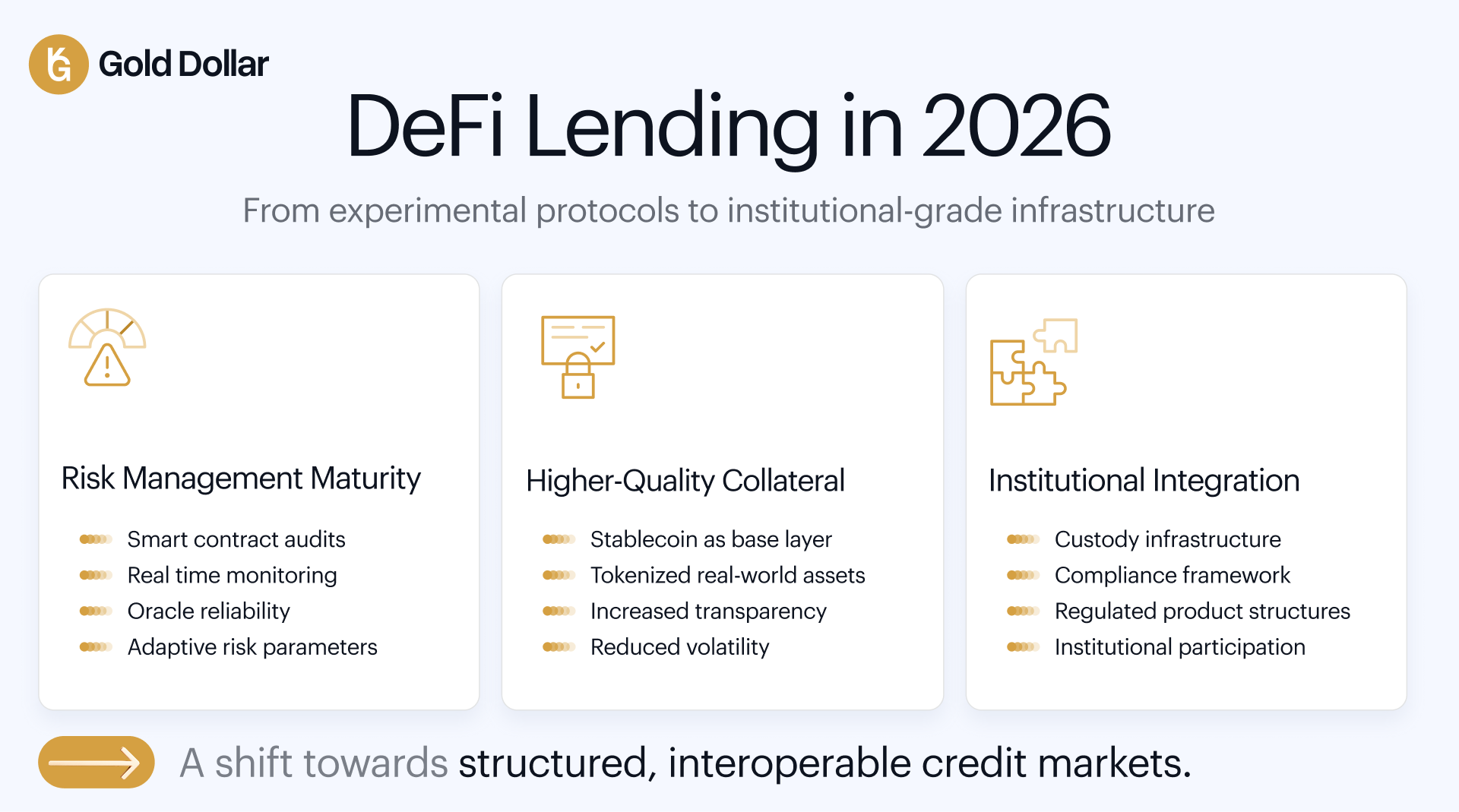
The first is risk management maturity, including improvements in smart contract auditing, real-time monitoring, oracle design, and adaptive parameter frameworks.
The second is collateral quality, with increasing emphasis on stablecoins and tokenized real-world assets that offer greater transparency and lower volatility.
The third is institutional integration, including custody solutions, compliance frameworks, and product structures tailored to regulated participants.
These developments indicate a transition from experimental financial systems toward more structured and interoperable credit markets.
Conclusion
DeFi lending can be understood as an emerging form of onchain credit infrastructure.
At a functional level, it enables the supply of assets, collateralized borrowing, and continuous liquidity provision through automated systems. At a structural level, it is becoming part of a broader shift toward programmable finance, where capital can be deployed and managed with greater transparency and efficiency.
Its significance is no longer limited to early-stage crypto participants. It increasingly relates to how financial systems may evolve to incorporate digital assets, tokenized collateral, and continuous market operation.
Within this framework, assets that offer transparency, verifiable backing, and institutional compatibility are likely to play a more prominent role. Gold-backed stablecoins such as USDKG represent one potential model for how traditional store-of-value assets can be integrated into next-generation credit systems.
Related Articles

August 11, 2026
Stablecoins Are Reshaping Financial Infrastructure
Financial infrastructure rarely changes through a single technological breakthrough. It evolves through the gradual adoption of systems that improve the movement, settlement, and management of capital while integrating into existing financial processes.

July 14, 2026
The Stablecoin Market Is Entering Its Regulatory Era
Stablecoins are entering a new phase of development where regulatory clarity is becoming as important as liquidity and network effects. Around the world, jurisdictions are reshaping digital finance, making governance, transparency, and legal certainty increasingly central to long-term adoption.

June 30, 2026
Beyond Backing: What Tether’s aUSDT Closure Reveals About Commodity-Backed Digital Assets
The closure of Tether's aUSDT highlights a broader shift within the commodity-backed digital asset market. As adoption matures, utility, transparency, liquidity, and integration into financial infrastructure are becoming just as important as the assets held in reserve.