.svg)
The Rise of Commodity-Backed Digital Assets in Global Finance
June 23, 2026
For much of modern financial history, commodities and financial infrastructure existed in separate worlds.
Gold was stored in vaults. Oil moved through global supply chains. Industrial metals were traded through commodity markets. Financial institutions interacted with these assets through futures contracts, ETFs, custodians, and banking networks.
Blockchain technology is beginning to change that relationship.
Today, commodities are increasingly being represented as digital assets that can move across blockchain networks with the same speed and accessibility as traditional cryptocurrencies. What started with tokenized gold has expanded into a broader movement toward commodity-backed digital assets and real-world asset tokenization.
As institutions explore new forms of settlement, collateral, and liquidity management, physical assets are becoming an increasingly important part of the digital finance conversation.
Why Commodities Are Moving On-Chain
The growth of digital assets created an entirely new financial ecosystem.
Stablecoins, decentralized finance protocols, digital exchanges, and tokenized assets introduced new ways to transfer and manage value. Yet much of this ecosystem initially relied on native digital assets with no direct connection to tangible reserves.
Over time, demand began shifting toward assets linked to the real economy.
Institutions, treasury teams, and market participants increasingly sought assets that combined blockchain efficiency with identifiable underlying collateral. This trend contributed to the rise of tokenized real-world assets, often referred to as RWAs.
Commodities became a natural fit.
They are globally recognized, highly liquid, and already serve as foundational assets within traditional financial systems. Bringing them on-chain allows these assets to participate directly in digital markets while maintaining their connection to physical value.
Gold Leads the Way
Among all commodities, gold has emerged as the most widely adopted tokenized asset category.
This is not surprising.
Gold already functions as a reserve asset for central banks, institutional investors, sovereign wealth funds, and private portfolios around the world. It has centuries of history as a store of value and remains one of the most universally recognized forms of collateral.
Tokenized gold products such as PAX Gold (PAXG) and Tether Gold (XAUT) demonstrated that physical bullion could be represented and transferred through blockchain infrastructure.
These products introduced a new level of accessibility while maintaining links to audited physical reserves.
More recently, gold-backed stablecoin structures have expanded the conversation beyond ownership and toward financial utility, including settlement, treasury operations, and cross-border transactions.
Beyond Gold: The Expansion of Commodity Tokenization
While gold remains the largest commodity-backed digital asset category, interest is expanding into other sectors.
Oil, natural gas, agricultural commodities, industrial metals, carbon credits, and energy-related assets are increasingly being explored through tokenization initiatives.
Several factors are driving this trend.
Tokenization can improve accessibility, increase transparency, reduce settlement friction, and create new forms of market participation. It also allows traditionally illiquid assets to interact more efficiently with digital financial infrastructure.
As blockchain networks mature, the number of commodities capable of participating in tokenized ecosystems is expected to grow.
The result is a broader convergence between physical markets and digital financial systems.
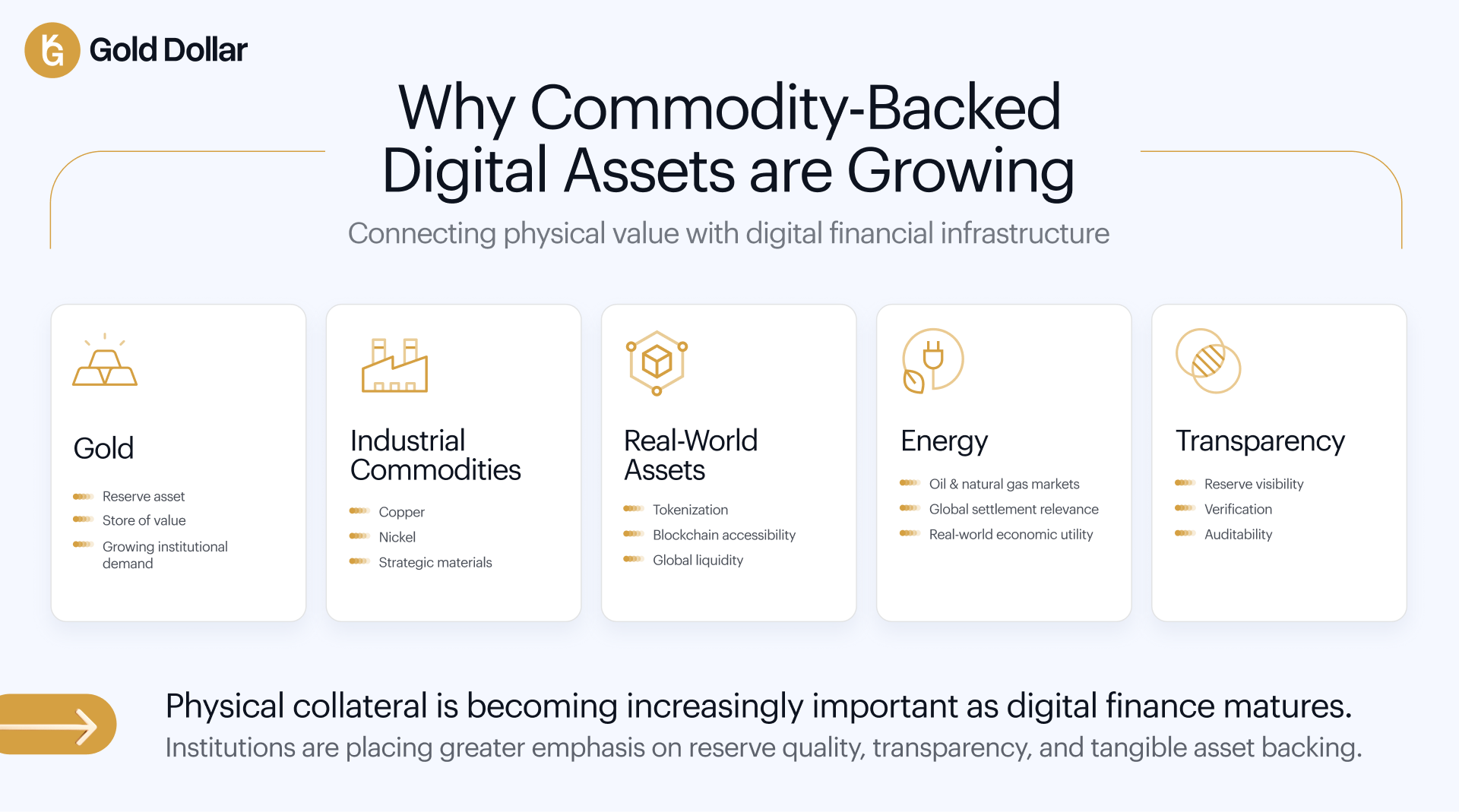
Why Physical Collateral Is Becoming More Relevant
One of the most significant developments in digital finance is the growing focus on collateral quality.
Early digital asset markets were largely driven by speculative growth and native crypto assets. Today's institutional participants often evaluate assets through a different lens.
Questions increasingly focus on reserve structure, transparency, verification, and underlying collateral.
This shift is visible across multiple sectors.
Money market funds continue attracting capital because of their reserve quality. Tokenized treasury products have become one of the fastest-growing RWA categories. Commodity-backed assets are gaining attention because they are linked to tangible resources with established market value.
Physical collateral introduces a level of visibility that many institutions already understand.
This does not eliminate risk, but it creates a framework that aligns more closely with traditional approaches to asset evaluation and risk management.
The Connection Between Commodities and Stablecoins
The rise of commodity-backed digital assets is closely linked to the evolution of stablecoins.
Stablecoins have become one of the most successful applications of blockchain technology because they solve a practical problem: efficient digital settlement.
As stablecoin adoption expands, market participants are increasingly evaluating what stands behind these assets.
Most major stablecoins rely on cash reserves, short-term government securities, or combinations of highly liquid financial instruments.
Commodity-backed models introduce an alternative reserve structure.
Rather than relying exclusively on financial assets, these models incorporate tangible collateral such as physical gold. This creates a different approach to reserve design while maintaining many of the operational advantages associated with digital settlement systems.
As institutions continue exploring stablecoins for payments, treasury operations, and cross-border transactions, reserve composition is becoming a more important part of the discussion.
Real-World Assets and the Future of Financial Infrastructure
Commodity tokenization forms part of a much larger movement toward real-world assets on-chain.
Governments, banks, asset managers, and technology companies are increasingly exploring how traditional assets can interact with blockchain infrastructure.
The opportunity extends beyond ownership.
Tokenized assets can potentially support settlement, collateralization, liquidity management, treasury operations, and broader financial workflows.
This is one reason why the RWA sector continues attracting significant attention from both traditional finance and digital asset markets.
As infrastructure improves, the distinction between traditional assets and digital assets may become increasingly blurred.
Where USDKG Fits
USDKG reflects many of the trends driving the growth of commodity-backed digital assets.
The stablecoin combines a U.S. dollar peg with physical gold reserves audited by Kreston Global, creating a structure designed to support transparency and long-term reserve integrity.
Unlike tokenized gold ownership products, USDKG is designed as a settlement-focused asset that can operate across payments, treasury management, trade finance, and blockchain-based financial environments.
This places it within a growing category of digital assets that combine physical collateral with operational utility.
As commodity-backed digital assets continue evolving, structures that integrate reserve transparency, blockchain accessibility, and real-world financial applications are likely to play an increasingly important role.
Conclusion
Commodity-backed digital assets are becoming an important part of the broader evolution of digital finance.
Gold, energy resources, industrial commodities, and other tangible assets are increasingly being represented through blockchain infrastructure, creating new connections between physical markets and digital financial systems.
As institutions place greater emphasis on collateral quality, transparency, and reserve integrity, physical assets are becoming more relevant within tokenized ecosystems.
The rise of commodity-backed digital assets reflects a simple idea: bringing trusted real-world value into modern financial infrastructure.
Related Articles
August 11, 2026
Stablecoins Are Reshaping Financial Infrastructure
Financial infrastructure rarely changes through a single technological breakthrough. It evolves through the gradual adoption of systems that improve the movement, settlement, and management of capital while integrating into existing financial processes.

June 30, 2026
Beyond Backing: What Tether’s aUSDT Closure Reveals About Commodity-Backed Digital Assets
The closure of Tether's aUSDT highlights a broader shift within the commodity-backed digital asset market. As adoption matures, utility, transparency, liquidity, and integration into financial infrastructure are becoming just as important as the assets held in reserve.
June 23, 2026
The Rise of Commodity-Backed Digital Assets in Global Finance
Commodity-backed digital assets are bringing tangible value into blockchain-based financial systems. As institutions place greater emphasis on collateral quality, transparency, and reserve integrity, assets such as gold, energy resources, and other commodities are becoming increasingly relevant within digital finance.