.svg)
From Gold Ownership to Gold-Backed Settlement: The Next Evolution of Tokenized Gold
June 9, 2026
Gold has historically served as a reserve asset, a store of value, and a foundation of trust within financial systems. For centuries, its role was primarily passive: held in vaults, central bank reserves, investment portfolios, and long-term wealth preservation strategies.
Blockchain infrastructure is beginning to change how gold can function within global finance.
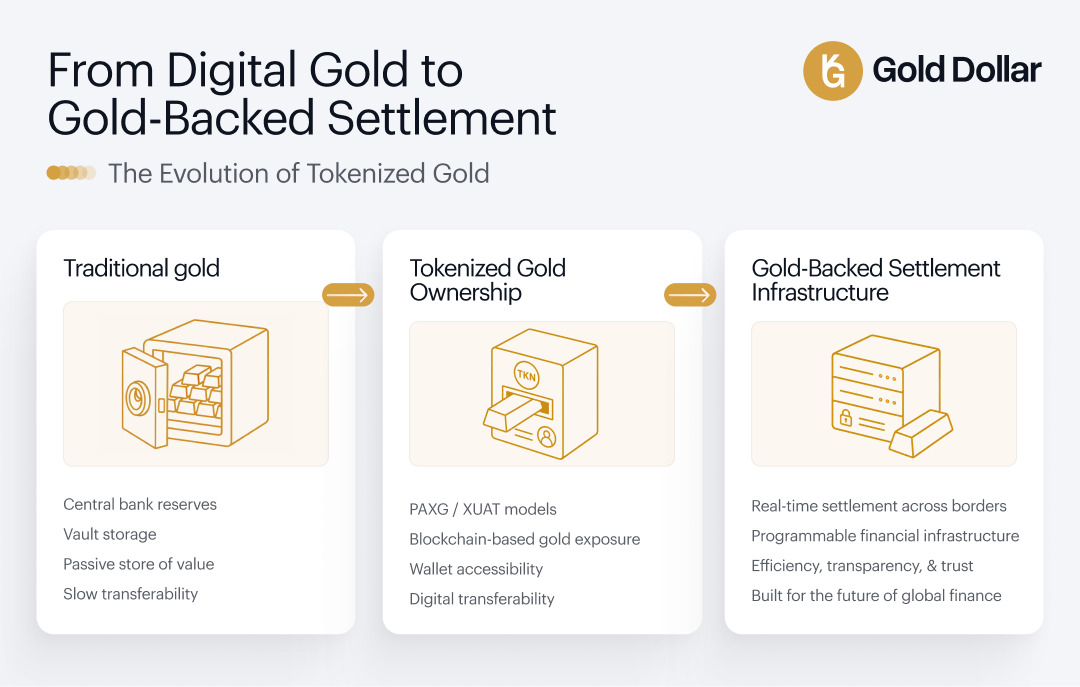
The first generation of tokenized gold products focused mainly on digital ownership. Assets such as PAX Gold (PAXG) and Tether Gold (XAUT) introduced blockchain-based access to physical gold reserves, allowing investors to hold and transfer tokenized exposure more efficiently than traditional gold instruments.
A second phase is now emerging.
Gold-backed digital assets are increasingly being explored not only as investment products, but also as components of financial infrastructure. The conversation is expanding toward settlement, treasury operations, cross-border transactions, and blockchain-based liquidity systems.
This transition reflects a broader evolution within digital finance, where tokenized real-world assets are moving beyond representation and into operational utility.
The First Phase of Tokenized Gold
The earliest tokenized gold models focused on improving access to physical gold ownership.
PAXG, issued by Paxos, structured its product around allocated LBMA gold reserves held in London vaults. Tether Gold introduced a similar model through gold reserves stored in Switzerland. Both products enabled blockchain-based transferability while maintaining links to physical bullion.
These models solved several practical limitations associated with traditional gold exposure.
Tokenized ownership reduced friction around custody, divisibility, transfer speed, and accessibility. Investors could gain exposure to physical gold while using blockchain wallets, exchanges, and digital asset infrastructure.
This represented an important milestone for real-world assets on-chain.
However, most early tokenized gold products remained positioned primarily as investment exposure instruments rather than active financial infrastructure.
The Shift Toward Financial Utility
The next phase of tokenized gold is increasingly focused on utility.
As stablecoin adoption expands globally, digital assets are being evaluated not only by market capitalization or liquidity, but also by reserve quality, operational usability, and settlement efficiency.
This creates a new role for gold-backed digital assets.
Rather than functioning solely as representations of physical ownership, gold-backed structures are beginning to support payment flows, treasury management, collateralization, and cross-border settlement systems.
This transition becomes particularly relevant in environments where institutions, exporters, treasury desks, and payment providers are seeking alternatives that combine blockchain efficiency with tangible reserve backing.
The market is gradually moving from tokenized gold as a passive store of value toward gold-backed digital infrastructure capable of participating in financial operations.
Why Settlement Infrastructure Matters
Traditional cross-border settlement systems often involve multiple intermediaries, banking hours, jurisdictional fragmentation, and delayed execution times.
Blockchain-based settlement infrastructure introduces a different operational model.
Transactions can settle continuously across jurisdictions while remaining interoperable with digital wallets, exchanges, and decentralized financial systems. Stablecoins have become one of the clearest examples of this infrastructure shift.
Most existing settlement-focused stablecoins rely primarily on fiat reserves and short-term government securities. Gold-backed structures introduce a different reserve model into this environment.
This distinction matters because reserve composition increasingly influences how market participants evaluate stability, transparency, and long-term trust.
Gold remains globally recognized as a reserve asset across both emerging and developed economies. Integrating gold-backed collateral into digital settlement infrastructure introduces an additional layer of tangible reserve backing into blockchain-based financial systems.
From Tokenized Ownership to Gold-Backed Stablecoins
This evolution can already be observed through different product structures emerging across the market.
PAXG and XAUT focus primarily on direct tokenized gold exposure. USDKG introduces a different framework by combining a dollar peg with audited physical gold reserves supporting the stablecoin structure.
The distinction is important.
In ownership-focused models, the token itself represents allocated gold holdings. In settlement-focused models, gold reserves support a stable unit designed for operational financial use cases such as payments, treasury movement, trade settlement, and liquidity management.
This allows gold-backed collateral to support transactional infrastructure rather than remaining limited to passive exposure.
As blockchain-based financial systems mature, these structural differences are becoming increasingly relevant.
Treasury and Trade Finance Applications
Corporate treasury and trade finance environments are beginning to explore blockchain infrastructure more actively.
Global businesses increasingly operate across multiple currencies, banking systems, and settlement networks. Delays, liquidity fragmentation, and FX exposure continue to create operational inefficiencies across international transactions.
Stablecoins are attracting attention because they can move value continuously across borders while integrating into programmable financial systems.
Gold-backed settlement assets introduce an additional dimension to this discussion by combining blockchain efficiency with reserve structures tied to tangible assets.
For treasury operations, this can support diversification considerations, collateral transparency, and cross-border liquidity movement. In trade finance environments, programmable settlement infrastructure can improve transaction efficiency while maintaining clearer reserve visibility.
These developments remain early-stage, but they illustrate how tokenized gold is evolving into broader financial infrastructure.
The Role of Transparency and Reserve Design
As digital assets move deeper into institutional environments, reserve structure becomes increasingly important.
The stablecoin market is gradually shifting toward greater emphasis on auditability, reserve verification, collateral quality, and operational governance.
This trend is particularly relevant for gold-backed structures because their credibility depends directly on the transparency of underlying reserves.
Independent audits, custody frameworks, reserve reporting, and redemption clarity are becoming essential components of institutional trust.
Projects operating in this category are therefore increasingly evaluated not only by adoption metrics, but also by how effectively they communicate reserve integrity and operational controls.
This reflects a broader maturation of digital financial infrastructure.
Gold and the Evolution of Real-World Assets
The expansion of gold-backed settlement systems is part of a larger movement toward tokenized real-world assets.
Governments, financial institutions, and blockchain platforms are increasingly exploring how tangible assets can integrate into programmable financial infrastructure.
Gold occupies a unique position within this transition because it already functions as a globally recognized reserve asset with deep historical trust across financial systems.
Blockchain infrastructure allows this trust layer to become more mobile, interoperable, and operationally flexible.
This creates the foundation for financial systems where tokenized assets are not only held, but actively used across payments, liquidity networks, collateral systems, and treasury operations.
What the Market Is Moving Toward
The tokenized gold market is no longer defined solely by digital ownership.
The broader direction increasingly points toward infrastructure-level integration where gold-backed assets can participate in settlement systems, decentralized finance environments, treasury operations, and cross-border financial activity.
This does not replace traditional gold ownership models. Instead, it expands how gold can function within digital financial ecosystems.
As institutions continue exploring blockchain infrastructure, reserve composition and operational utility are likely to become increasingly interconnected.
The next evolution of tokenized gold may therefore be less about holding gold digitally and more about integrating gold-backed value directly into the infrastructure of global finance.
Conclusion
Tokenized gold is evolving from a digital representation of ownership into a broader category of financial infrastructure.
The first phase focused on accessibility and transferability of physical gold exposure. The next phase increasingly focuses on how gold-backed assets can support settlement, treasury management, trade finance, and blockchain-based liquidity systems.
As digital finance matures, the distinction between investment assets and operational financial infrastructure continues to narrow.
Gold-backed digital assets are beginning to reflect this transition by combining blockchain efficiency with tangible reserve backing, creating new possibilities for how value moves across global financial systems.
Related Articles
August 11, 2026
Stablecoins Are Reshaping Financial Infrastructure
Financial infrastructure rarely changes through a single technological breakthrough. It evolves through the gradual adoption of systems that improve the movement, settlement, and management of capital while integrating into existing financial processes.

June 30, 2026
Beyond Backing: What Tether’s aUSDT Closure Reveals About Commodity-Backed Digital Assets
The closure of Tether's aUSDT highlights a broader shift within the commodity-backed digital asset market. As adoption matures, utility, transparency, liquidity, and integration into financial infrastructure are becoming just as important as the assets held in reserve.
June 23, 2026
The Rise of Commodity-Backed Digital Assets in Global Finance
Commodity-backed digital assets are bringing tangible value into blockchain-based financial systems. As institutions place greater emphasis on collateral quality, transparency, and reserve integrity, assets such as gold, energy resources, and other commodities are becoming increasingly relevant within digital finance.