.svg)
Gold-Backed Stablecoins Compared: What PAXG, XAUT, and USDKG Reveal About Digital Gold
June 2, 2026
Gold-backed stablecoins represent one of the clearest examples of how traditional assets are being integrated into blockchain infrastructure.
While fiat-backed stablecoins dominate trading volumes and payment activity, gold-backed models have developed a different role within digital asset markets. Their relevance is tied less to transactional scale and more to reserve structure, long-term stability, and the growing interest in tokenized real-world assets.
Projects such as PAX Gold (PAXG), Tether Gold (XAUT), and USDKG illustrate three distinct approaches to bringing gold onto blockchain networks. Together, they also reveal how the market for digital gold is evolving beyond simple tokenization toward broader financial infrastructure use cases.
Why Gold Is Moving On-Chain
Gold has historically served as a reserve asset, inflation hedge, and store of value across financial systems. Blockchain infrastructure introduces a new layer of accessibility and transferability to this market.
Tokenized gold allows ownership or exposure to physical reserves through digital assets that can move globally, settle continuously, and integrate into wallets, exchanges, and decentralized finance environments.
This changes how gold can be accessed and used. Rather than existing only within vault systems or traditional financial products, gold-backed assets can now participate in programmable financial infrastructure.
The result is a growing category of digital assets that combine blockchain-based mobility with tangible reserve backing.
PAXG: Regulated Gold Ownership Infrastructure
PAX Gold (PAXG), issued by Paxos, is structured around direct ownership of allocated physical gold.
Each PAXG token represents one fine troy ounce of gold held in LBMA-accredited vaults in London. Token holders can verify serial numbers and corresponding bars through Paxos’ reserve lookup system.
A defining characteristic of PAXG is its regulatory positioning. Paxos operates under oversight from the New York Department of Financial Services (NYDFS), which has made regulatory structure and reserve transparency central components of its market positioning.
The product primarily functions as a digital form of gold exposure for investors seeking blockchain-based access to physical reserves.
XAUT: Tether’s Global Gold Exposure Model
Tether Gold (XAUT), issued by Tether Gold, follows a similar model in which tokens are backed by physical gold reserves.
Each XAUT token represents ownership of one troy ounce of gold stored in Swiss vaults. Tether positions the product as a way to combine gold ownership with the portability and divisibility of blockchain infrastructure.
Unlike PAXG, which emphasizes regulated issuance under U.S. oversight, XAUT is more closely aligned with Tether’s broader international digital asset ecosystem. This gives it strong visibility within crypto-native markets and existing exchange infrastructure.
The project demonstrates how gold-backed assets can leverage broader liquidity networks and established digital asset distribution channels.
USDKG: Gold-Backed Digital Settlement Infrastructure
USDKG introduces a different structure within the gold-backed stablecoin category.
Rather than functioning primarily as tokenized gold ownership, USDKG is designed as a USD-denominated stablecoin backed by physical gold reserves audited by Kreston Global. The model combines a dollar peg with underlying gold collateral, positioning the asset for settlement, treasury, trade finance, and broader digital financial infrastructure use cases.
USDKG is issued by OJSC Virtual Asset Issuer, a state-owned entity operating under Kyrgyzstan’s Ministry of Finance. Smart contract infrastructure has been audited by ConsenSys Diligence, and the project operates within a FATF-aligned compliance framework.
This creates a structure where gold reserves function as collateral supporting a stable settlement asset rather than direct tokenized ownership of gold itself.
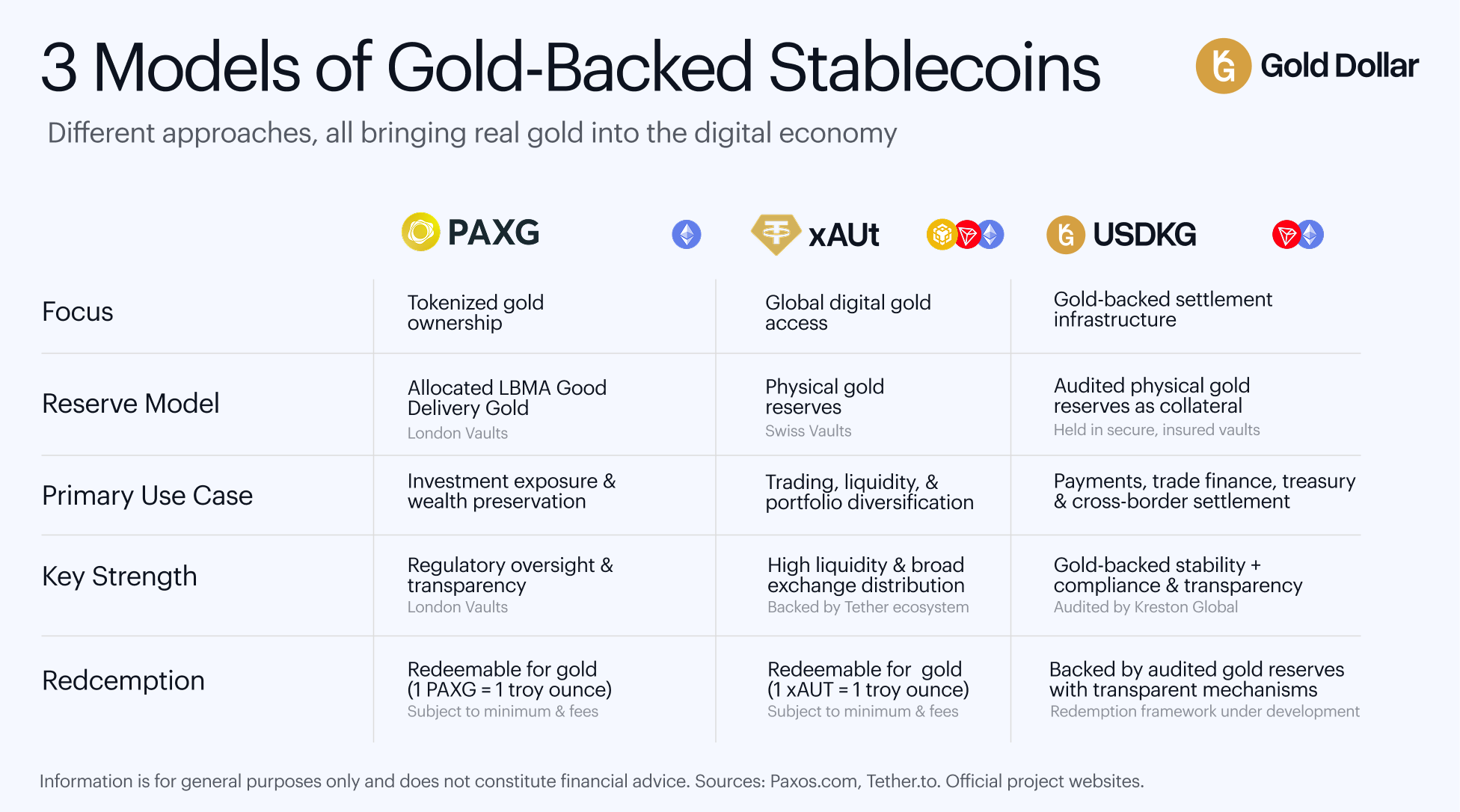
Three Different Models of Digital Gold
Although all three projects involve physical gold reserves, their market positioning reflects different financial objectives.
PAXG focuses on regulated digital ownership of allocated gold reserves. XAUT emphasizes globally accessible gold exposure integrated into crypto-native liquidity environments. USDKG focuses on combining gold-backed collateral with stablecoin infrastructure designed for settlement and operational financial use cases.
These distinctions matter because they reflect how tokenized gold is expanding beyond a single category.
The market is no longer limited to digital gold as an investment instrument. Gold-backed assets are increasingly being explored within trading infrastructure, treasury management, decentralized finance, and cross-border financial operations.
Reserve Structure and Transparency
Reserve design remains one of the defining factors in this segment.
PAXG emphasizes direct ownership claims tied to specific gold bars. XAUT provides allocated gold ownership with reserve verification through Tether’s infrastructure. USDKG uses audited physical gold reserves as collateral supporting a dollar-pegged stablecoin model.
All three approaches prioritize physical reserve backing, but they differ in how those reserves relate to the token itself.
This distinction influences how each asset is used, how redemption functions operate, and how market participants assess stability and transparency.
As institutional interest in tokenized assets continues to grow, reserve clarity and auditability are becoming increasingly important across the stablecoin sector.
The Expanding Role of Gold-Backed Assets
The growth of tokenized gold reflects broader developments across digital finance.
Investors, institutions, and financial platforms are increasingly exploring assets backed by tangible collateral rather than purely synthetic or uncollateralized models. At the same time, blockchain infrastructure is making traditionally static assets more accessible and interoperable.
This creates opportunities for gold-backed assets to evolve beyond passive exposure products into components of broader financial infrastructure.
In this environment, the distinction between tokenized commodities, stablecoins, and settlement assets becomes increasingly interconnected.
What This Means for Stablecoins
The emergence of different gold-backed models highlights a broader evolution within stablecoins themselves.
The market is increasingly evaluating not only liquidity and distribution, but also collateral quality, reserve transparency, redemption structure, and regulatory positioning.
Gold-backed assets provide a useful lens into this transition because they connect blockchain infrastructure directly to tangible reserves with globally recognized value.
As digital financial systems continue to mature, the role of collateral design is likely to become more important across both institutional and decentralized markets.
Conclusion
PAXG, XAUT, and USDKG each represent different approaches to integrating gold into blockchain-based financial infrastructure.
Together, they demonstrate that tokenized gold is no longer limited to a single use case or market segment. Instead, gold-backed digital assets are evolving into a broader category that includes investment exposure, liquidity infrastructure, and stable settlement mechanisms.
As the stablecoin market continues to develop, reserve structure, transparency, and real-world utility are becoming increasingly central to how digital assets are evaluated and adopted.
Related Articles

August 11, 2026
Stablecoins Are Reshaping Financial Infrastructure
Financial infrastructure rarely changes through a single technological breakthrough. It evolves through the gradual adoption of systems that improve the movement, settlement, and management of capital while integrating into existing financial processes.
July 14, 2026
The Stablecoin Market Is Entering Its Regulatory Era
Stablecoins are entering a new phase of development where regulatory clarity is becoming as important as liquidity and network effects. Around the world, jurisdictions are reshaping digital finance, making governance, transparency, and legal certainty increasingly central to long-term adoption.

June 30, 2026
Beyond Backing: What Tether’s aUSDT Closure Reveals About Commodity-Backed Digital Assets
The closure of Tether's aUSDT highlights a broader shift within the commodity-backed digital asset market. As adoption matures, utility, transparency, liquidity, and integration into financial infrastructure are becoming just as important as the assets held in reserve.