.svg)
Why Gold Is Returning to the Center of Global Finance in 2026
March 17, 2026

Gold is experiencing a renewed phase of strategic importance across the global financial system. Central banks are increasing reserve holdings, institutional investors are expanding commodity allocations, and digital asset markets are integrating gold into programmable financial infrastructure.
This convergence of traditional reserves and digital finance is reshaping how gold functions within global markets. What was once primarily a long-term store of value is increasingly becoming a component of modern financial infrastructure, particularly as blockchain networks introduce new mechanisms for transferring and verifying asset ownership.
Central Banks Are Expanding Gold Reserves
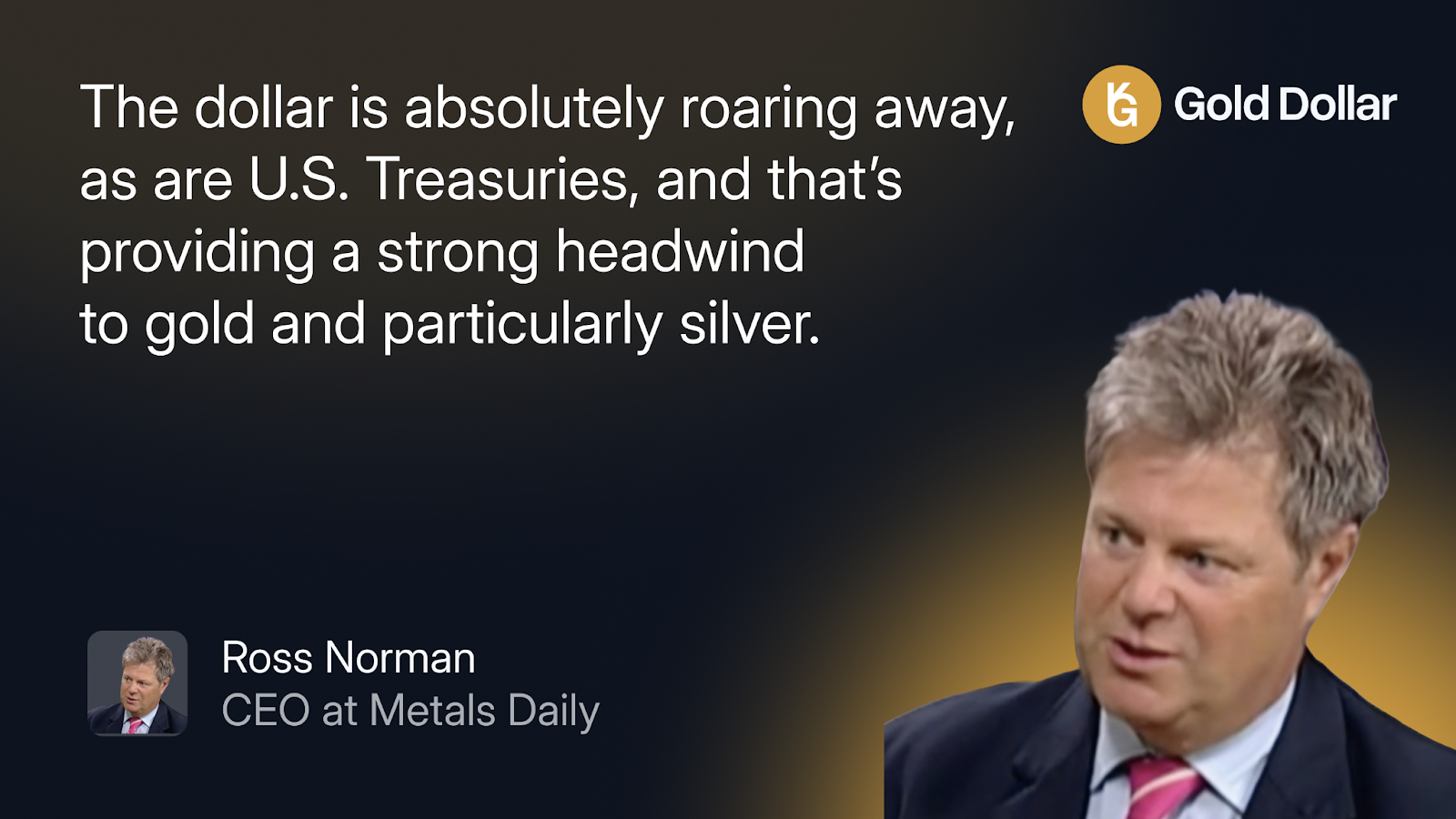
Gold reserve accumulation has accelerated in recent years. Central banks across emerging and developed markets have increased purchases as part of broader reserve diversification strategies.
Countries such as China, India, Turkey, and Kazakhstan have expanded national bullion reserves while maintaining currency and sovereign debt holdings within their portfolios. These acquisitions reflect a structural shift in reserve management. Monetary authorities are strengthening resilience by holding assets that are globally liquid and independent of any single currency system.
Data from the World Gold Council shows that central bank purchases have exceeded one thousand tonnes annually in recent years, one of the strongest demand cycles in decades. Institutional demand from sovereign funds and large asset managers has reinforced this trend.
Rising Gold Prices Reflect Structural Demand
Strong institutional demand has supported a sustained rally in gold prices. The metal has attracted capital from central banks, institutional investors, and macro funds seeking portfolio diversification and inflation resilience.
Gold has historically functioned as a reserve asset during periods of monetary transition and global economic uncertainty. Its price responds to a combination of real interest rates, currency movements, and global demand cycles. As the financial system evolves toward more digitized infrastructure, gold continues to play a stabilizing role within reserve portfolios.
Institutional investors increasingly view gold not only as a defensive asset but also as a strategic component of diversified financial systems.
The Emergence of Tokenized Gold Markets
At the same time, gold is becoming integrated into digital asset markets through tokenization.
Gold-backed tokens allow investors and institutions to hold fractional ownership of vaulted gold while benefiting from blockchain-based settlement. Transactions can occur globally and ownership records are verified on public ledgers.
The largest tokens in this category include PAX Gold and Tether Gold. Each token typically represents ownership of physical gold stored in professional vault facilities.
The tokenized gold sector has expanded rapidly. Market capitalization surpassed six billion dollars in early 2026, with PAXG and XAUT representing the majority of the market.
Growth in this segment reflects demand for assets that combine the reliability of physical commodities with the efficiency of blockchain-based settlement systems.
Digital Infrastructure Is Expanding Gold’s Role
Tokenization introduces a new operational layer for gold within financial markets.
Blockchain infrastructure enables programmable settlement, transparent ownership verification, and continuous global trading. These characteristics allow gold-backed digital assets to function within decentralized finance platforms, exchanges, and cross-border financial networks.
Institutions evaluating digital assets increasingly focus on reserve transparency, audit procedures, custody standards, and liquidity access. These factors determine whether tokenized commodities can integrate into institutional finance.
As real-world asset tokenization expands, gold-backed tokens represent one of the most mature categories in the sector.
Where USDKG Fits in This Landscape
Within the broader tokenized gold ecosystem, different design models exist.
Some tokens represent direct ownership of a fixed quantity of gold, typically measured in ounces or grams. Others introduce hybrid structures that maintain a dollar-denominated settlement unit while using gold as the underlying collateral.
USDKG follows the second model. The token is designed as a U.S. dollar-denominated stablecoin backed by physical gold reserves and issued within a defined regulatory framework.
This structure combines the operational familiarity of dollar-denominated settlement with collateral anchored to a tangible reserve asset. Independent audits and documented issuance procedures support transparency for institutional participants evaluating reserve-backed digital assets.
The model reflects a broader trend in financial markets. Institutions increasingly seek digital settlement instruments that combine predictable denomination, verifiable reserves, and structured governance.
Gold’s Expanding Role in Digital Finance
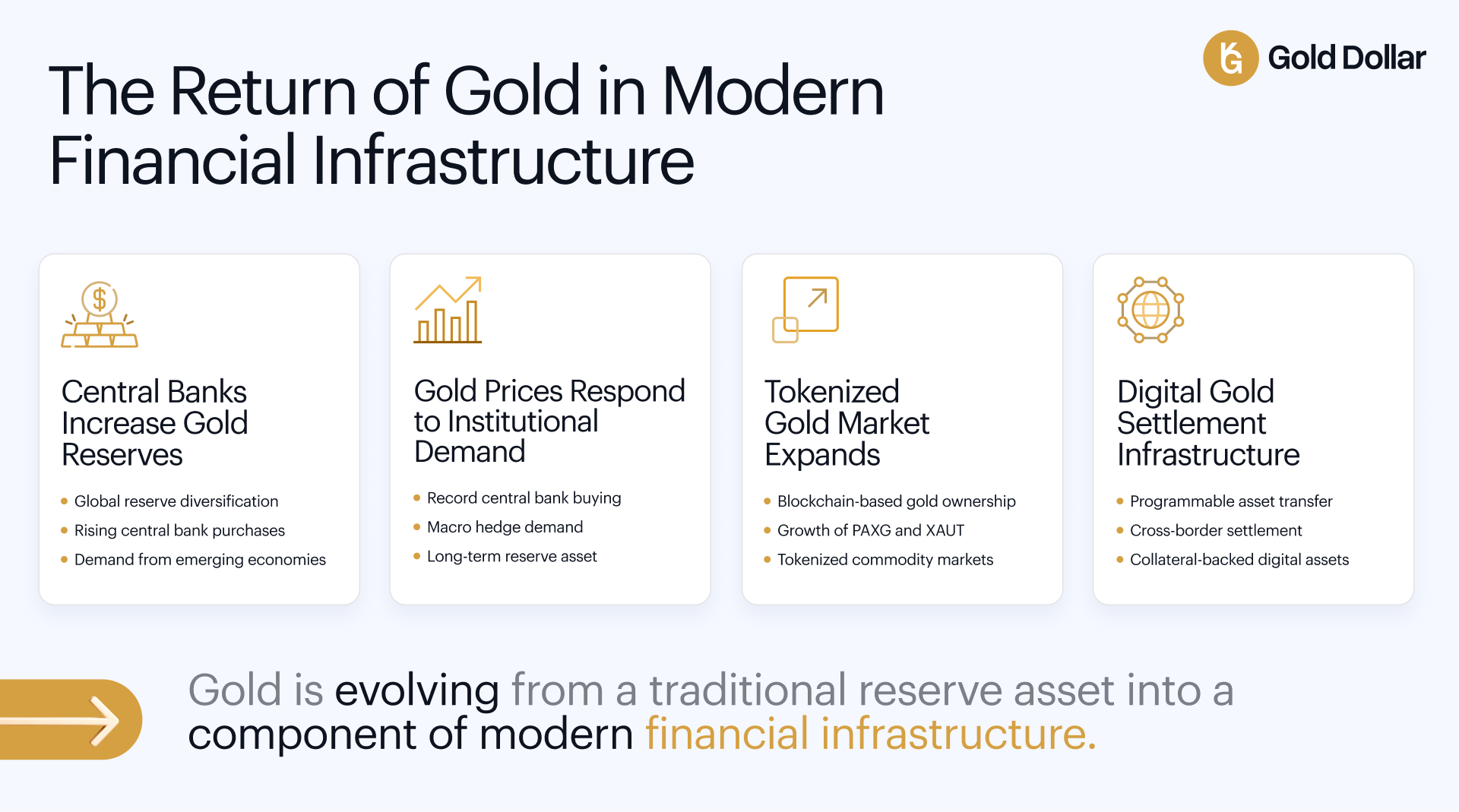
Gold’s renewed prominence reflects several structural developments across global finance.
Central banks are expanding reserves as part of diversification strategies. Institutional investors continue to allocate capital to bullion. At the same time, digital asset markets are developing tokenized instruments that allow gold to circulate within blockchain-based financial systems.
The convergence of these trends highlights an emerging category of financial infrastructure that blends traditional reserve assets with modern settlement technology.
As global financial markets continue to digitize, gold-backed digital instruments are likely to play an increasingly visible role in reserve diversification, cross-border settlement, and institutional asset allocation.
Related Articles

June 30, 2026
Beyond Backing: What Tether’s aUSDT Closure Reveals About Commodity-Backed Digital Assets
The closure of Tether's aUSDT highlights a broader shift within the commodity-backed digital asset market. As adoption matures, utility, transparency, liquidity, and integration into financial infrastructure are becoming just as important as the assets held in reserve.
June 23, 2026
The Rise of Commodity-Backed Digital Assets in Global Finance
Commodity-backed digital assets are bringing tangible value into blockchain-based financial systems. As institutions place greater emphasis on collateral quality, transparency, and reserve integrity, assets such as gold, energy resources, and other commodities are becoming increasingly relevant within digital finance.
June 9, 2026
From Gold Ownership to Gold-Backed Settlement: The Next Evolution of Tokenized Gold
Tokenized gold is entering a new phase where utility becomes just as important as ownership. As blockchain infrastructure matures, gold-backed assets are increasingly being explored for settlement, treasury operations, trade finance, and broader financial infrastructure use cases.