.svg)
How Stablecoins Are Used in Corporate Treasury and Trade Finance
May 18, 2026

The role of stablecoins in global finance is expanding beyond trading and digital asset markets.
As companies operate across multiple jurisdictions and currencies, treasury functions are becoming more complex. Managing liquidity, reducing settlement friction, and maintaining predictable value across borders are increasingly central priorities. In this context, stablecoins are being explored as tools that can support treasury operations and trade finance in more structured and efficient ways.
Their relevance is not defined by novelty, but by their ability to integrate into existing financial workflows while improving how value is stored, transferred, and managed.
The Evolving Role of Corporate Treasury
Corporate treasury functions are responsible for managing liquidity, cash flow, and financial risk across an organization.
For multinational companies, this often involves coordinating funds across different currencies, banking systems, and regulatory environments. Payment delays, settlement windows, and intermediary processes can affect how efficiently capital is deployed.
Stablecoins introduce an alternative settlement layer that operates continuously and can support direct value transfer between counterparties. This has implications for treasury operations, particularly in areas such as liquidity management, working capital efficiency, and cross-border transactions.
Rather than replacing existing systems, stablecoins are increasingly being evaluated as complementary tools that can improve specific parts of treasury workflows.
Stablecoins as Treasury Instruments
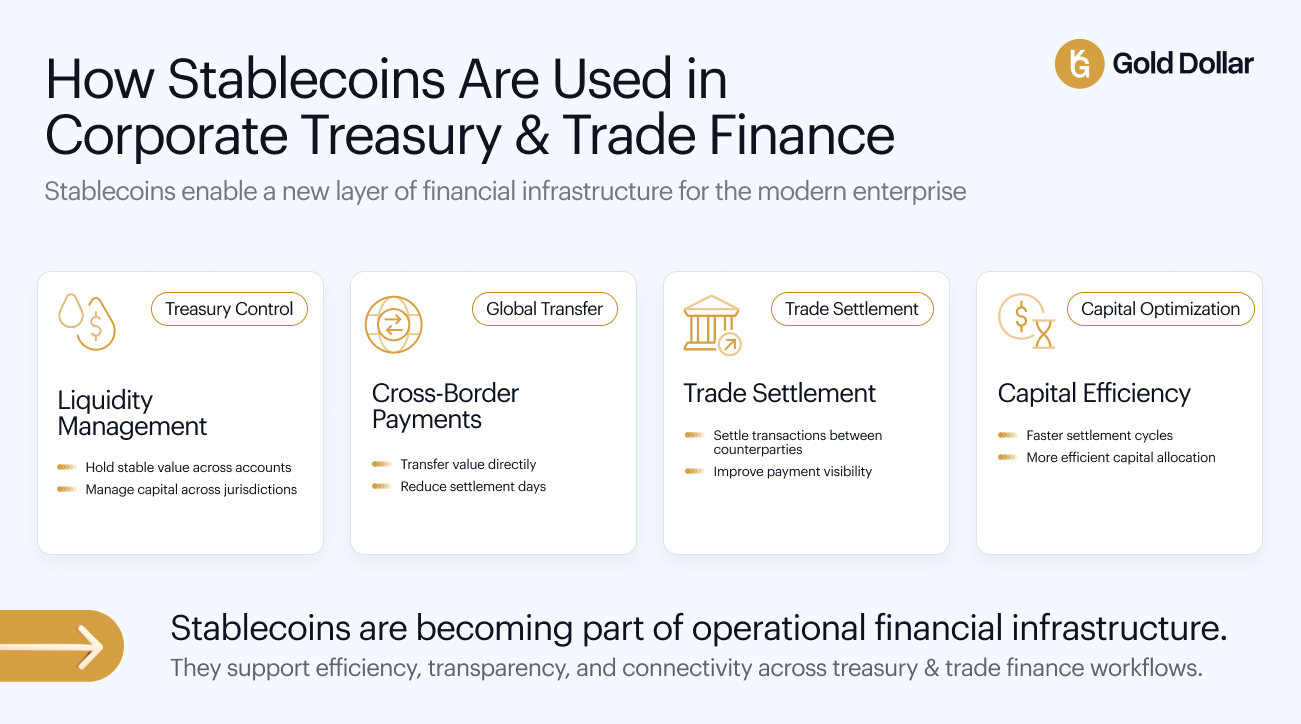
In a treasury context, stablecoins are primarily used as digital representations of value that can be transferred and held with predictable pricing.
Their utility depends on structural factors such as reserve design, liquidity, and accessibility across financial infrastructure. When these conditions are met, stablecoins can support several treasury-related functions.
They can be used to move funds between entities in different jurisdictions, reducing reliance on time-bound settlement processes. They can also serve as temporary stores of value within digital asset ecosystems, allowing treasury teams to manage exposure while maintaining flexibility.
In addition, stablecoins can contribute to liquidity management by enabling faster reallocation of capital between accounts, platforms, or markets.
Applications in Trade Finance
Trade finance involves the movement of goods, capital, and documentation across borders, often requiring coordination between multiple financial institutions and counterparties.
Stablecoins are being explored as part of this process due to their ability to support more direct and transparent settlement mechanisms.
In certain trade flows, stablecoins can facilitate payments between exporters and importers without the need for multiple intermediary steps. This can improve visibility into payment status and reduce delays associated with traditional settlement cycles.
They can also be integrated into digital trade platforms where transactions, documentation, and payments are increasingly managed in a unified environment. In these contexts, stablecoins function as a settlement layer that aligns with the digital nature of the underlying processes.
Liquidity and Capital Efficiency
One of the defining considerations in both treasury and trade finance is how efficiently capital can be used.
Stablecoins can contribute to capital efficiency by reducing the time between transaction initiation and settlement. Faster settlement can improve cash flow visibility and allow funds to be redeployed more quickly.
Liquidity is also an important factor. Stablecoins that are widely supported across exchanges, payment platforms, and financial infrastructure enable smoother transitions between different forms of value. This is particularly relevant for companies operating across regions with varying levels of financial market access.
The combination of liquidity and settlement efficiency influences how practical stablecoins are within real-world financial operations.
Regulatory and Operational Considerations
The use of stablecoins in corporate environments is closely tied to regulatory and operational frameworks.
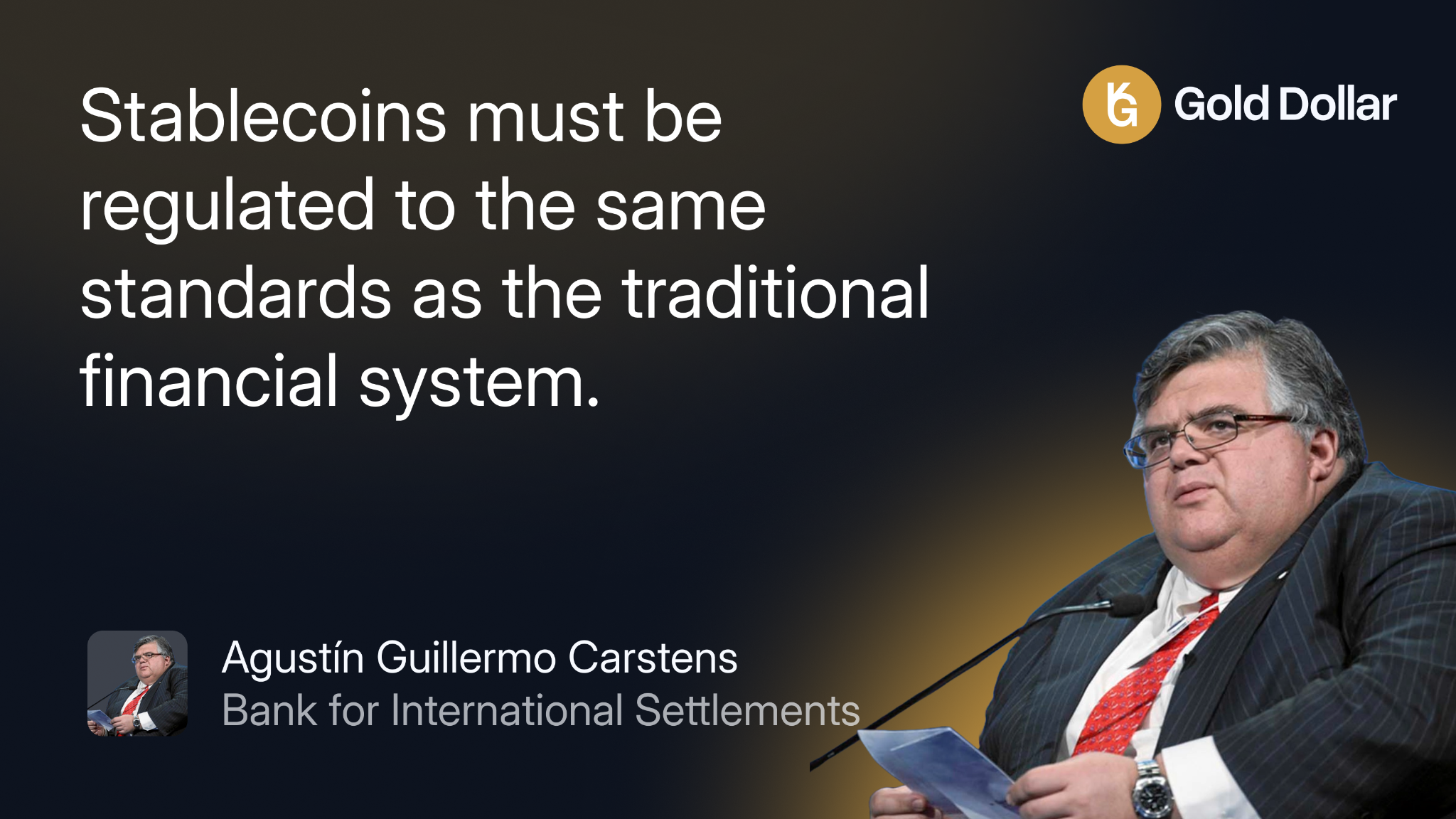
Treasury teams and financial institutions require assets that can be integrated into compliant processes. This includes considerations related to custody, reporting, transaction monitoring, and jurisdictional requirements.
Access through regulated platforms and infrastructure plays an important role in enabling this integration. It provides a framework within which stablecoins can be used in a manner consistent with institutional standards.
Operational factors such as custody solutions, internal controls, and system integration also influence how stablecoins are adopted within treasury and trade finance functions.
The Role of Asset-Backed Stablecoins
Within this landscape, the structure of the underlying reserves becomes increasingly relevant.
Asset-backed stablecoins introduce a model where digital value is linked to tangible reserves. This can provide an additional layer of clarity for participants evaluating how a stablecoin behaves over time.
In treasury and trade finance contexts, predictability and transparency are central considerations. Stablecoins that are supported by verifiable reserves and structured within a clear issuance framework align with these requirements.
USDKG reflects this approach as a USD-denominated stablecoin backed by physical gold reserves audited by Kreston Global, with smart contract infrastructure audited by ConsenSys Diligence. Its deployment across Ethereum and TRON supports integration into both centralized and decentralized financial environments.
From a structural perspective, this design aligns with the requirements of treasury and trade-related use cases, where stability, auditability, and accessibility are key.
Integration into Financial Infrastructure
The broader relevance of stablecoins in corporate finance depends on how they integrate into existing systems.
This includes connections to payment platforms, digital asset exchanges, custody providers, and enterprise financial tools. As infrastructure continues to develop, stablecoins are increasingly positioned within a hybrid environment that combines traditional finance and blockchain-based systems.
In this setting, their role is defined less by standalone functionality and more by how effectively they connect different parts of the financial ecosystem.
What This Means Going Forward
The use of stablecoins in corporate treasury and trade finance is evolving alongside broader changes in financial infrastructure.
As companies seek more efficient ways to manage capital across borders, tools that provide predictable value and flexible settlement are gaining relevance. At the same time, regulatory frameworks and institutional standards are shaping how these tools can be implemented at scale.
Stablecoins that align with these requirements are likely to play a growing role in how global financial operations are structured.
Conclusion
Stablecoins are becoming part of the operational toolkit for corporate treasury and trade finance.
Their ability to support efficient settlement, improve liquidity management, and integrate into digital financial systems makes them relevant for organizations operating across multiple markets.
As infrastructure, regulation, and adoption continue to develop, stablecoins are increasingly positioned as instruments that can support more connected and efficient global financial processes.
Related Articles

August 11, 2026
Stablecoins Are Reshaping Financial Infrastructure
Financial infrastructure rarely changes through a single technological breakthrough. It evolves through the gradual adoption of systems that improve the movement, settlement, and management of capital while integrating into existing financial processes.

July 14, 2026
The Stablecoin Market Is Entering Its Regulatory Era
Stablecoins are entering a new phase of development where regulatory clarity is becoming as important as liquidity and network effects. Around the world, jurisdictions are reshaping digital finance, making governance, transparency, and legal certainty increasingly central to long-term adoption.

June 30, 2026
Beyond Backing: What Tether’s aUSDT Closure Reveals About Commodity-Backed Digital Assets
The closure of Tether's aUSDT highlights a broader shift within the commodity-backed digital asset market. As adoption matures, utility, transparency, liquidity, and integration into financial infrastructure are becoming just as important as the assets held in reserve.