.svg)
What Are Stablecoins? Definition, Types, and How They Work
April 7, 2026

Stablecoins have become a central component of digital asset markets, serving as a bridge between traditional finance and blockchain-based systems.
As the use of digital assets expands, stablecoins are increasingly used for payments, trading, treasury operations, and cross-border transactions. Their role extends beyond crypto markets, positioning them as a foundational layer of modern financial infrastructure.
Understanding how stablecoins work, how they are structured, and where they are used is essential for evaluating their role in global finance.
What Is a Stablecoin
A stablecoin is a digital asset designed to maintain a stable value relative to a reference asset, most commonly the US dollar.
Unlike cryptocurrencies such as Bitcoin or Ethereum, which can experience significant price volatility, stablecoins aim to provide price stability while retaining the benefits of blockchain technology. These benefits include fast settlement, global accessibility, and transparent transaction records.
Stablecoins are typically issued on blockchain networks such as Ethereum and TRON, where they can be transferred, stored, and integrated into decentralized applications.
Why Stablecoins Matter in Financial Systems
Stablecoins address a fundamental challenge in digital finance: the ability to move value efficiently without exposure to short-term price fluctuations.
In traditional financial systems, transferring value across borders can involve multiple intermediaries, settlement delays, and varying fee structures. Stablecoins introduce an alternative model where value can be transferred directly between participants with predictable pricing and continuous availability.
This has made them widely used in areas such as:
- digital asset trading and liquidity management
- cross-border payments and remittances
- treasury and settlement operations
- decentralized finance applications
As adoption grows, stablecoins are increasingly viewed not only as crypto assets, but as digital settlement instruments.
Types of Stablecoins
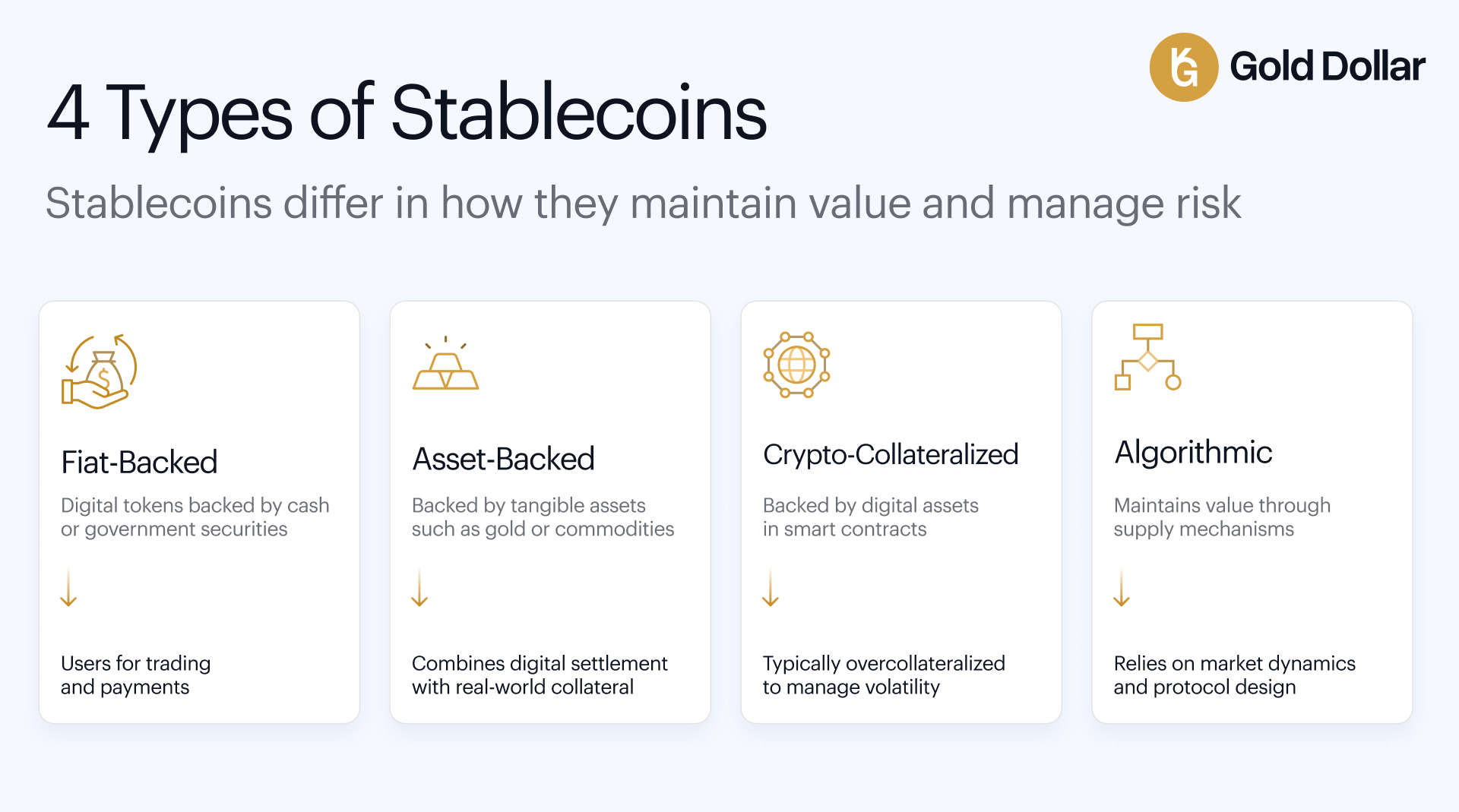
Stablecoins differ primarily in how they maintain their value. The structure of their reserves determines their stability, transparency, and risk profile.
Fiat-Backed Stablecoins
Fiat-backed stablecoins are supported by reserves held in traditional financial instruments such as cash or short-term government securities.
Each token is typically backed by an equivalent amount of fiat currency or liquid assets held in custody. This model is widely used due to its simplicity and direct link to established financial systems.
The reliability of this structure depends on the transparency and quality of reserve management, as well as the regulatory framework under which the issuer operates.
Asset-Backed Stablecoins
Asset-backed stablecoins are collateralized by tangible assets such as commodities or physical reserves.
This model introduces an additional layer of diversification by linking digital value to real-world assets. In some cases, these assets include precious metals such as gold, which have historically been used as reserve instruments.
USDKG is an example of this structure. It is a USD-denominated stablecoin backed by physical gold reserves, with independent audits verifying the existence and valuation of the underlying collateral. This design combines digital settlement capabilities with a reserve model grounded in a globally recognized asset.
Such structures are particularly relevant in environments where stability, transparency, and long-term value preservation are key considerations.
Crypto-Collateralized Stablecoins
Crypto-collateralized stablecoins are backed by other digital assets, typically held in smart contracts.
To maintain stability, these systems are often overcollateralized, meaning the value of the collateral exceeds the value of the issued stablecoins. This helps absorb price fluctuations in the underlying assets.
These models are commonly used in decentralized finance, where transparency and on-chain verification are central to the system’s design.
Algorithmic Stablecoins
Algorithmic stablecoins attempt to maintain their value through supply and demand mechanisms rather than direct collateral backing.
These systems adjust the circulating supply of tokens based on market conditions, often using automated protocols. While this approach introduces flexibility, it also depends heavily on market confidence and system design.
As a result, algorithmic models are typically considered more experimental and require careful evaluation.
How Stablecoins Maintain Their Value
The stability of a stablecoin depends on the mechanism used to maintain its peg to a reference asset.
In fiat-backed and asset-backed models, stability is achieved through reserves that support the value of the issued tokens. These reserves are often held in custody and verified through audits or reporting frameworks.
In crypto-collateralized systems, stability is maintained through overcollateralization and automated liquidation mechanisms.
In algorithmic systems, stability relies on supply adjustments and market incentives.
Across all models, transparency, governance, and reserve verification play a critical role in maintaining confidence.
How Stablecoins Are Used
Stablecoins are widely used across both traditional and digital financial environments.
In trading, they serve as a base currency for liquidity and settlement. In payments, they enable faster and more predictable transfers across borders. In treasury operations, they provide a tool for managing digital asset exposure while maintaining a stable unit of account.
In decentralized finance, stablecoins are used as collateral, liquidity assets, and settlement layers for various protocols.
As these use cases expand, stablecoins are increasingly integrated into broader financial systems, including payment platforms and institutional workflows.
Stablecoins in Cross-Border Payments
One of the most significant use cases for stablecoins is cross-border payments.
By enabling direct transfers on blockchain networks, stablecoins reduce dependency on multi-step settlement processes. Transactions can be executed globally with consistent pricing and without reliance on banking hours.
For businesses operating across regions, this improves cash flow management and reduces friction in international transactions.
This shift is also reflected at the institutional level. As Kristalina Georgieva has emphasized:
“We need to make cross-border payments faster, cheaper, more transparent and more inclusive.”
Stablecoins are increasingly contributing to this direction by enabling more efficient settlement and broader access to global financial infrastructure.
Stablecoins backed by real-world assets introduce an additional dimension by combining efficient settlement with value stability, particularly in regions where currency volatility can impact trade.

The Role of Stablecoins in Modern Finance
Stablecoins are evolving from niche instruments into core components of financial infrastructure.
Their ability to combine digital transfer efficiency with stable value makes them relevant across multiple layers of the financial system. This includes trading, payments, treasury management, and emerging digital finance applications.
As regulatory frameworks develop and adoption increases, stablecoins are likely to play a growing role in how value is stored, transferred, and managed globally.
Conclusion
Stablecoins represent a convergence between traditional financial concepts and digital asset infrastructure.
They provide a stable unit of value within blockchain-based systems while enabling faster, more transparent, and more flexible transactions. Their design varies across different models, each with its own approach to maintaining stability and managing risk.
As global financial systems continue to evolve, stablecoins are becoming an essential tool for bridging traditional finance and digital markets.
In this context, the structure of the underlying reserves, the level of transparency, and the intended use case will define how stablecoins are integrated into the next generation of financial infrastructure.
Related Articles

August 11, 2026
Stablecoins Are Reshaping Financial Infrastructure
Financial infrastructure rarely changes through a single technological breakthrough. It evolves through the gradual adoption of systems that improve the movement, settlement, and management of capital while integrating into existing financial processes.

July 14, 2026
The Stablecoin Market Is Entering Its Regulatory Era
Stablecoins are entering a new phase of development where regulatory clarity is becoming as important as liquidity and network effects. Around the world, jurisdictions are reshaping digital finance, making governance, transparency, and legal certainty increasingly central to long-term adoption.

June 30, 2026
Beyond Backing: What Tether’s aUSDT Closure Reveals About Commodity-Backed Digital Assets
The closure of Tether's aUSDT highlights a broader shift within the commodity-backed digital asset market. As adoption matures, utility, transparency, liquidity, and integration into financial infrastructure are becoming just as important as the assets held in reserve.