.svg)
What Makes a Stablecoin Suitable for Cross-Border Payments?
May 5, 2026
Cross-border payments are undergoing structural change as digital asset infrastructure becomes increasingly integrated into global finance.
For decades, international transactions have relied on multi-layered banking networks, often involving intermediaries, settlement delays, and varying cost structures. As global trade expands and financial systems become more interconnected, the need for efficient, transparent, and reliable payment mechanisms continues to grow.
Stablecoins have emerged as a relevant component within this transition. Their ability to combine price stability with blockchain-based settlement has positioned them as potential instruments for international value transfer. However, not all stablecoins are equally suited for cross-border payments. Their effectiveness depends on a set of structural characteristics that determine how they function within real-world financial environments.
The Role of Stablecoins in Cross-Border Payments
Stablecoins are designed to maintain a stable value relative to a reference asset, most commonly the US dollar. This stability allows them to function as a consistent unit of account while enabling fast and programmable transfers across blockchain networks.
In cross-border contexts, stablecoins introduce a different settlement model. Transactions can be executed directly between participants without relying on traditional banking hours, and settlement can occur continuously rather than in discrete windows.
This has implications for businesses managing international operations. Payment flows can become more predictable, treasury management can be streamlined, and liquidity can move across jurisdictions with greater efficiency.
At the same time, the suitability of a stablecoin for these use cases depends on how it is structured and how it interacts with broader financial infrastructure.
Stability and Reserve Design
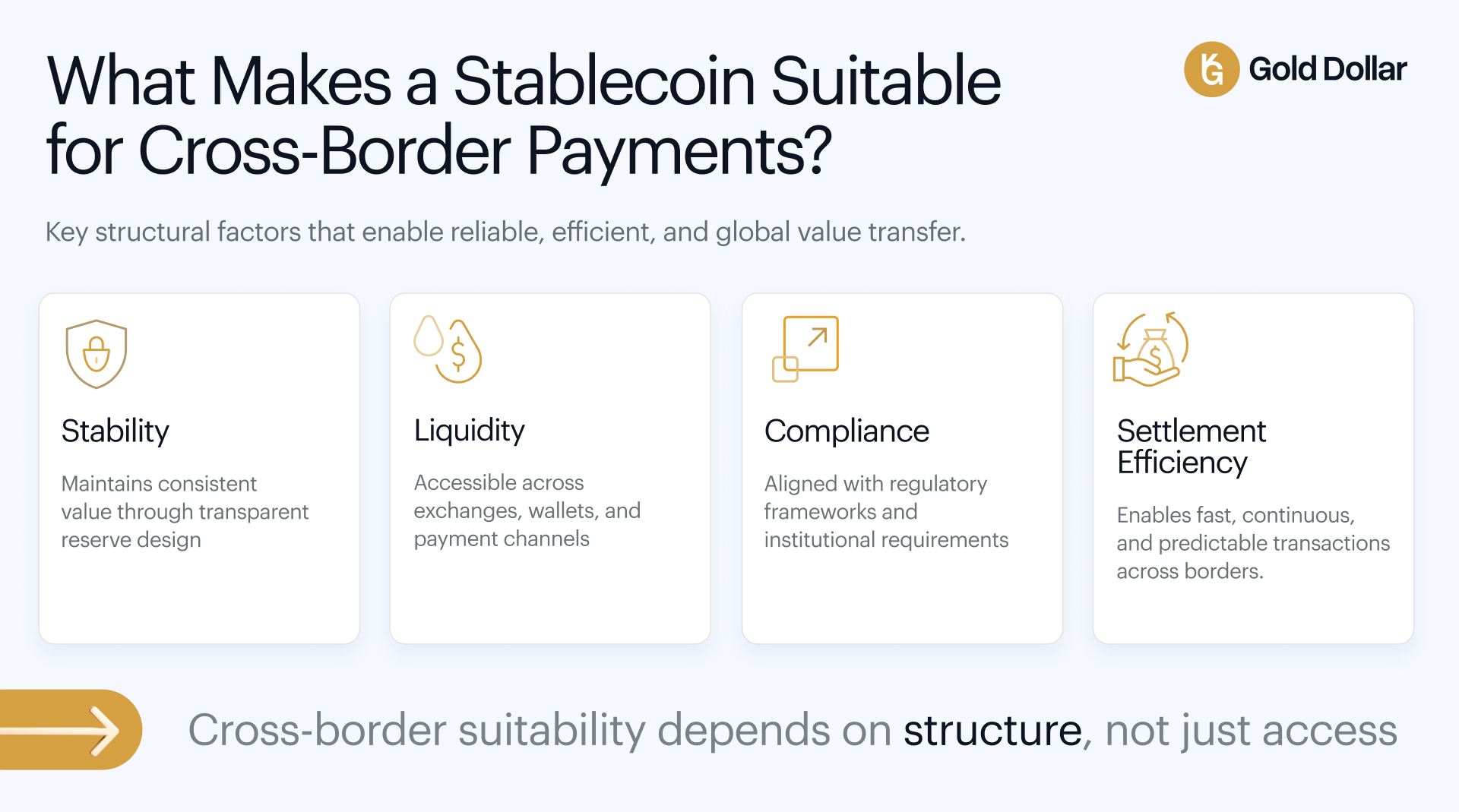
The foundation of any stablecoin used in cross-border payments is its ability to maintain value.
Stability is not only a function of market perception but also of underlying reserve design. Stablecoins backed by clearly defined and verifiable reserves provide a framework for maintaining confidence across different market conditions.
For cross-border transactions, this becomes particularly important. Businesses engaging in international trade require predictability in settlement value. Variability can introduce additional complexity into pricing, accounting, and risk management.
Reserve transparency, auditability, and the nature of the underlying collateral all contribute to how consistently a stablecoin maintains its reference value. These factors influence whether it can be reliably used in payment flows that extend beyond trading environments.
Liquidity and Market Accessibility
Liquidity is a critical factor in determining how effectively a stablecoin can be used across borders.
Deep and accessible liquidity ensures that the asset can be exchanged, transferred, and utilized across different platforms without friction. This includes availability on exchanges, integration into decentralized finance environments, and compatibility with widely used wallets.
For cross-border payments, liquidity also affects conversion efficiency. Businesses often need to move between currencies or digital assets as part of their operations. A stablecoin that is widely supported across trading venues and payment channels can facilitate smoother transitions between different financial systems.
Market accessibility further extends to geographic reach. The ability to operate across multiple regions, particularly in emerging markets, contributes to the practical usability of a stablecoin in global payment networks.
Regulatory Alignment and Compliance
Cross-border payments operate within a complex regulatory landscape.
Stablecoins intended for these use cases must align with applicable legal and compliance frameworks across jurisdictions. This includes considerations related to licensing, custody, reporting, and transaction monitoring.
Regulatory clarity plays an important role in institutional adoption. Financial institutions, payment service providers, and corporate treasury teams require assets that can be integrated into compliant workflows. This extends beyond the design of the stablecoin itself to the environments in which it is accessed and traded.
Platforms that operate within regulated frameworks, as well as stablecoins designed with compliance in mind, contribute to building a more reliable infrastructure for cross-border value transfer.
Settlement Efficiency and Blockchain Infrastructure
The efficiency of cross-border payments is closely tied to the underlying settlement infrastructure.
Stablecoins operate on blockchain networks that enable near real-time transaction processing and continuous availability. This allows value to move across borders without dependency on traditional clearing systems.
Network selection also plays a role. Factors such as transaction speed, cost, scalability, and ecosystem integration influence how effectively a stablecoin can be used in payment flows.
Interoperability between networks further enhances usability. As financial systems become more interconnected, the ability to transfer value across different blockchain environments contributes to a more flexible settlement layer.
Custody and Security Considerations
Secure storage and transfer of digital assets are essential for cross-border payment applications.
Stablecoins used in institutional contexts must be supported by custody solutions that align with established security and governance standards. This includes both self-custodial and institutional custody models, depending on the needs of the user.
Custody infrastructure influences how assets are managed, accessed, and integrated into operational workflows. Features such as asset segregation, access controls, and audit trails contribute to the overall reliability of the system.
In cross-border settings, where transactions often involve multiple parties and jurisdictions, these considerations become even more relevant.
USDKG as a Case Study
USDKG reflects a specific approach to designing a stablecoin for cross-border use.
It is structured as a USD-denominated stablecoin backed by physical gold reserves, with independent audits verifying the underlying collateral. This combines a familiar unit of account with a reserve model anchored in a globally recognized asset.
The token is deployed on both Ethereum and TRON, enabling integration across multiple blockchain ecosystems. It is also supported by a range of wallets and decentralized platforms, contributing to accessibility across different user environments.
From a structural perspective, USDKG aligns with several of the characteristics required for cross-border payments, including reserve transparency, multi-network deployment, and integration into both centralized and decentralized infrastructure.
The Evolution of Cross-Border Payment Infrastructure
The development of stablecoins is part of a broader transformation in how cross-border payments are executed.
Financial systems are gradually incorporating digital settlement layers that complement existing infrastructure. This includes the integration of blockchain-based payment rails, the expansion of regulated digital asset platforms, and the increasing role of tokenized assets in global finance.
Stablecoins sit at the intersection of these trends. Their suitability for cross-border payments will continue to depend on how effectively they integrate with both traditional financial systems and emerging digital ecosystems.
Conclusion
The suitability of a stablecoin for cross-border payments is determined by a combination of structural and operational factors.
Stability, liquidity, regulatory alignment, settlement efficiency, and custody infrastructure all contribute to how the asset functions within international payment flows. These elements shape whether a stablecoin can support real-world use cases beyond trading and speculation.
As global finance evolves, stablecoins that align with these characteristics are likely to play an increasing role in enabling more efficient and reliable cross-border transactions.
Related Articles

August 11, 2026
Stablecoins Are Reshaping Financial Infrastructure
Financial infrastructure rarely changes through a single technological breakthrough. It evolves through the gradual adoption of systems that improve the movement, settlement, and management of capital while integrating into existing financial processes.

July 14, 2026
The Stablecoin Market Is Entering Its Regulatory Era
Stablecoins are entering a new phase of development where regulatory clarity is becoming as important as liquidity and network effects. Around the world, jurisdictions are reshaping digital finance, making governance, transparency, and legal certainty increasingly central to long-term adoption.

June 30, 2026
Beyond Backing: What Tether’s aUSDT Closure Reveals About Commodity-Backed Digital Assets
The closure of Tether's aUSDT highlights a broader shift within the commodity-backed digital asset market. As adoption matures, utility, transparency, liquidity, and integration into financial infrastructure are becoming just as important as the assets held in reserve.