.svg)
Stablecoin vs Bitcoin: Key Differences and Use Cases in 2026
April 15, 2026
Digital assets have evolved into distinct categories, each serving different roles within financial systems. Among the most widely used are stablecoins and Bitcoin, which are often discussed together but designed for fundamentally different purposes.
As adoption increases across trading, payments, and institutional finance, understanding how these assets differ is essential for evaluating their role in modern financial infrastructure.
What Is Bitcoin
Bitcoin is a decentralized digital asset designed as a scarce, censorship-resistant store of value.
It operates on a public blockchain with a fixed supply of 21 million coins, making it one of the first digital assets to introduce verifiable scarcity. Bitcoin is not tied to any underlying asset or currency and its value is determined by market demand.
As a result, Bitcoin is widely used as:
- a long-term store of value
- a hedge against monetary expansion
- a reserve asset within digital portfolios
Its primary function is not transactional stability, but value preservation over time.
What Is a Stablecoin
A stablecoin is a digital asset designed to maintain a stable value relative to a reference asset, most commonly the US dollar.
Stablecoins are typically backed by reserves or collateral mechanisms that support price stability. They operate on blockchain networks such as Ethereum and TRON and enable efficient transfer of value across digital systems.
Stablecoins are widely used for:
- payments and remittances
- trading and liquidity management
- treasury operations
- decentralized finance applications
Their primary function is not scarcity, but stability and usability within financial transactions.
Core Differences Between Stablecoins and Bitcoin
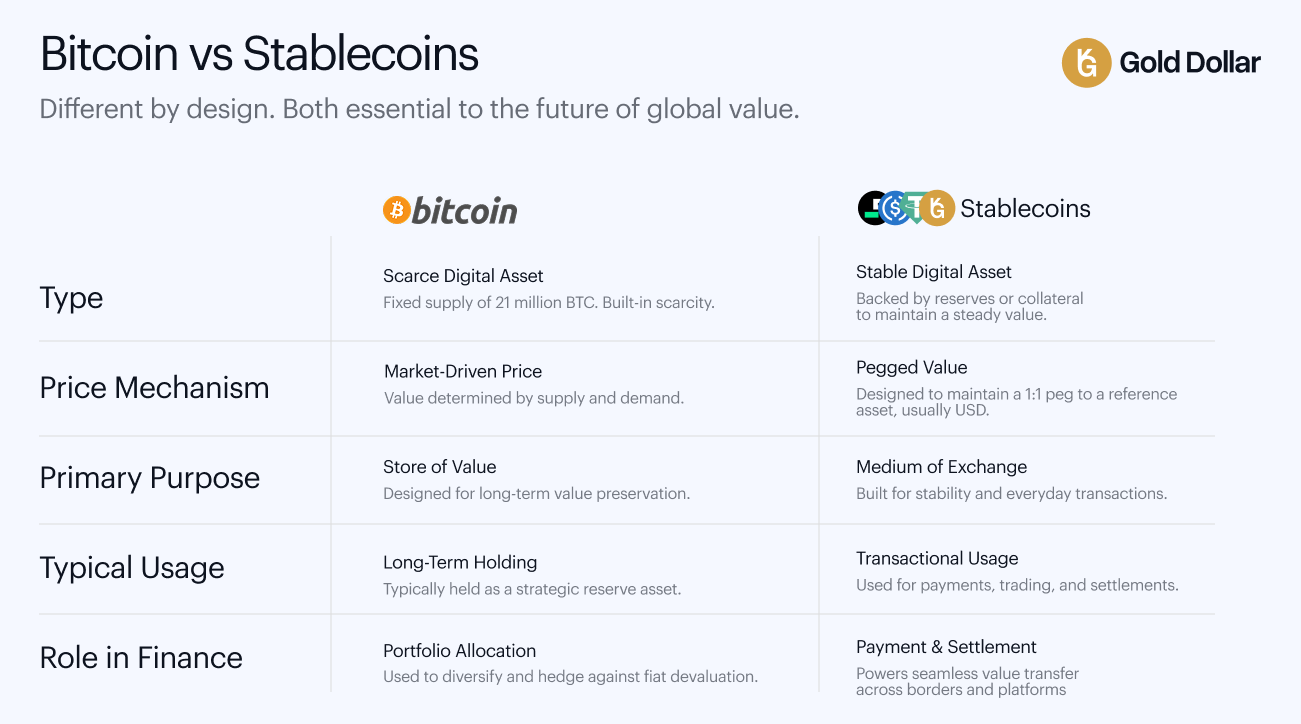
The distinction between stablecoins and Bitcoin can be understood through their design and use within financial systems.
Bitcoin introduces scarcity and operates independently of traditional financial assets. Stablecoins, by contrast, are designed to maintain predictable value and integrate more directly into payment and settlement processes.
Bitcoin’s price is determined by market dynamics, which can result in significant fluctuations. Stablecoins aim to minimize volatility, enabling consistent pricing across transactions.
In practical terms, this means Bitcoin is often held, while stablecoins are frequently used.
Use Cases in Financial Systems
Both Bitcoin and stablecoins play important roles, but in different contexts.
Bitcoin is commonly used as a long-term asset within investment portfolios. It is also used in scenarios where decentralized value storage is required without reliance on financial intermediaries.
Stablecoins are used in operational financial flows. They facilitate payments, enable trading liquidity, and support settlement across borders. Their stability makes them suitable for transactions where price predictability is required.
In cross-border environments, stablecoins allow businesses to move value more efficiently, while Bitcoin remains relevant as a reserve or strategic asset.
Stablecoins in Cross-Border Payments
Stablecoins have become increasingly relevant in cross-border payments due to their ability to enable direct, blockchain-based settlement.
Transactions can be executed globally with consistent pricing and continuous availability. This reduces friction in international transfers and supports more efficient financial operations across regions.
This direction is also reflected at the institutional level. As Lael Brainard, governor of the federal reserve, noted:
“We will likely see far-reaching innovation in payments in the coming years, with a plethora of new and emerging options, including stablecoins.”
This reflects a broader transition already underway, where stablecoins are evolving from niche instruments into part of the global financial infrastructure.
Stablecoins backed by real-world assets introduce an additional dimension by combining efficient settlement with value stability. This is particularly relevant in markets where currency volatility can impact trade and treasury operations.
USDKG reflects this category as a USD-denominated stablecoin backed by physical gold reserves, combining blockchain-based settlement with a reserve model anchored in a globally recognized asset.

Bitcoin and Stablecoins in Institutional Finance
Institutional participation in digital assets has expanded across both categories.
Bitcoin is often considered within long-term allocation strategies and reserve diversification. Its role is associated with scarcity and independence from traditional financial systems.
Stablecoins are increasingly integrated into operational workflows. They are used for settlement, liquidity management, and access to decentralized financial infrastructure.
This distinction highlights how digital assets are not interchangeable, but complementary within broader financial strategies.
The Role of Design in Asset Function
The key difference between Bitcoin and stablecoins lies in their design.
Bitcoin is designed for scarcity and long-term value preservation. Stablecoins are designed for stability and transactional efficiency.
As digital finance evolves, both models contribute to different layers of financial infrastructure. One supports value storage, while the other enables value movement.
Understanding this distinction is essential for navigating digital asset markets in 2026.
Conclusion
Stablecoins and Bitcoin represent two distinct approaches to digital value.
Bitcoin provides a decentralized store of value based on scarcity. Stablecoins provide a stable unit of account that supports payments, trading, and financial operations.
As global financial systems continue to integrate blockchain-based infrastructure, both asset types are expected to remain relevant, serving different but complementary roles.
Related Articles

August 11, 2026
Stablecoins Are Reshaping Financial Infrastructure
Financial infrastructure rarely changes through a single technological breakthrough. It evolves through the gradual adoption of systems that improve the movement, settlement, and management of capital while integrating into existing financial processes.

July 14, 2026
The Stablecoin Market Is Entering Its Regulatory Era
Stablecoins are entering a new phase of development where regulatory clarity is becoming as important as liquidity and network effects. Around the world, jurisdictions are reshaping digital finance, making governance, transparency, and legal certainty increasingly central to long-term adoption.

June 30, 2026
Beyond Backing: What Tether’s aUSDT Closure Reveals About Commodity-Backed Digital Assets
The closure of Tether's aUSDT highlights a broader shift within the commodity-backed digital asset market. As adoption matures, utility, transparency, liquidity, and integration into financial infrastructure are becoming just as important as the assets held in reserve.