.svg)
Impermanent Loss Explained: Understanding DeFi’s Hidden Risk
April 28, 2026

Impermanent loss is a fundamental consideration in decentralized finance.
As liquidity provision becomes an integral part of onchain market structure, understanding how value evolves within automated market makers is essential. Impermanent loss does not arise from operational failure or counterparty exposure. It is a structural outcome of how liquidity pools function and how prices adjust across markets.
For institutional participants, this positions impermanent loss as a measurable component of liquidity provision rather than an external risk factor.
What Is Impermanent Loss
Impermanent loss describes the difference in value between holding assets in a liquidity pool and holding the same assets independently.
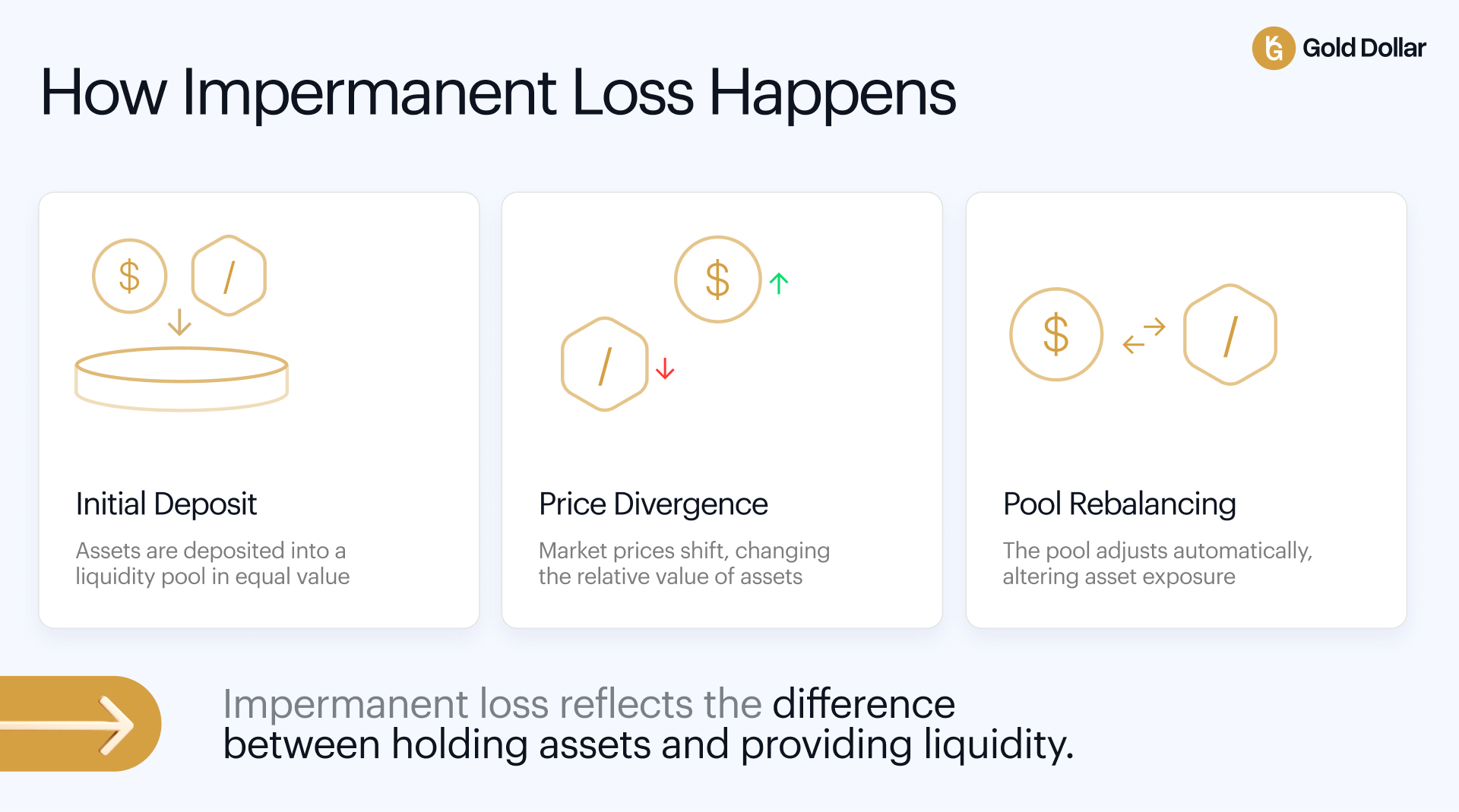
It occurs when the relative price of the deposited assets changes after they are supplied to an automated market maker. Because liquidity pools maintain a constant balance between assets, price movements lead to continuous rebalancing within the pool.
As a result, the composition of assets held by liquidity providers evolves over time. The difference between this rebalanced position and a static holding defines impermanent loss.
The term reflects that this effect is realized upon withdrawal, while its magnitude depends on how asset prices develop over time.
How Impermanent Loss Works
Impermanent loss is directly linked to the mechanics of automated market makers.
Liquidity providers deposit two assets into a pool, typically in equal value terms. The pool maintains a pricing function that adjusts balances in response to external market conditions.
When the price of one asset changes relative to the other, arbitrage activity aligns the pool with broader market prices. This process shifts the internal composition of the pool, gradually reducing exposure to the appreciating asset while increasing exposure to the other.
Liquidity providers continue to earn trading fees during this process. The overall outcome reflects the interaction between fee generation and the extent of price divergence.
Why Impermanent Loss Matters
Impermanent loss represents a form of performance variation linked to market dynamics.
It reflects how liquidity provision differs from holding assets without active participation in market-making mechanisms. The effect becomes more pronounced as relative price movements between assets increase.
From an institutional perspective, liquidity provision can be viewed as a structured exposure that combines fee generation with continuous rebalancing. This introduces a distinct return profile shaped by both market conditions and pool design.
Understanding this interaction is central to evaluating DeFi liquidity strategies within a broader portfolio context.
Key Factors That Influence Impermanent Loss
Several variables shape the magnitude and behavior of impermanent loss.
Price divergence between assets remains the primary driver. Larger relative movements lead to more pronounced rebalancing effects.
Asset characteristics influence how frequently and to what extent divergence occurs. Assets with similar pricing behavior tend to produce more stable outcomes, while broader variation introduces greater rebalancing dynamics.
Fee generation contributes to overall performance. Higher trading activity within a pool can offset structural effects, depending on market conditions.
Time horizon also plays a role. The duration of liquidity provision affects how temporary or sustained price movements influence outcomes.
These factors interact continuously, shaping the performance profile of liquidity positions.
Stablecoins and Impermanent Loss
Stablecoin-based liquidity pools are often associated with more stable pricing dynamics.
When assets are designed to maintain a consistent value, relative price movements tend to be more contained. This can lead to more predictable rebalancing behavior within liquidity pools.
At the same time, stability is linked to the structure and transparency of the underlying assets. Reserve design, liquidity conditions, and market confidence contribute to how consistently a stablecoin maintains its reference value.
USDKG is a USD-denominated stablecoin backed by physical gold reserves, with independent verification of its underlying collateral. Within DeFi environments, such structures contribute to the broader category of assets designed to support more stable liquidity conditions while maintaining transparency in reserve composition.
How Institutions Approach Impermanent Loss
Institutional participation in DeFi liquidity provision is typically evaluated through a structured analytical framework.
Liquidity positions are assessed in terms of asset behavior, correlation, and the relationship between fee generation and price dynamics. Allocation decisions reflect considerations such as volatility exposure, liquidity depth, and the characteristics of the underlying assets.
Portfolio construction may include diversified liquidity strategies across different asset types and market conditions. This approach reflects a broader view of DeFi as part of an evolving financial infrastructure rather than a standalone yield mechanism.
Impermanent loss, within this framework, is treated as an inherent component of liquidity provision that can be modeled, monitored, and incorporated into risk management processes.
Impermanent Loss in the Context of DeFi Infrastructure
As decentralized finance continues to mature, impermanent loss is increasingly understood as part of the operational design of automated liquidity systems.
This reflects a broader shift in how DeFi markets are analyzed. Liquidity provision is interpreted as a form of automated market-making, where returns are generated through transaction activity while asset composition adjusts dynamically.
Such mechanisms align with established financial concepts, where market participants balance income generation with exposure to underlying price movements.

Conclusion
Impermanent loss is a structural feature of liquidity provision in decentralized finance.
It arises from the interaction between automated market-making mechanisms and changing asset prices. Its magnitude is shaped by factors including price dynamics, asset characteristics, and trading activity within liquidity pools.
As DeFi markets evolve toward greater institutional participation, understanding impermanent loss becomes central to evaluating liquidity strategies and performance outcomes.
In this context, asset design, transparency, and stability play an increasingly relevant role in shaping how liquidity markets develop within a more structured financial environment.
Related Articles

August 11, 2026
Stablecoins Are Reshaping Financial Infrastructure
Financial infrastructure rarely changes through a single technological breakthrough. It evolves through the gradual adoption of systems that improve the movement, settlement, and management of capital while integrating into existing financial processes.

July 14, 2026
The Stablecoin Market Is Entering Its Regulatory Era
Stablecoins are entering a new phase of development where regulatory clarity is becoming as important as liquidity and network effects. Around the world, jurisdictions are reshaping digital finance, making governance, transparency, and legal certainty increasingly central to long-term adoption.

June 30, 2026
Beyond Backing: What Tether’s aUSDT Closure Reveals About Commodity-Backed Digital Assets
The closure of Tether's aUSDT highlights a broader shift within the commodity-backed digital asset market. As adoption matures, utility, transparency, liquidity, and integration into financial infrastructure are becoming just as important as the assets held in reserve.